
AppLovin Plummets 6.3% as Three-Day Slide Hits 14.9% Amid Bearish Technical Signals
Generated by AI AgentAinvest Technical RadarReviewed byAInvest News Editorial Team
Friday, Jan 16, 2026 8:47 pm ET2min read
APP-- Aime Summary
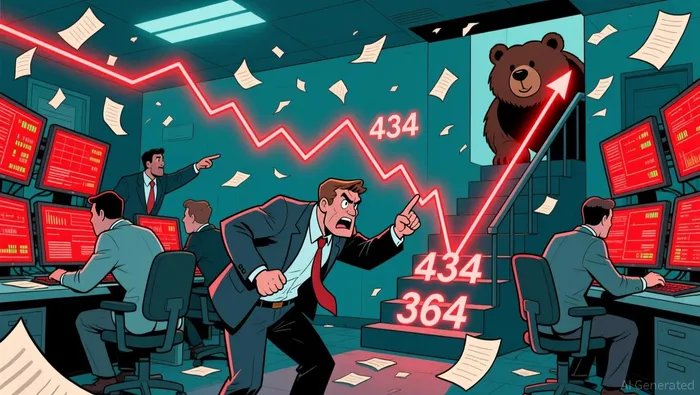 Key support levels emerge at the 52-week low of $244 (December 2025) and the 61.8% Fibonacci retracement level at $434, derived from the January 2026 peak of $698.82 to the February 2026 trough of $244. Resistance is clustered near the 38.2% retracement level at $530 and the 200-day moving average (around $500). A break below $434 could target the next Fibonacci level at $364, while a rebound above $530 may signal a short-term oversold bounce.
The MACD line (-$15) has crossed below the signal line (-$10), confirming bearish momentum, while the histogram shows expanding negative divergence. The KDJ stochastic oscillator is in oversold territory (K=20, D=25), suggesting a potential short-term bounce. However, the lack of bullish divergence (price lows vs. oscillator lows) weakens the case for a reversal. A sustained close above $500 could trigger a KDJ overbought condition, but this remains contingent on volume confirmation.
The confluence of bearish candlestick patterns, descending moving averages, and oversold RSI suggests a continuation of the downtrend, with $434 as the immediate support. However, the oversold KDJ and RSI hint at potential short-term buying interest. Divergences between price and momentum indicators remain limited, reducing the likelihood of an immediate reversal. Traders should prioritize risk management, with stops below $434 for short positions and cautious long entries above $530, pending confirmation from volume and MACD.
Aime SummaryApplovin (APP) fell 6.30% in the most recent session, marking a three-day decline of 14.94%. The stock’s price action and technical indicators suggest a bearish near-term bias, with potential for further downward momentum. Below is a structured analysis of key technical aspects.
Candlestick Theory
The three-day sell-off has formed a bearish engulfing pattern, with the most recent candle closing near its low, indicating strong distribution pressure. Key support levels emerge at the 52-week low of $244 (December 2025) and the 61.8% Fibonacci retracement level at $434, derived from the January 2026 peak of $698.82 to the February 2026 trough of $244. Resistance is clustered near the 38.2% retracement level at $530 and the 200-day moving average (around $500). A break below $434 could target the next Fibonacci level at $364, while a rebound above $530 may signal a short-term oversold bounce. Moving Average Theory
The 50-day ($484), 100-day ($467), and 200-day ($452) moving averages are in a descending order, confirming a bearish trend. The price remains below all three, with the 200-day MA acting as a critical psychological floor. A crossover of the 50-day MA above the 200-day MA (death cross) in early March 2025 has reinforced the downtrend. Short-term traders may watch for a potential 50-day MA retest of the 200-day MA as a possible reversal signal, though the broader trend remains bearish.MACD & KDJ Indicators
The MACD line (-$15) has crossed below the signal line (-$10), confirming bearish momentum, while the histogram shows expanding negative divergence. The KDJ stochastic oscillator is in oversold territory (K=20, D=25), suggesting a potential short-term bounce. However, the lack of bullish divergence (price lows vs. oscillator lows) weakens the case for a reversal. A sustained close above $500 could trigger a KDJ overbought condition, but this remains contingent on volume confirmation.
Bollinger Bands
Volatility has expanded, with the price trading near the lower Bollinger Band ($440–$590 range). This contraction-expansion pattern historically precedes breakouts or breakdowns. The current position near the lower band, combined with declining volume, suggests the downtrend may persist until the bands contract again. A break below the lower band could trigger a volatility spike, extending the decline toward $364.Volume-Price Relationship
Trading volume has surged during the recent sell-off, with the three-day average volume at $2.5 billion, up from a 90-day average of $1.8 billion. This validates the bearish move, as increased volume typically confirms distribution. However, a divergence in volume (declining volume during further declines) could signal exhausted selling pressure. Traders should monitor volume spikes above $3 billion as a warning of potential short-covering or a reversal.Relative Strength Index (RSI)
The 14-day RSI is at 28, entering oversold territory. While this may suggest a short-term rebound, RSI divergence (lower lows in price vs. higher lows in RSI) is absent, reducing the probability of a reversal. A bounce above $490 could push RSI into neutral territory (30–70), but a sustained close above $530 would be needed to confirm a trend reversal.Fibonacci Retracement
Key retracement levels from the January 2026 high ($698.82) to the February 2026 low ($244) are critical. The 61.8% level at $434 and 78.6% at $364 align with prior support zones. A break below $364 could target the 88.6% level at $280, though this remains speculative without additional confirmation. Conversely, a rebound above $530 (38.2%) may attract buyers, particularly if accompanied by a MACD crossover.Conclusion
The confluence of bearish candlestick patterns, descending moving averages, and oversold RSI suggests a continuation of the downtrend, with $434 as the immediate support. However, the oversold KDJ and RSI hint at potential short-term buying interest. Divergences between price and momentum indicators remain limited, reducing the likelihood of an immediate reversal. Traders should prioritize risk management, with stops below $434 for short positions and cautious long entries above $530, pending confirmation from volume and MACD.

If I have seen further, it is by standing on the shoulders of giants.
Latest Articles
Stay ahead of the market.
Get curated U.S. market news, insights and key dates delivered to your inbox.
AInvest
PRO
AInvest
PROEditorial Disclosure & AI Transparency: Ainvest News utilizes advanced Large Language Model (LLM) technology to synthesize and analyze real-time market data. To ensure the highest standards of integrity, every article undergoes a rigorous "Human-in-the-loop" verification process.
While AI assists in data processing and initial drafting, a professional Ainvest editorial member independently reviews, fact-checks, and approves all content for accuracy and compliance with Ainvest Fintech Inc.’s editorial standards. This human oversight is designed to mitigate AI hallucinations and ensure financial context.
Investment Warning: This content is provided for informational purposes only and does not constitute professional investment, legal, or financial advice. Markets involve inherent risks. Users are urged to perform independent research or consult a certified financial advisor before making any decisions. Ainvest Fintech Inc. disclaims all liability for actions taken based on this information. Found an error?Report an Issue


ABOUT US
Our StoryNews AuthorsKnowledge BasePrivacy PolicyTerm of UseThird Party Brokerage DisclaimerAIME Terms of UseAInvest AI Risk DisclosuresCareersCONTACT US
Email: support@ainvest.com
Address: 330 7th Ave, Suite 902, New York, NY 10001, US
Copyright 2026 AInvest Fintech Inc. All rights reserved.


Comments
No comments yet