
Applied Digital Stock Plunges 7.56% on Top 150 Trading Volume Amid $2.35B Debt-Laden AI/HPC Pivot
 Aime Summary
Market Snapshot
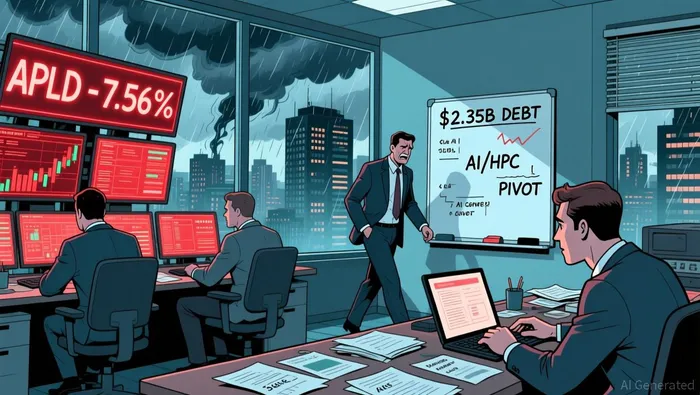
On November 12, 2025, Applied DigitalAPLD-- (APLD) experienced a significant drop in its stock price, falling 7.56% to close the day. Despite the sharp decline, the company’s shares remained among the most actively traded, with a trading volume of $0.72 billion, ranking 143rd in the U.S. market. The high volume suggests substantial investor activity, though the downward price movement indicates divergent market sentiment. The decline occurred amid a broader context of capital-raising efforts by APLDAPLD--, which announced a $2.35 billion senior secured notes offering to fund data center expansion in North Dakota.
Key Drivers
Applied Digital’s recent stock performance reflects a mix of optimism and caution tied to its aggressive capital-raising strategy and broader industry dynamics. The company’s announcement of a $2.35 billion offering of senior secured notes due 2030—backed by its subsidiary, APLD ComputeCo LLC—highlights its commitment to expanding high-performance computing (HPC) and AI infrastructure. Proceeds will fund the construction of two data centers (ELN-02 and ELN-03) at its North Dakota campus, repay existing debt, and establish a debt service reserve. While the move underscores APLD’s strategic pivot from BitcoinBTC-- mining to AI and HPC, the sheer scale of the offering has raised questions about its reliance on debt financing.
The offering aligns with a sector-wide trend as peers like Cipher Mining ($1.4 billion) and CleanSpark ($1.15 billion) also raise capital for similar HPC projects. This competitive landscape suggests a high-stakes race to secure market share in the AI infrastructure boom, driven by surging demand for data-center capacity. However, APLD’s debt-heavy approach, including notes issued at around 7% interest, introduces financial risks, particularly if construction delays or operational challenges arise. The notes are secured by first-priority liens on APLD’s assets, but the company’s obligation to fund completion guarantees adds another layer of financial exposure.
Investor skepticism is further amplified by recent insider trading activity. Over the past six months, executives including CEO Wes Cummins and CFO Mohammad Saidu Lavany have sold millions of shares, with Cummins alone offloading $6.1 million worth of stock. Such activity may signal concerns about short-term valuation or execution risks. Additionally, institutional investors have reduced their stakes, with 135 funds cutting positions in Q2 2025, including BNP Paribas Financial Markets and D. E. Shaw, which sold over $34 million in shares. While 9 Wall Street firms have issued “Buy” ratings, the stock’s 7.56% drop suggests market participants are weighing these risks against the company’s growth ambitions.
The debt offering also raises questions about APLD’s ability to maintain margins in a capital-intensive sector. The company’s pivot to AI and HPC requires not only upfront investment but also ongoing operational efficiency. The North Dakota campus, part of its Polaris Forge 1 initiative, is among the largest data-center developments in the U.S. Midwest, but scaling such projects involves logistical and regulatory hurdles. Moreover, the notes’ private placement under Rule 144A limits liquidity, potentially deterring broader investor participation. Analysts note that while APLD’s project guarantees and asset-backed structure provide some reassurance, the offering’s success hinges on favorable market conditions and regulatory approval.
In summary, APLD’s stock decline reflects a complex interplay of strategic bets on AI infrastructure, sector competition, and financial prudence concerns. While the company’s expansion into HPC aligns with long-term industry trends, the magnitude of its debt financing and insider sales have introduced volatility. Investors will likely monitor construction progress, debt servicing costs, and competitive developments to assess whether the stock can rebound from its recent losses.

Stay ahead of the market.
Get curated U.S. market news, insights and key dates delivered to your inbox.
AInvest
PRO
AInvest
PRO



Comments
No comments yet