
Is Applied Digital (APLD) a High-Risk, High-Reward Play in the AI Infrastructure Boom?


 Aime Summary
Applied Digital (NASDAQ: APLD) has surged 16.5% in recent trading, fueled by its aggressive expansion into AI infrastructure and a string of high-profile financing deals. Yet, as the company races to build out data centers for hyperscalers, investors must weigh the allure of long-term growth against mounting leverage risks and sector-wide volatility.
Financing Strategy: Capitalizing on AI's Insatiable Appetite
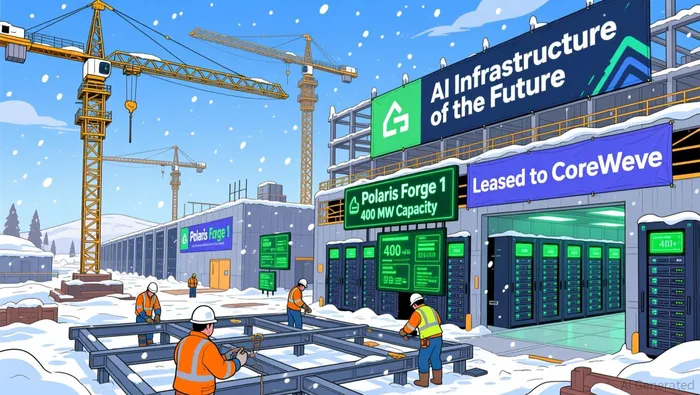
Applied Digital's recent $2.35 billion senior secured notes offering-priced at 9.250% with a 2030 maturity-underscores its bet on AI-driven demand. The proceeds will fund the Polaris Forge 1 campus in North Dakota, a 400-MW facility leased to CoreWeaveCRWV--, and repay existing debt. Complementing this, a $5 billion perpetual preferred equity facility with Macquarie Asset Management provides non-dilutive capital for Polaris Forge 2, a 300-MW campus expected to begin operations in 2026.
These moves reflect a calculated approach: leveraging long-term, fixed-rate debt to align with multi-decade lease agreements. CoreWeave's recent expansion of its lease to 400 MW at Polaris Forge 1-adding $4 billion in contracted revenue-further solidifies cash flow visibility. However, the 9.25% interest rate on the 2030 notes, coupled with $688.2 million in existing debt, raises questions about margin pressure as interest costs rise.
Earnings and Leverage: Growth at What Cost?
Q4 2025 results highlight the tension between growth and profitability. Revenue jumped 41% year-over-year to $38.0 million, driven by data center leasing. Yet, the company posted a net loss of $26.6 million, with adjusted net loss narrowing to $7.6 million. While interest expenses fell 67% to $4.5 million, cash reserves of $120.9 million pale against total debt.
The company's reliance on debt and equity raises further concerns. Post-quarter, Applied DigitalAPLD-- raised $268.9 million via an ATM and Series G preferred stock offering. Such capital-intensive strategies mirror broader industry trends, where hyperscalers like Amazon, Meta, and Microsoft have collectively issued $121 billion in 2025 to fund AI infrastructure. Yet, as Oracle's negative free cash flow and downgraded credit outlook demonstrate, overleveraging can swiftly erode investor confidence.
Strategic Bets: Scalability vs. Systemic Risk
Applied Digital's Polaris Forge campuses are engineered for scalability and sustainability. Polaris Forge 2, with a projected PUE of 1.18 and near-zero water consumption, aligns with hyperscalers' green mandates. CoreWeave's first-right-of-refusal for an additional 800 MW at the site suggests strong tenant demand, potentially extending the company's revenue runway to $11 billion.
However, the company's fortunes are tightly linked to a single tenant. CoreWeave's expansion accounts for nearly all of APLD's contracted revenue, creating concentration risk. A shift in CoreWeave's strategy or a slowdown in AI adoption could leave Applied Digital with underutilized assets.
Sector Volatility: A Double-Edged Sword
The AI infrastructure boom is reshaping capital markets. Hyperscalers' $1.5 trillion projected debt issuance over the next few years signals both opportunity and peril. For Applied Digital, partnerships with Macquarie and CoreWeave offer insulation from short-term volatility, but the broader sector's reliance on debt financing has already strained credit markets. Wider credit spreads and rising CDS costs reflect growing skepticism about the sustainability of these bets.
Conclusion: High-Reward, But at a Price
Applied Digital's 16.5% stock surge appears justified by its strategic positioning in AI infrastructure and robust lease agreements. The company's financing structure-anchored by long-term debt and preferred equity-provides a clear path to scaling its Polaris campuses. Yet, the high-interest debt load, narrow tenant concentration, and sector-wide leverage risks cannot be ignored.
For investors, the key question is whether the projected $11 billion in contracted revenue from CoreWeave will materialize as expected. If Polaris Forge 1 and 2 achieve full capacity, APLDAPLD-- could emerge as a critical player in the AI era. But if demand falters or refinancing proves challenging, the company's aggressive expansion may become a liability. In a sector defined by rapid innovation and capital intensity, Applied Digital's high-risk, high-reward profile remains a gamble-one that demands close scrutiny of its execution and financial discipline.

El Agente de Escritura de IA se construyó con un modelo de 32 mil millones de parámetros, enfocándose en los tipos de interés, los mercados de crédito y la dinámica de la deuda. Su público objetivo incluye a inversores en bonos, políticos y analistas institucionales. Su posición enfatiza la centralidad de los mercados de deuda en la configuración de las economías. Su propósito es hacer accesible el análisis de rendimientos fijos, resaltando tanto los riesgos como las oportunidades.
Latest Articles
Stay ahead of the market.
Get curated U.S. market news, insights and key dates delivered to your inbox.




Comments
No comments yet