
Apple, TSMC, and Major Chipmakers Could Be Exempt from Trump's 100% Tariff Threat by Investing in U.S. Manufacturing
President Trump on Wednesday threatened to impose a sweeping 100% tariff on all semiconductor imports into the United States but said companies that commit to domestic manufacturing would be exempt—a major reprieve for tech giants like AppleAAPL--, NvidiaNVDA--, and TSMCTSM--, which have pledged substantial U.S. investments.
The announcement, made during a White House event spotlighting Apple’s new $100 billion manufacturing investment pledge, marks a significant escalation in Trump’s trade policy. While the tariffs are intended to bring more chip production onshore, they come with strategic exemptions for companies promising to build in the U.S.
“If you’re building, there will be no charge,” Trump said from the Oval Office. The president’s remarks formalized an understanding already circulating among industry leaders—that investing in U.S. operations is the pathway to avoiding the looming tariffs.
Apple, which has long lobbied against tariffs on China and India, appears to be a major beneficiary. CEO Tim Cook has secured exemptions before, and Wednesday’s event further cemented Apple’s special status. Although iPhones are still not assembled in the U.S., the company has shifted some production to India and ramped up investments in American component manufacturing. Apple’s latest $100 billion pledge builds on a $500 billion, four-year commitment announced in February—much of which repackaged prior spending.
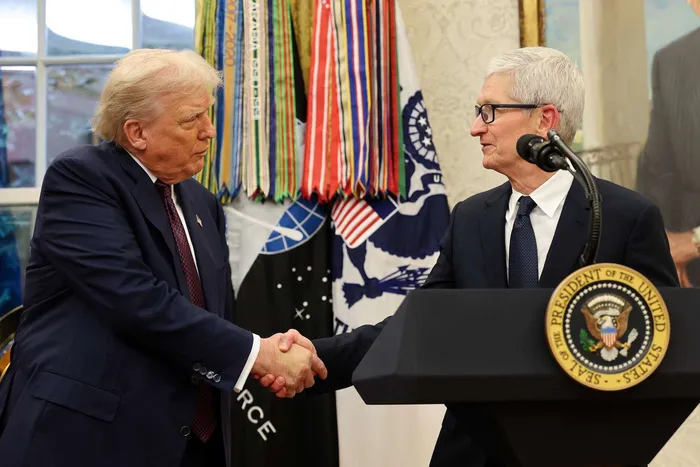
Cook presented Trump with a commemorative U.S.-made glass plaque during the meeting and pledged that all glass for iPhones and Apple Watches would soon come from Corning’s Kentucky facilities, part of a $2.5 billion investment. He also noted that Apple will produce 19 billion chips in 24 U.S. factories across 12 states.
“We’re going to keep hiring in America, and we’re going to keep building technologies at the heart of our products right here in America,” Cook said.
Nvidia CEO Jensen Huang, another Trump favorite, was also present at the White House this week. The company has committed to invest $500 billion in the U.S. and recently lobbied successfully to ease export restrictions on advanced chips designed for China—a move widely viewed as a win for the tech sector.
South Korean chip giants Samsung and SK Hynix also appear to be exempt from the tariffs, according to the country’s top trade envoy. Apple confirmed it would source chips from Samsung’s Texas facility, further reinforcing the exemption pathway for companies building in the U.S.
TSMC, the world's largest contract chipmaker, has announced major U.S. investments—including an initial $65 billion for three plants in Arizona and an additional $100 billion commitment in March. This could be a huge boost for customers like Apple, Nvidia, BroadcomAVGO--, AMDAMD--, and other major chipmakers. As a result, the majority of these companies are expected to be exempt from the tariffs.
Despite the sweeping headline, key details about the implementation of the 100% tariffs remain unclear. Analysts say the move could benefit certain segments of the semiconductor industry, particularly Japanese chipmaking equipment manufacturers, as their tools are essential for building U.S.-based fabrication plants.
Trump also announced a new 25% tariff on Indian exports on Wednesday, raising total U.S. tariffs on India to 50% in response to New Delhi’s purchases of Russian oil. However, this move is not expected to affect Apple, as the company was already unaffected by the 25% reciprocal tariffs imposed on August 1. According to the White House, that status is unlikely to change even if tariffs increase to the 50% level later in August.

Expert analysis on U.S. markets and macro trends, delivering clear perspectives behind major market moves.
Latest Articles
Stay ahead of the market.
Get curated U.S. market news, insights and key dates delivered to your inbox.
AInvest
PRO
AInvest
PRO



Comments
No comments yet