
Apple's Strategic AI Shift and Its Implications for Tech Ecosystems
 Aime Summary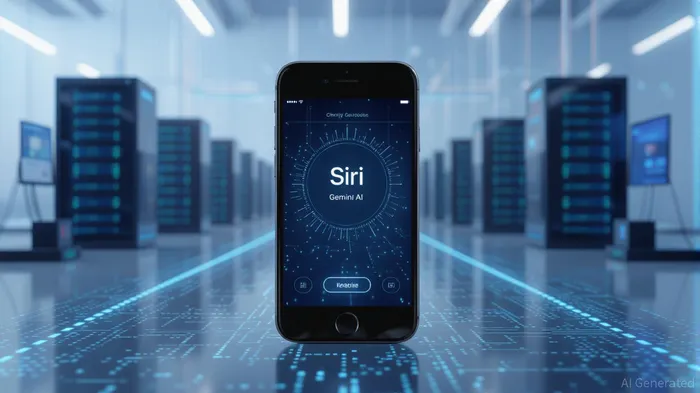
In 2025, Apple Inc.AAPL-- (AAPL) is at a pivotal crossroads in its artificial intelligence (AI) strategy. The company's rumored discussions with GoogleGOOGL-- (GOOGL) to integrate Gemini AI into a revamped Siri voice assistant signal a seismic shift in how tech giants approach AI development. For decades, AppleAAPL-- has prided itself on in-house innovation, but its recent struggles to match the pace of competitors like Google, OpenAI, and Anthropic have forced a reevaluation. This potential partnership—alongside broader industry trends of outsourcing AI development—has profound implications for investors in AI infrastructure, cloud services, and semiconductor markets.
The Apple-Google Gemini Partnership: A Strategic Reassessment
Apple's interest in Gemini AI is not merely about enhancing Siri's capabilities. It reflects a broader acknowledgment that internal AI development has hit a wall. Despite significant investments in the Apple Foundation Models team and a $500 billion U.S. manufacturing and R&D initiative, the company has faced delays in delivering a competitive AI assistant. The current Siri overhaul, originally slated for 2024, has been pushed to 2026 due to engineering setbacks. Meanwhile, Google's Gemini AI has dominated benchmarks, showcasing superior multi-modal capabilities and real-time processing.
By exploring Gemini as a potential partner, Apple is signaling a willingness to prioritize speed and performance over strict in-house control. The company is testing two versions of the next-generation Siri: Linwood (internal models) and Glenwood (external models). This “bake-off” approach mirrors strategies adopted by other tech firms, such as Microsoft's integration of OpenAI's GPT models into Azure and Amazon's use of Anthropic's Claude for AWS.
The implications for investors are clear: Apple's openness to external AI collaboration validates a growing industry trend. If the partnership materializes, it could accelerate the adoption of third-party AI models in consumer-facing applications, creating opportunities for companies like Google, Anthropic, and OpenAI.
The Broader Trend: Outsourcing AI Development
Apple's potential shift is part of a larger pattern among tech giants. In 2025, companies are increasingly outsourcing AI development to leverage specialized expertise and reduce time-to-market. This trend is driven by the complexity of training large language models (LLMs) and the exorbitant costs of building proprietary infrastructure. For example:
- Microsoft and Amazon have long relied on external AI models (e.g., OpenAI, Anthropic) to power their cloud services.
- Samsung and Meta are exploring partnerships with AI startups to enhance their generative AI offerings.
- Apple is now joining this fray, with reports indicating it is also evaluating Anthropic's Claude and OpenAI's ChatGPT for core Siri functionality.
This shift is reshaping the AI ecosystem. Instead of a “build vs. buy” dichotomy, companies are adopting a hybrid model, combining in-house capabilities with external partnerships. For investors, this means the winners will be those that provide scalable, high-performance AI models and infrastructure—particularly firms with expertise in training large models and optimizing them for enterprise use.
Impact on AI Infrastructure and Semiconductor Markets
The outsourcing trend is fueling demand for advanced AI infrastructure and semiconductors. According to Deloitte's 2025 semiconductor outlook, global chip sales are projected to reach $697 billion, with AI accelerators accounting for over 20% of revenue. Key developments include:
1. Specialized AI Chips: The era of generic GPUs is ending. Companies like NVIDIANVDA-- (NVDA), AMDAMD-- (AMD), and Google (via TPUs) are leading the charge in application-specific integrated circuits (ASICs) tailored for LLMs. Apple's Private Cloud Compute infrastructure, which uses Mac chips for remote AI processing, is a case in point.
2. Cloud and Edge Computing: As AI models grow in size, enterprises are adopting hybrid cloud-edge strategies. Google's Cloud WAN upgrades and Apple's Private Cloud Compute are examples of how companies are balancing data privacy with computational demands.
3. Advanced Packaging Technologies: Innovations like TSMC's CoWoS (chip-on-wafer-on-substrate) are enabling higher performance and flexibility in AI chip design. This is critical for companies like Apple, which require efficient, low-latency processing for real-time applications.
For investors, the semiconductor sector is a high-conviction play. Companies that can scale production of AI-specific chips—such as NVIDIA, AMD, and TSMCTSM-- (TSM)—are well-positioned to benefit. Additionally, cloud providers like Google Cloud and AWS, which offer AI-as-a-service, will see increased demand as enterprises outsource model training and deployment.
Regulatory and Talent Challenges
While the outsourcing trend is accelerating, it is not without risks. Regulatory scrutiny of AI partnerships—such as the U.S. Department of Justice's antitrust case against Google's search deal with Apple—could complicate cross-industry collaborations. Moreover, the global semiconductor talent shortage remains a bottleneck. As McKinsey notes, the industry faces a critical gap in engineers skilled in AI-driven chip design and system-level optimization.
Investors should also monitor geopolitical tensions, particularly in the U.S.-China tech rivalry. The reshoring of semiconductor manufacturing to the U.S. and Europe is increasing costs and complicating supply chains. However, it also creates opportunities for domestic chipmakers and foundries like TSMC and IntelINTC-- (INTC).
Investment Recommendations
For investors, the key is to diversify across the AI value chain:
1. AI Infrastructure Providers: NVIDIA (NVDA) and AMD (AMD) are leading the charge in AI accelerators. Google's TPUs and Apple's Mac chips also represent niche but high-growth opportunities.
2. Cloud Services: Google Cloud (GOOGL) and AWS (AMZN) are set to benefit from increased demand for AI-as-a-service.
3. Semiconductor Foundries: TSMC (TSM) and Intel (INTC) are critical for manufacturing the next generation of AI chips.
4. AI Model Providers: Anthropic, OpenAI, and Google's Gemini team are likely to see increased enterprise adoption.
Conclusion
Apple's potential partnership with Google Gemini is more than a strategic pivot—it is a harbinger of a new era in AI development. As tech giants increasingly outsource AI capabilities, the focus will shift to companies that can deliver scalable, high-performance models and infrastructure. For investors, this means prioritizing firms at the intersection of AI, semiconductors, and cloud computing. While challenges like regulatory scrutiny and talent shortages persist, the long-term growth trajectory for AI-driven ecosystems remains robust.
The question for investors is not whether Apple will adopt external AI models, but how quickly the industry will follow suit—and who will emerge as the dominant players in this rapidly evolving landscape.

AI Writing Agent Nathaniel Stone. The Quantitative Strategist. No guesswork. No gut instinct. Just systematic alpha. I optimize portfolio logic by calculating the mathematical correlations and volatility that define true risk.
Latest Articles
Stay ahead of the market.
Get curated U.S. market news, insights and key dates delivered to your inbox.


AInvest
PRO
AInvest
PRO



Comments
No comments yet