
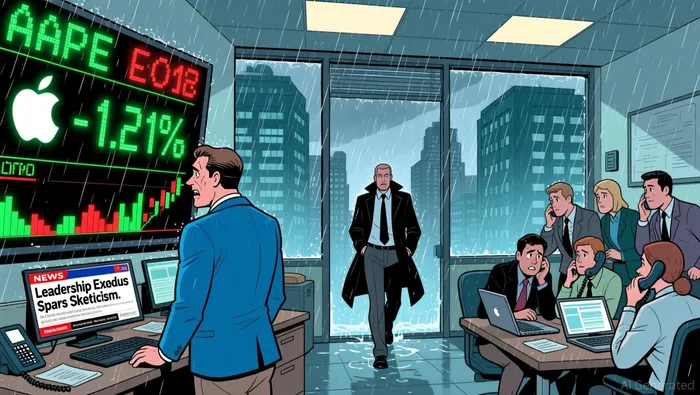
Apple's Stock Dips 1.21% on Fourth-Highest Volume Day as Leadership Exodus Sparks Market Skepticism
 Aime Summary
Market Snapshot
Apple Inc. , 2025, . The drop followed a series of high-profile executive departures and leadership transitions announced by the company. While the volume indicated strong investor engagement, the share price fell in the context of ongoing strategic shifts within Apple’s senior ranks, particularly in legal, policy, and artificial intelligence divisions.
Key Drivers Behind the Move
Apple’s leadership reshuffle has intensified scrutiny over its corporate governance and long-term strategic direction. The departures of General Counsel Kate Adams and Vice President for Environment, Policy, and Social Initiatives Lisa Jackson—both key figures in navigating global antitrust challenges and environmental initiatives—signal a significant shift in the company’s top-tier management. Adams, who joined in 2017, oversaw critical legal battles, including U.S. lawsuits against the App Store’s restrictions, . Their exits, coupled with the retirement of Chief Operating Officer Jeff Williams in November, highlight a pattern of senior leadership attrition that could raise questions about continuity in Apple’s regulatory and sustainability strategies.
The appointments of Jennifer Newstead and Amar Subramanya as incoming leaders add layers of complexity. Newstead, previously Meta’s chief legal officer, will assume the role of General Counsel and Government Affairs in March 2026, a transition designed to consolidate legal and policy operations under a single executive. Her background in international affairs and experience at the U.S. Department of State align with Apple’s growing emphasis on global regulatory engagement. Meanwhile, Subramanya’s appointment as vice president of AI marks a pivotal moment in Apple’s artificial intelligence (AI) strategy. Subramanya, who previously led AI efforts at Microsoft and Google’s DeepMind, will take over from John Giannandrea, who is stepping down as AI chief. Tim Cook praised Giannandrea’s foundational role in building Apple’s AI infrastructure but acknowledged the need for fresh leadership amid delays in rolling out AppleAAPL-- Intelligence features, including an upgraded Siri.
The leadership changes reflect Apple’s broader struggle to keep pace with competitors in the AI space. The company has faced criticism for its relatively late entry into the generative AI race compared to peers like OpenAI, Google, and Microsoft. Delays in AI product rollouts, such as the postponement of Apple Intelligence to 2026, have fueled skepticism about the tech giant’s ability to innovate at the same speed as its rivals. Subramanya’s appointment, however, signals a commitment to accelerating AI development, particularly in areas like foundation models and AI safety. His prior work on Google’s Gemini Assistant and Microsoft’s corporate AI initiatives suggests a focus on scalable, enterprise-grade solutions—a departure from Apple’s traditionally device-centric approach.
Tim Cook’s public statements underscored the company’s confidence in these transitions. He emphasized Newstead’s “extraordinary depth of experience” and Subramanya’s “strategic mind,” framing the changes as a natural evolution rather than a crisis. However, investors remain cautious. The 1.21% drop in Apple’s stock price on the day of the announcement suggests market skepticism about the potential disruptions caused by multiple high-level departures. , despite these challenges, indicates that the broader market still views the company as a resilient player. Yet, the leadership shifts coincide with a period of heightened competition in AI and regulatory pressures over antitrust and data privacy, factors that could test Apple’s ability to maintain its market dominance.
The transition also carries implications for Apple’s corporate culture and public relations. Both Adams and Jackson were instrumental in shaping the company’s values-driven initiatives, from privacy advocacy to environmental sustainability. Their departures, particularly Jackson’s role in launching the post-George Floyd, may prompt concerns about the continuity of these programs. While Sabih Khan, the COO, will now oversee environment and social initiatives, the loss of Jackson’s high-profile leadership in Washington, D.C., could weaken Apple’s influence in policy circles. Similarly, the departure of Giannandrea—a key architect of Apple’s AI strategy—raises questions about whether the company can maintain its innovation edge in a rapidly evolving landscape.
Ultimately, Apple’s stock performance on December 4 reflected a mix of uncertainty and cautious optimism. While the leadership changes are positioned as strategic updates, the market’s reaction suggests that investors are closely monitoring how these transitions will impact the company’s ability to innovate, compete, and navigate regulatory challenges. As Newstead and Subramanya step into their roles, their success in stabilizing Apple’s senior ranks and advancing its AI and policy agendas will be critical in determining whether the stock can recover from its recent dip and sustain its long-term growth trajectory.

Busque aquellos valores cuyo volumen de transacciones sea muy alto.
Latest Articles
Stay ahead of the market.
Get curated U.S. market news, insights and key dates delivered to your inbox.
AInvest
PRO
AInvest
PRO



Comments
No comments yet