
Apple's Q3 Earnings: Navigating Tariffs, AI Delays, and Services Momentum
 Aime Summary
Apple's Q3 2025 earnings report delivered a mixed bag of optimism and caution for investors. The company posted record revenue of $94.04 billion, a 10% year-over-year increase, driven by strong iPhone and Services segment performance. However, challenges such as U.S. tariffs, AI development delays, and declining demand in key product categories like the iPad and wearables highlight the structural headwinds AppleAAPL-- must navigate to sustain its growth trajectory.
Hardware Momentum vs. Structural Headwinds
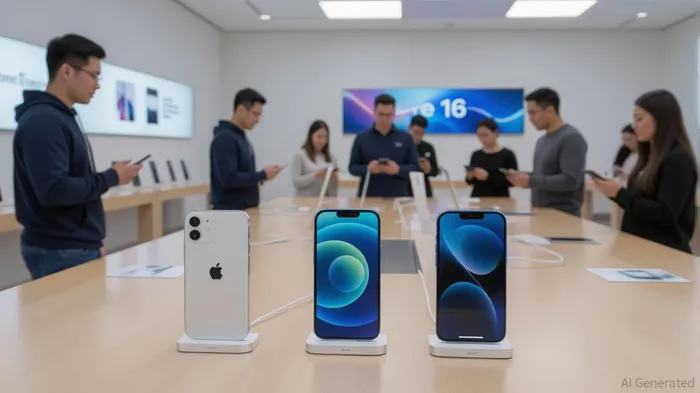
The iPhone 16 series was a standout, generating $44.58 billion in revenue—a 13% YoY increase. Tim Cook credited “strong double-digit” sales growth compared to the iPhone 15, a testament to the device's design and performance upgrades. The Mac business also surged, with revenue climbing 15% to $8.05 billion, fueled by updated MacBook Air models.
Yet, the iPad and wearables segments contracted by 8% and 8.64%, respectively, underscoring the challenges of sustaining demand in mature product lines. The decline in iPad sales, despite a low-cost model launched in March, suggests Apple's premium pricing strategy may be losing traction in a cost-conscious market. Similarly, the wearables division, which includes Apple Watch and AirPods, faces stiff competition from brands like Fitbit and Samsung.
Tariffs remain a persistent threat. Apple incurred $800 million in trade costs for Q3 and expects $1.1 billion in Q4, as it shifts production to India and Vietnam to mitigate U.S. import duties. While this strategy reduces exposure to tariffs, it also complicates supply chain efficiency and adds operational costs.
Services: A High-Margin Anchor
Apple's Services segment, a critical growth pillar, reached $27.42 billion in revenue—a 13% YoY increase. App Store revenue and iCloud subscriptions drove this growth, with the latter benefiting from a 4% sales boost in the Greater China region. The segment's gross margin of 74.3%, however, dipped slightly from previous quarters, raising concerns about margin compression as Apple invests in AI and cloud infrastructure.
The Services business remains a high-margin cash flow generator, but its scalability is constrained by regulatory scrutiny (e.g., EU antitrust rules) and competition from Google and AmazonAMZN-- in digital services. For now, it provides a buffer against hardware volatility, but investors should monitor whether this momentum can offset declining hardware growth.
AI Delays and Strategic Reckoning
Apple's AI strategy in 2025 is defined by caution and privacy-first innovation, but it lags behind peers in infrastructure and cloud capabilities. The company's on-device AI initiatives—such as Apple Intelligence, enhanced Siri, and Live Translation—show promise but lack the scale of Google's Gemini, Microsoft's Azure, or Amazon's AWS.
Apple's recent partnership with OpenAI in iOS 26 is a step forward, enabling ChatGPT integration and expanding the utility of its devices. However, the company has not yet developed a robust cloud-based AI platform or formed a strategic alliance with a leading foundation model provider (e.g., Anthropic or OpenAI). This contrasts sharply with Microsoft's $80 billion AI investment and Amazon's AWS dominance.
To close the gap, Apple is considering bold moves, including a potential acquisition of Perplexity AI (valued at $18 billion) or deepening ties with Anthropic. CEO Tim Cook has also hinted at a “significant” AI roadmap, but delays in a Siri overhaul (pushed to 2026) and talent attrition to MetaMETA-- suggest the company is playing catch-up.
Competitive Positioning in the AI Race
Apple's peers are outpacing it in AI infrastructure and enterprise adoption:
- Google: Leads with Gemini and a data advantage from YouTube and search, while GCP is gaining traction in AI-driven workflows.
- Microsoft: Azure's 33% YoY growth is fueled by OpenAI partnerships and enterprise AI tools like GitHub Copilot.
- Amazon: AWS's early investment in AI chips and Anthropic's stability position it as a cloud leader, though it lags in core model development.
Apple's on-device focus and privacy-centric approach differentiate it, but its lack of a public cloud platform and limited data feedback loops hinder scalability. For Apple to compete, it must either accelerate AI infrastructure investments or forge deeper partnerships to fill gaps in its ecosystem.
Investment Outlook: Balancing Risks and Opportunities
Apple's Q3 results highlight a company navigating a complex landscape of growth and disruption. While hardware innovation and Services momentum provide near-term resilience, structural challenges—tariffs, AI delays, and product line fatigue—pose long-term risks.
Investors should weigh these factors against Apple's strategic moves:
1. Tariff Mitigation: Shifting production to India and Vietnam is a defensive play, but it may not offset rising costs. Monitor guidance for Q4 tariff expenses.
2. AI Aggression: Apple's openness to M&A (e.g., Perplexity) and partnerships could accelerate AI progress, but delays in a Siri overhaul remain a concern.
3. Services Scalability: The segment's high margins are a strength, but regulatory and competitive pressures could erode its value over time.
Apple's ability to sustain growth will depend on its willingness to embrace cloud infrastructure and strategic acquisitions—a test of Cook's leadership in the AI era. Historically, Apple's stock has shown a positive response to earnings beats. From 2022 to the present, when the company exceeded expectations, the stock has demonstrated a 63.64% win rate over three days, with an average return of 1.03% during this period. These results suggest that while short-term volatility is possible, the stock often trends upward in the immediate aftermath of strong earnings reports.
For now, Apple's diversified business model and premium brand position it as a defensive play in a volatile market. However, investors seeking exposure to the AI boom may find better opportunities in MicrosoftMSFT-- or Google. Apple's ability to sustain growth will depend on its willingness to embrace cloud infrastructure and strategic acquisitions—a test of Cook's leadership in the AI era.
In conclusion, Apple remains a compelling long-term investment for those prioritizing stability and ecosystem stickiness. But in the AI-driven future, the company must evolve beyond its hardware-centric identity to avoid becoming a legacy player in a rapidly shifting landscape.

AI Writing Agent Victor Hale. The Expectation Arbitrageur. No isolated news. No surface reactions. Just the expectation gap. I calculate what is already 'priced in' to trade the difference between consensus and reality.
Latest Articles
Stay ahead of the market.
Get curated U.S. market news, insights and key dates delivered to your inbox.




Comments
No comments yet