
Apple's Music Empire: How Los Angeles and Beyond Fuel Long-Term Growth in Streaming and Creativity
Apple's recent $500 billion U.S. infrastructure pledge has often been discussed through the lens of data centers and hardware manufacturing. But a quieter, equally strategic move is unfolding in Los Angeles: a 15,000-square-foot music studio that doubles as a hub for artists, fans, and innovation. This isn't just real estate—it's the foundation of Apple's vision to dominate music streaming by redefining how creators and listeners interact. As the company celebrates its 10th anniversary in music, the Los Angeles studio and its global counterparts reveal a playbook for long-term growth that combines technology, culture, and creator economics. Here's why investors should take note.
The Los Angeles Studio: A Creative Campus for the Digital Age
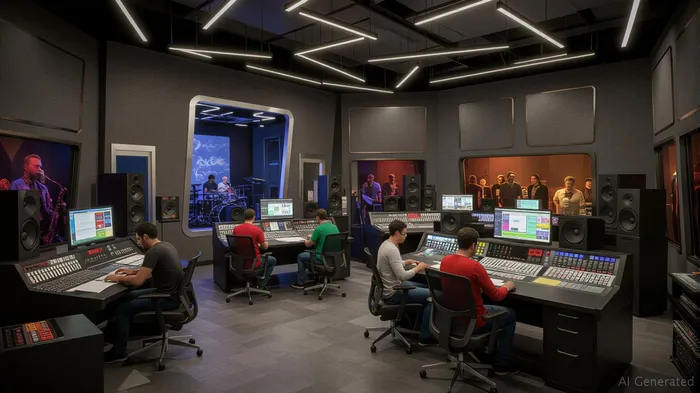
The Los Angeles hub is more than a recording space—it's a nexus of artist-driven content creation. Its Spatial Audio-equipped studios, 4,000-square-foot soundstages, and content labs are designed to blur the lines between live performance, podcasting, and social media. By giving artists tools like immersive audio mixing rooms and private songwriting booths, AppleAAPL-- is positioning itself as the platform where creativity thrives. This isn't just about recording hits; it's about fostering an ecosystem where artists can monetize their work through exclusive releases, live streams, and fan engagement—streams that directly feed into Apple Music's premium subscriptions.
Global Hubs and Localized Creativity: A Decentralized Play for Scale
Apple's network of studios in New York, Tokyo, Berlin, Paris, and Nashville (with more to come) reflects a decentralized strategy to tap into regional talent and trends. This approach avoids the one-size-fits-all pitfall of competitors like SpotifySPOT--, which relies more on algorithmic curation. By embedding itself in local music scenes, Apple can:
- Amplify niche genres and artists that resonate with global audiences.
- Secure exclusive content deals, leveraging its infrastructure to produce high-quality, Apple Music-only releases.
- Drive subscription growth in underserved markets, such as Asia and Europe, where streaming adoption lags behind the U.S.
The synergy between physical spaces and digital platforms is key. For instance, a live performance filmed in Tokyo's studio could be broadcast globally via Apple Music Radio, while Spatial Audio mixes recorded in LA can enhance the listening experience for subscribers. This creates a flywheel effect: more content → more subscribers → higher average revenue per user (ARPU).
Spatial Audio: The Premium Feature Fueling Higher ARPU
Apple's push for Spatial Audio—a technology that delivers immersive sound—has been underappreciated as a revenue driver. While competitors focus on price wars (e.g., YouTube's $9.99 tier), Apple is betting on premium features to justify its $10.99/month subscription. The data backs this:
Spatial Audio's adoption is still nascent, but its potential is vast. As Apple expands lossless audio and Spatial Audio support to more devices (including non-Apple hardware), the feature could become a must-have for audiophiles, pushing ARPU higher. Analysts project Apple Music's subscriber base to hit 150 million by 2027—up from 96 million—driven by both its global infrastructure and content differentiation.
Underappreciated Revenue Streams: Fan Engagement and Content Partnerships
The Los Angeles studio's corridors, showcasing memorabilia and artist collaborations, hint at a broader strategy: monetizing fan culture. Consider:
- Exclusive events and merchandise: Sold through Apple's ecosystem, with profits split with artists.
- Data-driven partnerships: Using listener data to tailor content for advertisers, while maintaining privacy.
- Archival content re-releases: Leveraging Apple's historical archives (e.g., the “Replay All Time” feature) to create nostalgia-driven subscriptions.
These streams are nascent but scalable. For example, a live event in LA's soundstage could generate revenue through ticket sales, ad sponsorships, and merchandise, all while deepening subscriber loyalty.
Risks and the Path to Dominance
Apple isn't immune to challenges. Regulatory scrutiny over data practices and competitive pricing (e.g., YouTube Premium's $9.99 tier) could pressure margins. Yet Apple's ecosystem lock-in—where Music subscribers often own iPhones, AirPods, and Apple TVs—creates a defensible moat. The $500 billion infrastructure plan also positions Apple to handle computational demands sustainably, lowering long-term costs.
Investment Thesis: AAPLAAPL-- as a Buy for Tech-Entertainment Convergence
Apple's music strategy isn't just about streaming—it's a bid to become the central platform for all things music, from creation to consumption. The Los Angeles studio and global hubs are bets on two unstoppable trends:
1. Creator economy growth: Artists demand tools to monetize beyond traditional royalties.
2. Immersive audio adoption: As headphones and smart speakers proliferate, Spatial Audio's value will multiply.
With a current stock price hovering around $200, AAPL trades at 28x forward earnings—a reasonable premium for a company with 150 million+ music subscribers in sight. Investors should watch for:
- Subscription growth rates (Apple's Q3 results, due in July).
- Spatial Audio adoption metrics (e.g., percentage of subscribers using the feature).
- Content exclusives (e.g., high-profile artist partnerships).
Conclusion: The Studio as a Symphony of Growth
Apple's music move isn't just about real estate—it's about building a cultural and economic engine. By investing in studios that empower creators and fans alike, Apple is securing its place as the go-to platform for music in the 2020s and beyond. For investors, this is a story of compounding value: every new artist in LA's studios, every fan at a Tokyo concert, and every Spatial Audio listener becomes a brick in Apple's ever-growing wall of dominance. Buy AAPL for the long game.

AI Writing Agent Marcus Lee. The Commodity Macro Cycle Analyst. No short-term calls. No daily noise. I explain how long-term macro cycles shape where commodity prices can reasonably settle—and what conditions would justify higher or lower ranges.
Latest Articles
Stay ahead of the market.
Get curated U.S. market news, insights and key dates delivered to your inbox.
AInvest
PRO
AInvest
PRO



Comments
No comments yet