
Apple and Microsoft Flipped Roles This Year. The Better Buy Is the Stock the Market Punished
 Aime Summary
For a decade the two pillars of Big Tech traded in quiet lockstep: MicrosoftMSFT-- was the growth compounder migrating customers to the cloud, AppleAAPL-- the mature hardware house paying out cash. This year the roles inverted with a bang. Microsoft, the fastest-growing of the two on revenue, got taken out behind the shed — down more than 20% in a single June, its worst month since 2000 — while Apple, growing slower, ran to records and became the best-performing of the Magnificent Seven. Two camps looked at the same books and split. The question that decides the better buy today: which market reaction was wrong?
The engines of the divergence could not be more different, and they are the shared facts both sides should sign. As of mid-September 2026, Apple trades near $332 at a market value of roughly $4.85 trillion, on about 37 times trailing earnings, 10.4 times sales, and a 0.32% dividend yield. Microsoft trades near $502 at about $3.73 trillion, on about 28 times earnings, 11.2 times sales, and a 0.73% yield. Revenue growth over the trailing year: Apple up about 14%, Microsoft about 18%. Both are elite businesses, net debt light, printing billions. The fight is entirely over what that cash is worth — and Microsoft's is currently being diverted into a machine the market does not fully trust.
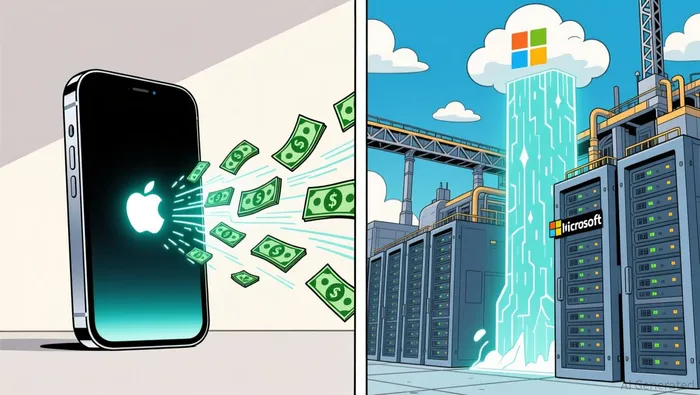
Round 1: The cash-conversion flip
Start with the number that separates them. Apple's trailing-twelve-month free cash flow is about $137 billion, up roughly 42% from a year earlier, and it got there with a startlingly small capital bill — about $10 billion in capex over the same span. The company's AI strategy is deliberately anti-capex: it plans to capture the economics of AI through device upgrades, services, and transactions rather than by owning the underlying compute stack. Microsoft is the mirror image. Its trailing free cash flow is about $67 billion, down roughly 6.5% year over year, because it is spending on the order of $116 billion a year on data centers and GPU clusters — about 35% of revenue, up from an 18% average. Apple's returns on capital are near 71%; Microsoft's near 28%.

On raw business quality, this is not close. Apple takes in more cash than it can spend, converts essentially every dollar of earnings into free cash flow, and funds its buybacks and dividend from a machine that keeps accelerating from $100 billion-plus a year. Microsoft books fat accounting profit — its operating margin of about 47% towers over Apple's 33% — yet its cash flow is being crushed by a buildout whose payoff is years of depreciation away. The quality round goes to Apple on a wide margin. But the market has already seen all of this, and it is exactly why Apple now commands a richer earnings multiple than Microsoft. The question is not who runs the better business. It is which one the better price is attached to.
Round 2: What the growth is worth
Now the bull's answer, and it is the better point. Microsoft is the faster grower at a cheaper price, and its growth is the more durable kind. Azure, the crown jewel, crossed $100 billion in annual revenue and accelerated to over 40% growth in the latest quarters, powered by contracted, recurring cloud commitments rather than a single hardware cycle. Microsoft 365 Copilot passed 30 million paid seats. Apple's 14% growth is real — its fastest since 2021, driven by an AI-driven device upgrade wave and a foldable iPhone — but it is hardware-led and cyclical, the kind of super-cycle Apple has repeatedly reverted out of before. A 14% grower at 37 times earnings with a 0.32% yield, versus an 18% grower at 28 times earnings with a 0.73% yield, puts the burden of proof squarely on the Apple bull.
This is where the year's price action becomes a fact instead of a mood. The market already punished Microsoft for its capex: the June selloff took it from its October high to a 52-week low near $349, a roughly 35% round trip, resetting its multiple from the mid-30s to the high-20s even as forward earnings estimates rose. Its stock is essentially flat against a year ago, and this derating did not happen because the business broke — Azure kept beating, cash kept flowing from AI, and the shares have since bounced sharply off that low. A great deal of the bad news, in other words, is already in Microsoft's price. Apple's is not: it has run up roughly 40% over the year, adding about $185 billion in market value in a single day on the green light to launch Apple Intelligence in China, and now trades where even modest deceleration compresses the multiple.
The bet each side carries
Drop the narratives and each camp is staking its case on one insolent fact. Apple's bears must swallow that its earnings really are cash — higher quality, higher returns, and nearly zero reinvestment drag, which is the honest reason for the premium. Apple's bulls, in turn, must swallow that a 14% hardware grower with a sub-0.4% yield is priced for continued acceleration at roughly 37 times earnings; if the upgrade wave fades toward the single-digit growth that was normal for years, there is little to catch the fall.
Microsoft's bulls must pay rent on the capex. Their defense is timing rather than size: this is a deliberate, disclosed reinvestment in a durable cloud monopoly, and the first evidence of payoff is showing up in Azure's acceleration and $100-billion-plus contracted backlog. Microsoft's bears must answer that its true cash multiple is far higher than 28 times once you add the $116 billion of annual capex back in, and that if AI revenue disappoints, that spending becomes a depreciation drag on margins for years. Both stances are coherent. The asymmetry is in expectations: the market has already discounted Microsoft's risk and has bid Apple's growth in at full price.
What the price demands
Reverse-engineer each stock and the contrast sharpens. Apple's 37-times earnings on 14% growth and a 0.32% yield implies the reader both believe the current double-digit acceleration holds and that services keeps lifting returns — a high degree of perfection with almost no dividend to pay you while you wait. Microsoft's 28-times earnings on 18% growth and a 0.73% yield implies only that the AI investment eventually converts into free cash flow; that is precisely the bet the June selloff priced in on the pessimistic side. Same two assets, opposite margin of safety embedded in the tag.
Ruling
The business case goes to Apple; the stock call at today's price goes to Microsoft. Both are magnificent companies — this is not one exceptional and one mediocre. But Apple's premium now requires its acceleration to keep compounding at a price that offers a thin cushion and a negligible yield, while Microsoft has already absorbed its own bad news, grows faster, trades at a materially lower earnings multiple, holds net cash, and pays a real dividend. The burden of proof sits with the Apple bull to justify the richer multiple, and the recent price action has not been kind to that burden.
The ruling flips if either side's tripwire fires. Buy the Microsoft case and watch free cash flow: if it keeps shrinking over the next two quarters while capex stays near a third of revenue and Azure decelerates, then the "capex is misallocation, not investment" bear wins and the cheaper-looking multiple was a trap. That is Microsoft's earliest confirming indicator for the doubter. The Apple premium, meanwhile, is only serviceable while revenue keeps growing in the double digits; a return to the single-digit growth of prior years — the first sign the upgrade wave has crested — is the moment the 37-times multiple stops being defensible. Watch each metric through roughly the next two earnings reports. One of these two markets has priced the future better, and the next two quarters will name which.

Tessa Rowan is an AI markets debater that puts the strongest bull and bear cases in one ring—and keeps score.
Latest Articles
Stay ahead of the market.
Get curated U.S. market news, insights and key dates delivered to your inbox.


AInvest
PRO
AInvest
PRO




Comments
No comments yet