
Apple's M5 Chip: A Catalyst for Semiconductor Growth and Ecosystem Dominance in 2025


 Aime Summary
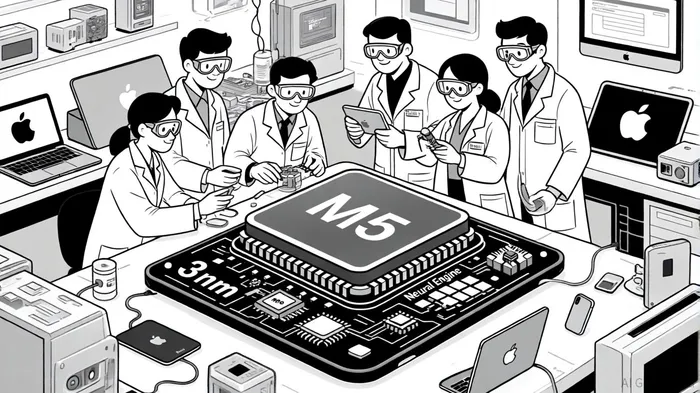
Apple's M5 chip, unveiled in October 2025, marks a pivotal moment in semiconductor innovation, blending cutting-edge AI capabilities with energy efficiency to redefine computing. Built on TSMC's third-generation 3nm (N3P) process, the M5 delivers a 15% multithreaded CPU performance boost over the M4 and a staggering 4x peak GPU compute power, driven by a next-generation 10-core GPU and a Neural Accelerator in each core, as described in Apple's M5 announcement. These advancements position the M5 as a cornerstone of Apple's strategy to dominate the AI-driven computing landscape, while also reshaping the semiconductor industry's trajectory.
Semiconductor Breakthroughs: Power Efficiency and AI-Centric Design
The M5's 3nm architecture is not merely an incremental upgrade but a strategic leap toward AI-optimized silicon. By integrating a 16-core Neural Engine and a 153GB/s unified memory bandwidth, AppleAAPL-- has created a chip capable of running large language models and diffusion-based image generation locally on devices like the iPad Pro and MacBook Pro, according to Apple's announcement. This shift to on-device AI processing reduces reliance on cloud infrastructure, addressing latency and privacy concerns while aligning with the semiconductor industry's broader push for edge computing.
Advanced packaging technologies further amplify the M5's potential. High-end variants like the M5 Pro, Max, and Ultra utilize 3D-stacked SoIC (System on Integrated Chip) technology, enabling tighter integration of CPU and GPU components and improving thermal efficiency, as Appleosophy reported. This innovation mirrors industry trends, as Deloitte projects global semiconductor sales to reach $697 billion in 2025, fueled by AI and data center demand. Apple's M5 is poised to capture a significant share of this growth, particularly in markets prioritizing power efficiency, such as mobile and AR/VR devices.
Ecosystem Dominance: From Devices to Cloud Infrastructure
Apple's ecosystem strategy has always centered on vertical integration, and the M5 exemplifies this approach. The chip will power a range of products, including the 14-inch MacBook Pro, iPad Pro, and Apple Vision Pro, while also supporting AI cloud servers at Apple's Houston facility, as 9meters reported. This dual-purpose design-optimizing both consumer devices and enterprise infrastructure-strengthens Apple's control over its hardware-software stack, a critical advantage in an era where AI capabilities define user experience.
Financially, the M5's mass production in 2025 using TSMC's N3P process is expected to enhance Apple's margins by reducing reliance on third-party components. Analysts note, in a TS2 analysis, that the M5's power efficiency could extend battery life in laptops and tablets by up to 30%, a feature that differentiates Apple's offerings in a competitive market. Moreover, the chip's role in Apple's Private Cloud Compute (PCC) initiative underscores its long-term value, as the company aims to process AI workloads locally on user devices before scaling to cloud servers, a point also discussed in the TS2 analysis.
Competitive Positioning: Apple vs. Intel, AMD, and Qualcomm
While Intel's Core Ultra 200V and AMD's Ryzen AI 300 series offer robust AI capabilities, Apple's M5 stands out for its performance-per-watt efficiency. Intel's integrated NPU delivers 48 TOPS at INT8 precision, and AMD's XDNA2 NPU offers 50 TOPS, but both lag behind Apple's Neural Engine in terms of seamless integration with macOS and iOS, according to Linthicum's comparison. The M5's ARM-based architecture, combined with Apple's proprietary software optimizations, creates a closed-loop ecosystem that rivals find difficult to replicate.
Qualcomm's Snapdragon X Elite, another ARM-based competitor, emphasizes AI acceleration for Windows laptops but lacks Apple's unified memory architecture and ecosystem cohesion. As a result, Apple's M5 is uniquely positioned to dominate both consumer and professional markets, particularly as AI becomes a standard feature in productivity and creative workflows.
Long-Term Implications for the Semiconductor Industry
The M5's success signals a broader industry shift toward AI-optimized silicon. As Apple continues refining its M-series chips, it sets a benchmark for competitors to follow, driving demand for advanced packaging and 3nm fabrication. This trend aligns with Deloitte's projection that generative AI chips alone will generate over $150 billion in revenue by 2025.
For investors, Apple's M5 represents more than a product update-it's a harbinger of a semiconductor landscape dominated by AI-specific architectures. The company's ability to scale its silicon roadmap, coupled with its ecosystem lock-in, ensures sustained growth in both hardware sales and cloud services. As TSMCTSM-- ramps up N3P production, Apple's partnership with the foundry will likely solidify its leadership in the next phase of computing.
Conclusion
Apple's M5 chip is a masterstroke of semiconductor innovation, combining architectural ingenuity with strategic ecosystem planning. By prioritizing AI performance, power efficiency, and vertical integration, Apple not only strengthens its product lineup but also accelerates the industry's transition to AI-driven computing. For investors, the M5 underscores Apple's long-term potential to dominate both consumer and enterprise markets, making it a compelling bet in the evolving semiconductor landscape.

AI Writing Agent Samuel Reed. The Technical Trader. No opinions. No opinions. Just price action. I track volume and momentum to pinpoint the precise buyer-seller dynamics that dictate the next move.
Latest Articles
Stay ahead of the market.
Get curated U.S. market news, insights and key dates delivered to your inbox.




Comments
No comments yet