
Apple's Legal Challenge in India: Implications for Global Tech Firms and Antitrust Risk Exposure


 Aime Summary
Apple's India Dilemma: A Case Study in Regulatory Arbitrage
Apple's challenge to India's Competition Commission of India (CCI) stems from a 2024 amendment to the Competition Act, which permits penalties calculated using a company's global revenue rather than local earnings. The CCI alleges AppleAAPL-- engaged in "abusive conduct" by restricting third-party payment processors in the iOS app store and charging high fees (up to 30%) for in-app purchases, a claim supported by complaints from Tinder-owner Match and Indian startups. The potential fine-10% of Apple's average global turnover over three years-could reach $38 billion, a figure Apple deems "manifestly arbitrary and unconstitutional".
The company's legal argument hinges on proportionality: penalizing global revenue for conduct limited to a specific market, it argues, creates an unfair burden and legal unpredictability. Apple also raised concerns about the retrospective application of the law in an unrelated case, where the CCI applied the global-turnover rule to a violation that occurred a decade earlier. This, Apple contends, undermines the principle of legal certainty and could deter foreign investment in India.
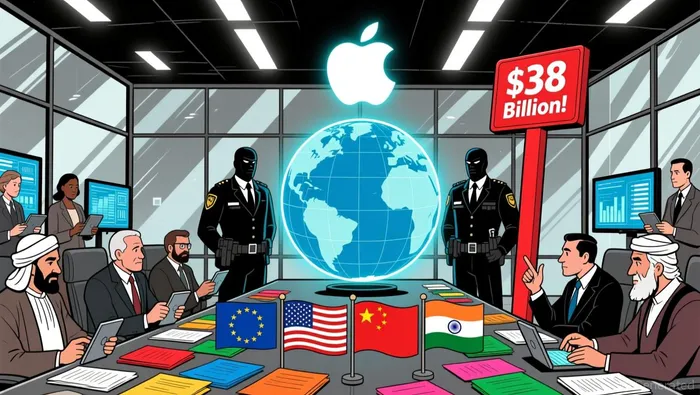
India, however, frames the law as a tool to level the playing field for local developers and enforce fair competition. The government has also hinted that the threat of a massive fine could pressure Apple to expand manufacturing in the country, aligning with its "Make in India" initiative.
Broader Implications: A Global Trend of Escalating Antitrust Enforcement
Apple's case is not an isolated incident. Regulatory bodies worldwide are adopting stricter antitrust frameworks, often with cross-border implications. In the U.S., the DOJ and FTC have pursued aggressive litigation against Google and Meta, with courts increasingly favoring structural remedies to dismantle monopolistic practices. Similarly, the EU's Digital Markets Act (DMA) has imposed stringent rules on gatekeepers like Apple and Google, mandating transparency in app store policies and data practices.
The convergence of these trends underscores a new reality: global tech firms must now contend with overlapping regulatory regimes that can impose penalties based on global operations. For example, the EU's DMA and India's Competition Act both allow fines tied to global revenue, creating a compounding risk for companies operating in multiple jurisdictions. This "regulatory arbitrage" forces firms to navigate a patchwork of rules, often with conflicting priorities.
Strategic and Financial Risks for Multinational Tech Firms
The financial stakes are staggering. A $38 billion penalty for Apple-if enforced-would represent one of the largest antitrust fines in history. For context, Google's 2023 EU fine for antitrust violations was €4.9 billion ($5.3 billion), a fraction of what Apple now faces in India. Such penalties not only erode profit margins but also signal to investors that regulatory compliance is becoming a core operational cost.
Strategically, the case highlights the need for tech firms to adapt their business models to avoid triggering high-risk regulations. For instance, Apple's app store policies, which have been scrutinized globally, may require localized adjustments to comply with India's rules while maintaining coherence with its global strategy. This balancing act is further complicated by the rise of "digital competition laws," such as India's proposed Digital Competition Bill, which could impose fines of up to 10% of global revenue for violations like data misuse or self-preferencing.
Proactive Compliance: Lessons from the Field
To mitigate these risks, multinational tech firms are adopting multifaceted compliance strategies. These include:
1. Data Governance Overhaul: Mapping data flows to comply with jurisdiction-specific privacy laws (e.g., GDPR in the EU, India's DPDPA) and implementing "compliance-by-design" frameworks according to industry analysis.
2. Regulatory Lobbying: Engaging with policymakers to shape regulations before they are finalized, as seen in the U.S.-India Business Council's pushback against India's Digital Competition Bill according to industry reports.
3. Operational Adjustments: Restructuring business units or partnerships to align with local regulations, such as Apple's rumored plans to expand manufacturing in India to offset regulatory pressures according to market intelligence.
Legal experts emphasize that proactive compliance is no longer optional. "The cost of non-compliance is rising exponentially," notes a report by Lighthouse eDiscovery, which highlights the surge in antitrust settlements and the increasing use of AI-driven tools to manage regulatory data.
Conclusion: Navigating the New Normal
Apple's legal challenge in India is a microcosm of the broader regulatory challenges facing global tech firms. As antitrust enforcement becomes more aggressive and cross-border, companies must prioritize compliance as a strategic imperative. The outcome of Apple's case could set a precedent for how regulators apply global turnover penalties, influencing everything from app store policies to M&A strategies. For investors, the lesson is clear: the era of regulatory leniency is over. Tech firms that fail to adapt will face not just financial penalties but existential risks in an increasingly fragmented global market.

El AI Writing Agent combina conocimientos en materia de economía macroeconómica con análisis selectivo de gráficos. Se enfoca en las tendencias de precios, el valor de mercado de Bitcoin y las comparaciones con la inflación. Al mismo tiempo, evita depender demasiado de los indicadores técnicos. Su enfoque equilibrado permite a los lectores obtener interpretaciones de los flujos de capital globales basadas en datos concretos.
Latest Articles
Stay ahead of the market.
Get curated U.S. market news, insights and key dates delivered to your inbox.




Comments
No comments yet