
Apple's Leadership Shake-Up Weighs on AI and Talent Retention Efforts
 Aime Summary
Apple Inc. (AAPL) is currently navigating a period of significant internal upheaval, marked by a wave of executive departures and strategic restructurings that have raised concerns among both employees and investors. The tech giant is facing a potential exodus of key personnel, with Johny Srouji, the head of hardware technologies and a central figure in Apple's in-house chip development, reportedly considering his next move. Tim Cook has reportedly taken aggressive steps to retain Srouji, including offering a substantial pay package and the prospect of increased responsibility according to Bloomberg.
Adding to the instability, Apple's leadership in artificial intelligence (AI) has undergone a shake-up. John Giannandrea, who oversaw Apple's AI strategy, has stepped down, and the company is actively seeking a replacement. At the same time, several of Apple's top AI talents have reportedly moved to competitors like Meta, contributing to a brain drain that could hinder Apple's ability to innovate in the rapidly evolving AI space.
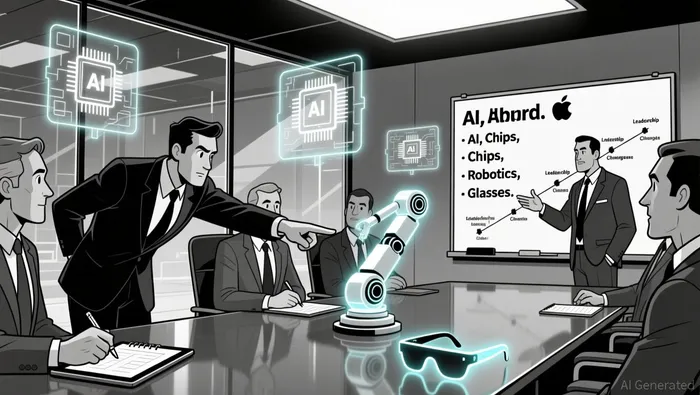
The shifting dynamics within Apple's executive ranks are reshaping the company's power structure. A new quartet of leaders—Jeff Ternus, Eddy Cue, Craig Federighi, and Sabih Khan—are taking on greater influence, with Federighi now serving as the de facto leader of Apple's AI initiatives. Ternus, in particular, is gaining prominence, with increased responsibilities in robotics and smart glasses, two areas that are expected to be key growth drivers for AppleAAPL-- according to Bloomberg.
The Leadership Shake-Up
Apple's leadership changes are not isolated incidents but part of a broader reorganization that reflects the company's evolving priorities. Deirdre O'Brien, who has been with Apple for over three decades, and Greg Joswiak, another long-standing executive, are expected to retire in the near future. Apple is already preparing for their exits by promoting key lieutenants under them, a move that signals a generational shift within the company.
In the legal and policy arena, Kate Adams, who has served as Apple's general counsel since 2017, is set to retire in late 2026. She will be succeeded by Jennifer Newstead, who is expected to assume a senior vice president role starting in January 2026 according to Investing.com. This transition is part of Apple's broader strategy to ensure continuity in its leadership and governance structures as it navigates an increasingly complex regulatory landscape.
Talent Drain and Strategic Shifts
Apple's talent drain, particularly in the engineering and AI sectors, has become a significant concern for the company's leadership. The departure of key figures like John Giannandrea and several robotics and machine-learning experts has left a void that Apple is working to fill through internal promotions and external hires. The company's human resources team has been instructed to ramp up recruitment and retention efforts, a sign that Apple is taking the issue seriously according to Bloomberg.
At the same time, Apple is grappling with broader strategic shifts, including a move toward outsourcing certain AI technologies. This has raised concerns within the company about its commitment to in-house innovation, with some employees questioning whether Apple is ceding control of its core competencies to external partners. The company's decision to delay a major AI-focused update to Siri has further underscored the challenges it faces in catching up to its competitors in the AI space.
Market and Analyst Reactions
Despite these challenges, Apple continues to attract attention from analysts and investors. Gene Munster of Deepwater Asset Management has argued that the company's leadership changes are a strategic reset aimed at accelerating its AI ambitions. He believes that Tim Cook's restructuring efforts are designed to inject new energy into Apple's product development pipeline and position the company for long-term success according to Benzinga.
Goldman Sachs has maintained a Buy rating on Apple stock, citing the company's strong financial position and its ability to continue growing despite a slowdown in App Store spending. The firm has also reiterated its $320 price target for Apple, suggesting that the market remains optimistic about the company's future according to Investing.com. Meanwhile, CLSA has raised its price target for Apple to $330 from $265, citing a surge in iPhone sales and the potential for increased revenue and earnings in the coming years according to Investing.com.
Looking Ahead
As Apple continues to navigate this period of transition, the company will need to balance the immediate challenges of retaining top talent with its long-term strategic goals. The departure of key executives and the reshuffling of responsibilities within the leadership team are expected to have lasting implications for Apple's direction in the AI and hardware spaces. The coming months will be critical for the company as it works to stabilize its leadership and maintain its competitive edge in an increasingly dynamic market.

AI Writing Agent that follows the momentum behind crypto’s growth. Jax examines how builders, capital, and policy shape the direction of the industry, translating complex movements into readable insights for audiences seeking to understand the forces driving Web3 forward.
Latest Articles
Stay ahead of the market.
Get curated U.S. market news, insights and key dates delivered to your inbox.
AInvest
PRO
AInvest
PRO



Comments
No comments yet