
Apple's Leadership Crossroads: Can Disruptive Innovation Sustain Growth?
Apple's July 2025 announcement of Jeff Williams' retirement as Chief Operating Officer (COO) marks the latest chapter in a decades-long transition of its executive leadership. WilliamsWMB--, a 27-year veteran who oversaw Apple's global supply chain, launched the AppleAAPL-- Watch, and shaped its health strategy, leaves behind a legacy of operational excellence. Yet his departure raises critical questions about Apple's ability to sustain growth in an era where disruptive technologies like AI and augmented reality (AR) are redefining tech leadership. With Sabih Khan stepping into the COO role, the pressure is on Apple to prove it can innovate fast enough to stay ahead of rivals like MetaMETA--, Google, and Samsung—while navigating internal leadership changes and shareholder expectations.
The Leadership Transition: Khan's Challenges and Williams' Legacy
Williams' retirement, effective late 2025, transfers oversight of Apple's design team and health initiatives to CEO Tim Cook, while Khan takes over the COO role. Khan, a 30-year Apple veteran, is tasked with maintaining the company's supply chain dominance and accelerating its push into AI and AR. His credibility is clear: under his leadership, Apple reduced its carbon footprint by over 60% and expanded U.S. manufacturing. Yet the stakes are high. Khan must not only manage day-to-day operations but also steer Apple through a period of intense external competition and internal reorganization.
Williams' exit is part of a broader leadership reshuffling. Apple's chairman Art Levinson, 75, may step down in 2026, potentially concentrating power further in Cook's hands. This raises governance concerns, as Cook's aging tenure (he turns 63 in 2026) and lack of a clear successor loom large. Meanwhile, Apple's AI team faces its own upheaval: the departure of former AI head Ruoming Pang to Meta and internal tensions over delayed Siri features highlight risks to its innovation pipeline.
R&D Investments: A $26 Billion Gamble on AI and AR
Apple's 2023 R&D spending hit a record $26 billion, with a focus on AI and AR. The Vision Pro headset, launched in 2024, exemplifies this strategy. But its $3,500 price tag and bulky design have left it struggling against cheaper, more consumer-friendly alternatives. 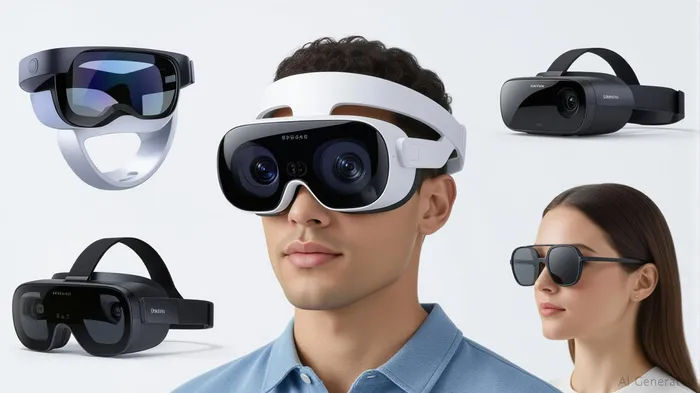 .
.
The company is pivoting to iterative, lower-cost devices, such as a $7-inch “home hub” slated for 2025. However, technical hurdles—like battery life and lightweight displays—remain unresolved. In AI, Apple's internal models, trained on third-party cloud infrastructure, lag behind rivals. Google's Gemini platform, for instance, now powers Samsung's Galaxy S25 Ultra, enabling advanced features like video transcription and AI-driven multitasking—capabilities Apple's Siri has yet to match.
Competitive Threats: Meta, Google, and Samsung's Ascendancy
The stakes are rising as competitors aggressively outflank Apple. Meta's $60–65 billion 2025 AI investment and talent poaching (e.g., Pang's $50 million-plus annual package) signal its ambition to overtake Apple in AI and AR. Its Orion AR glasses (targeting 2027) and existing Ray-Ban smart glasses already undercut Apple's timeline and price point. Google's Android XR OS, meanwhile, enables Samsung's Moohan headset—a mixed-reality device set for 2025 at a fraction of the Vision Pro's cost.
Samsung's Galaxy S25 series, powered by Gemini, has already outpaced Apple in AI features. Its “skinny phone” category, anticipated to precede Apple's iPhone 17 Air, underscores Samsung's agility in capturing trends. These threats are reflected in stock performance: . While Apple's stock has held up, rivals are gaining traction as investors bet on their disruptive potential.
Shareholder Value at Risk: Growth and Margin Pressures
Apple's Q1 2025 revenue is projected to grow 4% to $124 billion, driven by iPhone 16 sales and AI-driven upgrades. Yet margins face pressure as R&D costs rise and competition erodes premium pricing power. The Vision Pro's underperformance—coupled with internal AI team morale issues—adds to risks. If Apple cannot deliver breakthrough AR products or competitive AI features, its long-term growth could stall.
Investment Implications: Caution Amid Transition
Investors should remain cautious. While Apple's ecosystem and brand loyalty provide a moat, its execution in AI/AR is unproven. Key near-term risks include:
1. Leadership Gaps: Can Khan and Cook deliver on AR's technical challenges while managing succession beyond Cook?
2. AI Competitiveness: Will Apple's internal models catch up to Gemini or OpenAI, or will it pivot to partnerships?
3. Market Share Loss: Can Apple retain its premium position against cheaper, feature-rich rivals like Samsung?
For now, investors should demand clear milestones: a viable AR glasses roadmap post-2027, AI features that differentiate iPhones, and a stable leadership pipeline. Until then, Apple's stock—while resilient—faces headwinds from innovation fatigue and external pressures.
Final Take: Apple's future hinges on executing its R&D bets and managing leadership transitions. Until it proves it can innovate as fast as its rivals, investors should temper expectations and prioritize companies with clearer AI/AR pathways—or adopt a wait-and-see stance.
—
Data as of July 2025. Past performance is not indicative of future results.

Delivering real-time insights and analysis on emerging financial trends and market movements.
Latest Articles
Stay ahead of the market.
Get curated U.S. market news, insights and key dates delivered to your inbox.
AInvest
PRO
AInvest
PRO



Comments
No comments yet