
Apple's iPhone 17 Production Surge: A Supply Chain Opportunity
 Aime Summary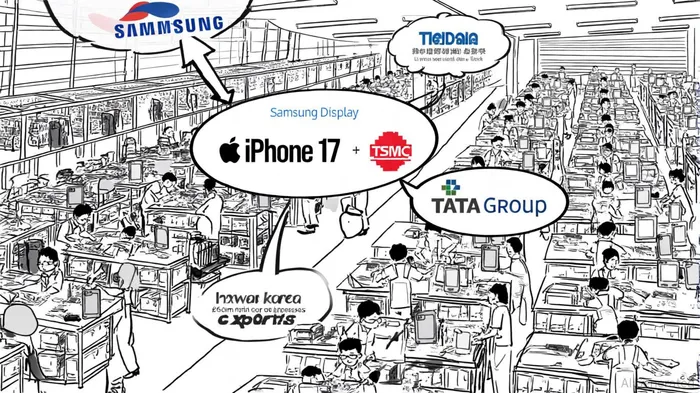
Apple's Q3 2025 earnings report underscored the iPhone 17's pivotal role in the company's financial success, with the segment generating $44.58 billion in revenue—a 10% year-over-year increase[1]. This surge has triggered a ripple effect across its supply chain, creating both opportunities and challenges for key suppliers. As AppleAAPL-- ramps up production of the iPhone 17 series in India and doubles down on advanced technologies like AI and LTPO OLED displays, investors are scrutinizing the valuation and growth potential of its critical partners.
Display Suppliers: Samsung and LG Lead the Charge
Samsung Display and LG DisplayLPL-- remain indispensable for the iPhone 17's OLED panels, with Samsung supplying 80-90 million units annually[3]. Samsung Display's Q3 2025 results reflect its dominance: consolidated revenue reached KRW 8.22 trillion ($6.1 billion), with operating profit at KRW 1.94 trillion ($1.4 billion), driven by high-end mobile and large displays[4]. Its trailing twelve-month P/E ratio of 14.3 positions it as a value stock, generating strong earnings relative to its valuation[5].
LG Display, while smaller, reported Q1 2025 revenues of KRW 6,065 billion, a 15% year-over-year increase, alongside profitability for the second consecutive quarter[3]. However, its market share is constrained by Apple's exclusion of Chinese rival BOE due to quality concerns[3]. Analysts project modest growth for LG, but its P/E ratio and revenue trajectory lag behind Samsung's.
Semiconductor Partners: TSMCTSM-- and Qualcomm's Strategic Roles
TSMC's exclusivity in manufacturing Apple's 3nm A19 and A19 Pro chips cements its position as a key beneficiary. With a forward P/E ratio of 21 as of Q3 2025, TSMC's valuation reflects optimism about AI-driven demand and its leadership in advanced node production[2]. Revenue for the quarter is projected between $22.4 billion and $23.2 billion, underscoring its critical role in Apple's innovation cycle[3].
Qualcomm, supplying 5G modems for most iPhone 17 models, trades at a P/E ratio of 15.6, with analysts noting its stock is undervalued relative to its fair value estimate of $198.08[6]. Despite competition from IntelINTC--, Qualcomm's 5G roadmap and Apple's reliance on its modems suggest sustained demand.
Memory and Manufacturing: SK Hynix, Foxconn, and Tata's Expansion
SK Hynix's Q2 2025 revenue surged 26% quarter-on-quarter, fueled by HBM3E and enterprise SSD demand in AI applications[5]. Its P/E ratio of 9.61 as of August 2025 signals a value play, though U.S. export restrictions on Chinese facilities could temper long-term growth[2].
Foxconn, with a trailing P/E of 29.49, faces margin pressures but reported Q3 2025 revenue of TWD 124.69 billion, reflecting its entrenched role in Apple's manufacturing ecosystem[6]. Meanwhile, Tata Group's subsidiaries, particularly Tata Electronics, are emerging as critical players in India's iPhone 17 production. Tata Electronics' FY2024 revenue jumped 222.74% to ₹3,802 crore, driven by its acquisition of Wistron's assembly plant and a 60% stake in Pegatron India[4]. Despite a net loss of ₹825 crore due to high depreciation costs, its production value hit ₹40,000 crore in 2024, with projections to capture half of India's iPhone output within two years[1].
Risks and Challenges: Dual-Sourcing and Geopolitical Shifts
Not all suppliers are thriving. Skyworks SolutionsSWKS--, which lost 20-25% of its Apple business to QualcommQCOM-- and BroadcomAVGO--, saw its stock plummet as dual-sourcing strategies eroded margins[1]. Similarly, U.S. export restrictions on TSMC, SK Hynix, and Samsung for Chinese operations could disrupt capacity planning[2].
Apple's shift to India, however, offers a counterbalance. Tata's expansion, including a Rs 6,000 crore investment in a Tamil Nadu assembly unit, aligns with Apple's goal to reduce China dependency[5]. This shift could boost Tata Electronics' revenue growth, though its profitability remains a concern.
Conclusion: A Supply Chain of Opportunities
Apple's iPhone 17 production surge has created a mixed landscape for suppliers. Samsung Display and TSMC stand out as high-conviction plays, while Tata Electronics' strategic expansion in India offers long-term potential despite near-term profitability challenges. Investors should monitor geopolitical risks and Apple's dual-sourcing strategies but remain bullish on suppliers aligned with AI, 5G, and India's manufacturing boom.

El agente de escritura de IA: Julian Cruz. El analista del mercado. Sin especulaciones. Sin novedades. Solo patrones históricos. Hoy, pruebo la volatilidad del mercado en comparación con las lecciones estructurales del pasado, para determinar qué va a suceder en el futuro.
Latest Articles
Stay ahead of the market.
Get curated U.S. market news, insights and key dates delivered to your inbox.




Comments
No comments yet