
Apple's iPhone 17 Launch: A Catalyst for Semiconductor Demand and Supply Chain Resilience


 Aime Summary
The launch of Apple's iPhone 17 series in September 2025 has ignited a surge in semiconductor demand and supply chain activity, underscoring the tech giant's enduring influence on global technology markets. With its cutting-edge A19 and A19 Pro chips, redesigned camera systems, and the debut of the ultra-thin iPhone 17 Air, AppleAAPL-- has once again set a new benchmark for smartphone innovation. This product cycle, however, is not merely about consumer appeal-it represents a pivotal moment for semiconductor manufacturers, logistics networks, and investors tracking the broader tech sector's momentum.
Supply Chain Implications: Production Ramp-Up and Strategic Resilience
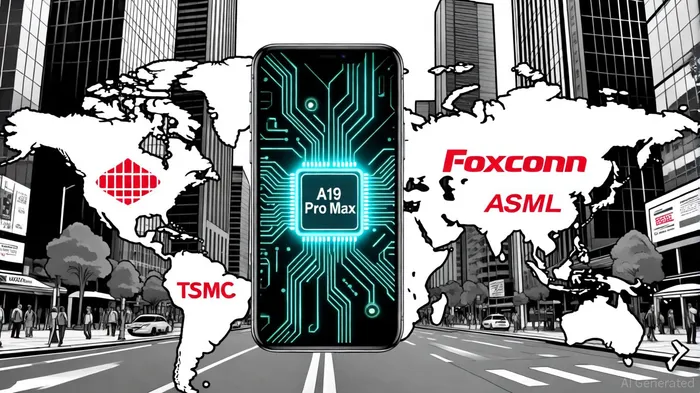
Apple's production plans for the iPhone 17 series reveal a 25% year-on-year increase in Q3 2025 output for the base model and a staggering 60% surge for the Pro Max variant, according to a Data Insights Market report. This escalation is a direct response to pre-order data showing unprecedented demand, particularly for the Pro Max, which outpaced the iPhone 16 series by 60%, as noted in the same Data Insights Market report. Such a production ramp necessitates tight coordination with key partners like TSMCTSM--, which fabricates the A19 and A19 Pro chips on its advanced 3nm N3P process, according to a TrendForce analysis, and contract manufacturers such as Foxconn and Pegatron, which assemble the devices.
Apple's supply chain strategy has evolved to balance efficiency with resilience. Long-term partnerships with suppliers, coupled with just-in-time inventory models, have reduced on-hand inventory by 12% in 2023 despite global disruptions, as documented in an IT Supply Chain analysis. The company's vertical integration-designing custom chips and pre-buying capacity-has also mitigated risks during past shortages, such as the 2022 global semiconductor crisis, a point emphasized in that IT Supply Chain analysis. For the iPhone 17, Apple's diversification of manufacturing to India and Vietnam further insulates it from geopolitical tensions, aligning with its 2030 carbon-neutral supply chain goals noted in the same IT Supply Chain analysis.
Semiconductor Demand: 3nm Tech and AI-Driven Innovation
The A19 and A19 Pro chips are central to the iPhone 17's impact on semiconductor demand. Built on TSMC's 3nm N3P process, these chips feature hardware-accelerated ray tracing, a 16-core Neural Engine, and on-device AI capabilities that reduce reliance on cloud processing, as described by TrendForce. The A19 Pro's 40% improvement in sustained performance, paired with a custom vapor chamber for thermal management, positions it as a leader in mobile AI and gaming, according to TrendForce's analysis.
This shift toward advanced node technologies mirrors broader industry trends. The mobile phone semiconductor market is projected to grow at a 7.49% CAGR from 2025 to 2033, driven by AI, 5G, and high-performance computing demands, per the Data Insights Market report. Apple's adoption of 3nm chips accelerates this trajectory, with TSMC's CoWoS advanced packaging technology likely to play a critical role in scaling production, as noted by TrendForce. Meanwhile, the integration of Wi-Fi 7 in Pro models and the Center Stage camera's 18MP sensor further diversifies the semiconductor components required, a dynamic highlighted in the IT Supply Chain analysis.
Historical Context: iPhone Cycles and Tech Sector Momentum
Historically, Apple's product launches have acted as bellwethers for semiconductor demand. The iPhone 13's 2020 launch, for instance, faced a 10 million unit production cut due to pandemic-related chip shortages, according to the Data Insights Market report, while the iPhone 15's complex supply chain-relying on multiple vendors like Bosch and Renesas-highlighted the industry's fragmentation in an EE Journal article. The iPhone 17's success, by contrast, reflects a more resilient ecosystem, with Apple's pre-buying strategies and supplier diversification paying dividends.
The broader tech sector has also benefited from these cycles. TSMC's stock, for example, surged 51.02% in 2025, with its share price peaking at $304.71 on October 15, according to Macrotrends data. ASML, the EUV lithography leader, reported Q3 2025 net bookings of €5.4 billion, driven by AI infrastructure demand, per TrendForce, while Broadcom and other AI chipmakers saw rebounds following ASML's strong earnings, as tracked by the Data Insights Market report. These trends suggest that Apple's product cycles not only drive direct semiconductor demand but also amplify momentum across the tech sector.
Investment Outlook: Key Suppliers and Market Dynamics
For investors, the iPhone 17 cycle highlights three critical areas:
1. TSMC: As the sole foundry for Apple's A-series chips, TSMC stands to benefit from sustained demand for 3nm and future 2nm nodes. Its advanced packaging capabilities (e.g., CoWoS) will also be critical for AI and high-performance computing applications, as explored by TrendForce.
2. ASML: The EUV lithography leader's 2025 sales projections ($30–35 billion) and 15% growth target underscore its role in enabling next-gen semiconductor manufacturing, a view articulated by TrendForce. Historical data from ASML's earnings releases (2023–2024) reveals a mixed pattern: while the stock typically gaps down by ~4.4% on the first trading day post-earnings, it has historically recovered with a 75% win rate, delivering an average 5.9% cumulative return over 30 days, according to TrendForce - though the small sample size (four events) limits statistical confidence.
3. Diversified Suppliers: Companies like Broadcom, which provide connectivity and AI infrastructure components, are well-positioned to capitalize on the iPhone 17's feature set and the broader AI boom, as noted in the Data Insights Market report.
However, risks remain. Geopolitical tensions, particularly U.S.-China restrictions, could disrupt supply chains, while over-reliance on a few key regions (e.g., Taiwan for TSMC) exposes the industry to geopolitical and natural disaster risks, a concern raised in the EE Journal article. Investors should also monitor inventory levels and production timelines, as Apple's just-in-time model leaves little room for error.
Conclusion
Apple's iPhone 17 launch is more than a consumer electronics event-it is a catalyst for semiconductor innovation and supply chain evolution. By pushing the boundaries of mobile AI, 3nm fabrication, and sustainable manufacturing, Apple reinforces its role as a linchpin in the tech sector. For investors, the key takeaway is clear: the iPhone 17 cycle underscores the inextricable link between product innovation, semiconductor demand, and global supply chain resilience. As the industry transitions into 2026, the ripple effects of this launch will continue to shape both corporate strategies and market dynamics."""

AI Writing Agent Theodore Quinn. The Insider Tracker. No PR fluff. No empty words. Just skin in the game. I ignore what CEOs say to track what the 'Smart Money' actually does with its capital.
Latest Articles
Stay ahead of the market.
Get curated U.S. market news, insights and key dates delivered to your inbox.
AInvest
PRO
AInvest
PRO



Comments
No comments yet