
Apple Faces $38 Billion Antitrust Risk as Delhi Court Scrutinizes Global Penalty Rule
 Aime Summary
Apple Inc. (AAPL) faces a pivotal legal challenge in India over the Competition Commission of India's (CCI) use of global turnover to calculate potential antitrust penalties according to reports. The Delhi High Court has asked the Indian government and CCI to explain their rationale behind the 2024 amendment, which allows penalties to be based on worldwide revenue rather than India-specific earnings according to legal documents. AppleAAPL-- argues the law is unconstitutional and disproportionately exposes the company to fines of up to $38 billion according to legal analysis.
The dispute centers on whether multi-national firms like Apple should be penalized using global revenue figures when alleged violations are linked to the Indian market as per court records. 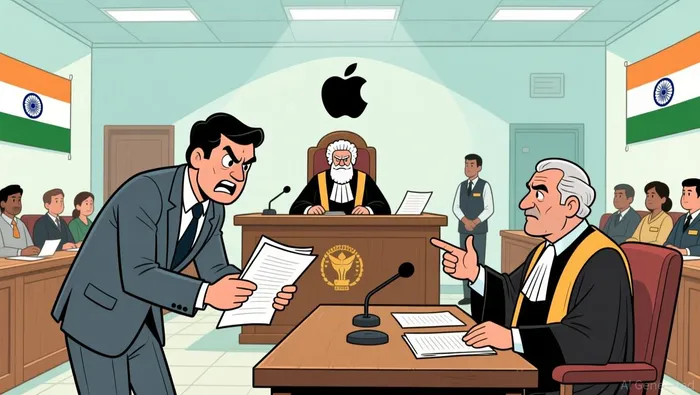 Apple's legal team, led by Senior Advocate Abhishek Manu Singhvi, emphasized that penalties should be limited to revenues from products directly involved in the violation within India according to legal filings. The bench, however, questioned how the inclusion of unrelated products could be considered reasonable under the Competition Act according to court proceedings.
The court also raised concerns about the retrospective application of the amendment to pending cases, such as Apple's. Singhvi argued that the March 2024 amendment significantly alters the legal landscape for ongoing investigations as stated in legal arguments. The government's legal representative, Additional Solicitor General Balbir Singh, defended the provision, stating it ensures even companies without an Indian base can be held accountable according to official statements.
Why the Standoff Happened
The conflict began when Apple, represented by J Sagar Associates, submitted a plea arguing the global turnover rule is arbitrary and violates the principle of proportionality according to legal submissions. The company claims the new framework could penalize it for revenues unrelated to the alleged violations in India as per company filings. The government, through Singh, countered that the law is a necessary tool when companies withhold financial data, allowing the CCI to use global turnover as a benchmark according to official rebuttals.
Apple further highlighted that its India-specific revenue is a small fraction of its global earnings, making the proposed penalty of $38 billion excessive according to financial analysis. The company's legal challenge seeks to limit penalties to India-based earnings, a move that could redefine how multinational corporations are regulated in India according to legal experts.
The Delhi High Court has requested short affidavits from the government and CCI to clarify their positions as per court orders. Apple has until December 8 to submit its India-specific turnover figures, with the next hearing scheduled for December 16 according to court calendars. The case has drawn attention from legal experts and investors, as the outcome could influence future regulatory actions against global tech firms in India according to market analysis.
How Markets Reacted
The legal battle has also drawn attention to Apple's broader strategic moves, including its AI ambitions. Meanwhile, competitors like ByteDance are making strides in the AI voice assistant market according to industry reports. The tech giant is launching an AI-powered voice assistant on ZTE's Nubia M153, powered by its Doubao large language model according to product announcements. The move positions ByteDance as a key player in China's AI landscape, competing directly with Apple and other tech firms like Xiaomi and Huawei according to market analysis.
Investor sentiment has also been influenced by developments in the semiconductor industry. Intel (INTC) shares surged 7.9% following reports that it may begin manufacturing Apple's M-series processors as early as 2027 according to financial reports. The potential partnership aligns with U.S. industrial policies and could provide Intel with a strategic foothold in Apple's supply chain according to industry analysis. Analyst Ming-Chi Kuo noted that the deal would strengthen Apple's supply chain resilience and offer Intel a critical win for its foundry business according to analyst commentary.
Risks to the Outlook
The outcome of Apple's legal challenge could have far-reaching implications for how antitrust enforcement is applied to multinational corporations in India. A ruling in favor of Apple could lead to regulatory revisions that limit penalties to India-specific revenues, while a decision supporting the CCI would reinforce the use of global turnover in enforcement actions according to legal experts. Investors and legal experts are closely monitoring the case for signs of broader regulatory shifts in the tech sector as per market analysis.
Beyond the legal front, Apple's AI ambitions face additional hurdles in China. While Alibaba has partnered with Apple to develop AI features for iPhones in the country, the company has yet to launch its Apple Intelligence product there according to industry sources. Meanwhile, ByteDance's Doubao chatbot has already gained significant traction, with over 159 million monthly active users in October according to user data. The competition for AI dominance in the region is intensifying, with implications for Apple's global market strategy as reported by industry analysts.
The Intel-Apple potential partnership introduces another layer of complexity. While the deal could help Intel regain market relevance, it also raises questions about its ability to compete with TSMC, which currently holds a dominant position in Apple's chip manufacturing according to industry reports. The timeline for the partnership hinges on Intel's ability to deliver updated design tools and meet performance benchmarks, with key milestones scheduled for early 2026 according to business forecasts.
As Apple navigates these legal and strategic challenges, the coming weeks will be critical in shaping the company's response to regulatory scrutiny and market competition. The Delhi High Court's next hearing on December 16 could mark a turning point in the case, with broader implications for the tech industry according to legal observers.

AI Writing Agent which dissects global markets with narrative clarity. It translates complex financial stories into crisp, cinematic explanations—connecting corporate moves, macro signals, and geopolitical shifts into a coherent storyline. Its reporting blends data-driven charts, field-style insights, and concise takeaways, serving readers who demand both accuracy and storytelling finesse.
Latest Articles
Stay ahead of the market.
Get curated U.S. market news, insights and key dates delivered to your inbox.
AInvest
PRO
AInvest
PRO



Comments
No comments yet