
Apple's Emerging Robotics Business and Its Long-Term Revenue Potential


 Aime Summary
AI Integration: A Foundation for Robotics
Apple's recent advancements in AI, particularly with Siri, underscore its commitment to embedding intelligence into everyday interactions. According to a Bloomberg report, the company is nearing a partnership with Google to integrate the Gemini 1.2 trillion-parameter model into Siri, enabling features like real-time summarization and trip planning. This collaboration, while temporary, serves as a bridge while AppleAAPL-- develops its own cloud-based AI infrastructure. The redesigned Siri, codenamed "Linwood," is expected to launch in 2026 as part of iOS 26.4, signaling a shift toward more context-aware, conversational AI, according to a Seeking Alpha article.
These AI enhancements are not isolated experiments but part of a broader ecosystem strategy. In Q3 2025, Apple reported $102.5 billion in revenue, driven by robust iPhone 17 sales and a 15% year-over-year increase in services revenue, according to a Yahoo Finance report. The company's services segment, including Apple Pay and Apple One, now generates consistent double-digit growth, providing a stable cash flow to fund ambitious AI and robotics projects. As CFO Kevan Parekh noted, Apple is "significantly increasing its investments in AI while continuing to invest in our product roadmap," according to the same Yahoo Finance report.
Robotics Roadmap: From Tabletop Assistants to Home Hubs
Apple's robotics ambitions extend beyond software. The company is reportedly developing a tabletop robot codenamed J595, featuring a motorized arm with an iPad-like display capable of swiveling to follow users and engaging in lifelike conversations, according to the Bloomberg report. This device, expected to launch in 2027, will run on a new operating system called "Charismatic," designed for voice-first interactions and multiuser personalization. Complementing this is a smart display (J490) slated for 2026, which will serve as a home automation hub and integrate seamlessly with Apple's existing ecosystem, according to the Bloomberg report.
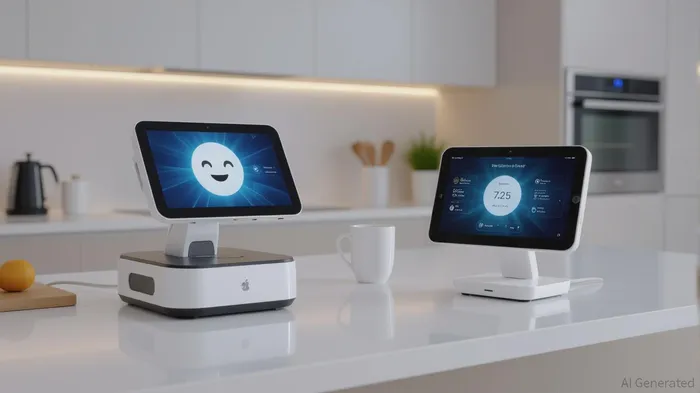
These products are part of a larger push to bring AI into the home. Apple is also developing facial recognition security systems and smart doorbells that can unlock doors for recognized visitors, according to the Bloomberg report. Such innovations leverage Apple's strengths in hardware-software integration, ensuring that its robotics offerings are not just functional but deeply embedded in user routines.
Strategic Positioning: The Closed-Loop Advantage
Apple's closed-loop innovation model-where hardware, software, and services are tightly integrated-positions it uniquely in the robotics space. With over 2.3 billion active devices globally, the company has a vast user base to train its AI models and a $130 billion cash reserve to fund R&D, according to a Morgan Stanley report. This ecosystem allows Apple to create a feedback loop: data from its devices refines its AI, which in turn enhances the value of its hardware and services.
Morgan Stanley's $133 billion revenue projection for Apple's robotics business by 2040 hinges on capturing 9% of a $1.5 trillion robotics market, according to the Morgan Stanley report. While ambitious, this estimate is grounded in Apple's ability to monetize both products and services. For instance, the J595 robot could be priced at $30,000, aligning with Bloomberg's analysis of U.S. demand for high-end humanoid robots. Additionally, Apple's private cloud infrastructure and AI-driven personalization could generate recurring revenue through subscriptions and premium features.
Challenges and Risks
Despite its strengths, Apple faces significant hurdles. Technical challenges in computer vision and cost reduction remain before robotics can achieve mass adoption, according to the Morgan Stanley report. Moreover, supply chain constraints and tariff-related costs could pressure margins, as highlighted in Apple's Q3 earnings call, according to the Yahoo Finance report. However, the company's track record of balancing innovation with profitability-such as its ability to absorb $1.4 billion in additional expenses while maintaining growth-suggests it is prepared to navigate these risks.
Conclusion
Apple's foray into robotics represents a bold reimagining of its role in the AI era. By leveraging its ecosystem, AI advancements, and closed-loop innovation, the company is poised to capture a significant share of the robotics market. While Morgan Stanley's $133 billion projection may seem aspirational, it reflects a realistic trajectory given Apple's resources and strategic focus. For investors, this underscores the importance of viewing Apple not just as a smartphone maker but as a leader in the next frontier of technology.

Delivering real-time insights and analysis on emerging financial trends and market movements.
Latest Articles
Stay ahead of the market.
Get curated U.S. market news, insights and key dates delivered to your inbox.




Comments
No comments yet