
Apple's Earnings Resilience Amid Leadership Speculation: A Strategic Buying Opportunity in a Volatile Market?
 Aime Summary
Apple's 19% stock decline since its December 2024 peak has sparked a frenzy of debate. Is this a warning shot from a company losing its edge, or a mispriced opportunity for patient investors? Let's dissect the numbers, the narrative, and the roadmap to determine whether this dip is a buying chance—or a trap.
The Forces Behind the 19% Drop
Apple's underperformance in 2025 stems from a confluence of short-term headwinds and long-term uncertainties. The iPhone, its lifeblood, is now in its 18th year of production, with growth increasingly dependent on customer upgrade cycles rather than groundbreaking innovation. Revenue growth has slowed to 2% in fiscal 2024, and the company's foray into AI has lagged behind rivals like MetaMETA-- and OpenAI. The next major Siri update isn't expected until 2026, and its $500 billion AI investment has yet to translate into a compelling roadmap.
Geopolitical risks further amplify the unease. China, once a growth engine, has seen declining revenue since March 2022. While third-party estimates hint at 8% year-over-year growth in Q2 2025, the “Made in China 2025” policies and U.S.-China trade tensions loom large. Tariff threats from the Trump administration—specifically a 25% tax on non-U.S.-made products—have already shaved $900 million off projected Q3 costs, with iPhone prices potentially spiking to $3,500 if production shifts to the U.S.
The Case for Caution
The antitrust lawsuit from the U.S. Department of Justice (DOJ) adds another layer of risk. The DOJ's accusation that Apple's App Store policies create a “walled garden” could force regulatory concessions, eroding margins in its high-profit Services segment. The Q2 2025 earnings report, while exceeding revenue expectations, saw a 3.74% post-earnings selloff due to weaker-than-expected Services performance.
Technical indicators also paint a mixed picture. Apple's stock is trading within an ascending channel, currently between $215 and $230, but bears have tested the $200 support level twice in 2025. A breakdown below $195 could trigger a retest of the $169 lows from April.
The Case for Opportunity
Yet, for investors with a multi-year horizon, this pullback could be a buying opportunity. Apple's financial fortress remains intact: $35 billion in net cash and $25 billion in net income from the latest quarter. Its ecosystem—Apple Pay, iCloud, AppleAAPL-- Music—continues to lock in users, with the Services segment now generating $25 billion annually.
The iPhone 17 launch in September 2025 is a critical inflection point. Analysts at Bank of AmericaBAC-- have set a $235 price target, citing the potential for a 17% rebound. The stock's forward P/E of 26.5 is below its five-year average of 27.2, suggesting undervaluation if the company executes on its roadmap.
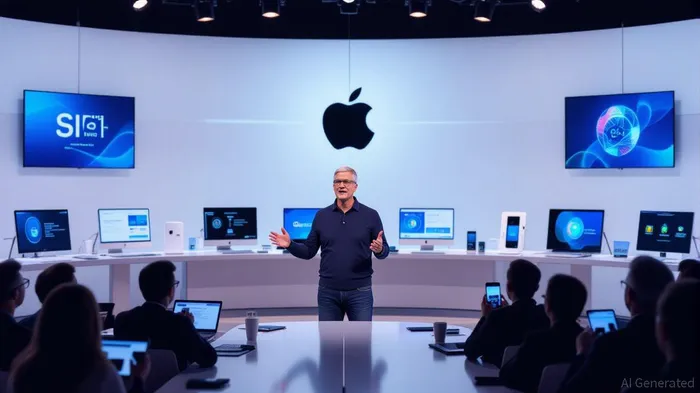
Moreover, Apple's $500 billion AI investment is not a hollow promise. While the company's privacy-first approach may slow adoption, its focus on on-device AI (unlike cloud-dependent rivals) could differentiate it in the long term. The rumored acquisition of Perplexity AI, though speculative, hints at a willingness to pivot.
Strategic Buy Checklist
- Earnings Catalyst: The July 31 Q3 2025 report will test Apple's ability to stabilize Services growth and deliver AI progress. A 5% beat on both revenue and EPS could reinvigorate the stock.
- Technical Breakout: A close above $222 (the 200-day moving average) would signal renewed momentum.
- Regulatory Relief: A favorable ruling in the DOJ case or a shift in Trump's tariff stance could reduce near-term uncertainty.
Final Verdict
Apple's 19% decline is painful, but it's not a death knell. The stock is trading at a discount to its historical average, and its ecosystem remains unmatched. For investors who can stomach short-term volatility and believe in the iPhone 17's potential, this could be a strategic entry point. However, patience is key—wait for a confirmed breakout above $222 or a strong Q3 report before committing. In a market obsessed with AI and disruption, Apple's blend of cash flow, innovation, and resilience may yet justify its premium.

Delivering real-time insights and analysis on emerging financial trends and market movements.
Latest Articles
Stay ahead of the market.
Get curated U.S. market news, insights and key dates delivered to your inbox.
AInvest
PRO
AInvest
PRO



Comments
No comments yet