
Apple's China Strategy: Navigating Tensions While Fueling Growth
 Aime Summary
Apple continues to reduce its App Store commission in China as part of regulatory concessions, with fees now at 25% instead of 30%.
The company's China smartphone sales surged 23% in early 2026, bucking the 4% decline seen across the broader market.
Apple CEO Tim Cook emphasized collaboration with Chinese partners on innovation and green development during a recent visit.
Despite tensions, 80 of Apple's top 100 suppliers still operate in China, highlighting its critical role in the global supply chain.
Apple is also navigating antitrust investigations and pressure to open up its ecosystem further in the region.
Apple's relationship with China remains a double-edged sword—offering massive growth potential while also presenting regulatory and geopolitical risks. The recent 23% jump in smartphone sales in China during the first nine weeks of 2026 shows that the company's strategy of price discipline and selective concessions is working. But AppleAAPL-- is also facing increasing pressure from Beijing to open up its App Store to third-party payment systems and alternative app distribution methods. Tim Cook's recent visit to China included meetings with high-level officials and a keynote speech at the China Development Forum, where he highlighted shared goals in green development and innovation.
What Is Apple Doing to Reduce Friction in the Chinese Market?
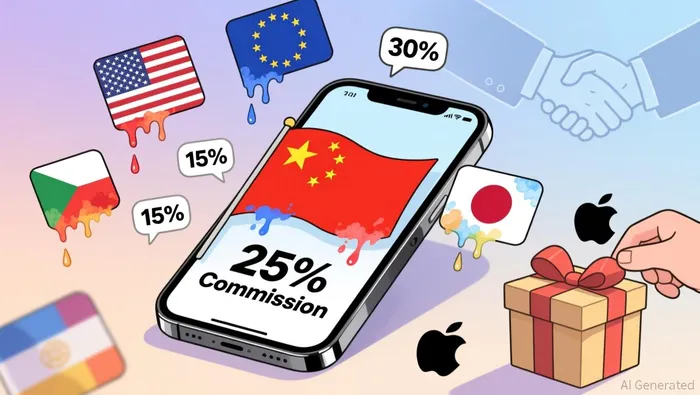
Apple has taken a series of measures to de-escalate tensions and secure its foothold in one of the world's largest tech markets. In early 2026, the company cut its App Store commission from 30% to 25%, a move widely seen as a response to regulatory pressure from Chinese authorities. This concession was particularly impactful for smaller developers and mini-app partners.
At the same time, Apple has diversified its supply chain by shifting some manufacturing to Vietnam and India. But these moves have not diminished the company's reliance on Chinese infrastructure. During a meeting with China's Commerce Minister Wang Wentao, Cook reiterated that China remains the most important production base for Apple and a critical part of its global supply chain.
How Is Apple's China Strategy Affecting Its Financial Performance?
Apple's ability to maintain pricing discipline in China has been a key differentiator in a challenging market. While rising memory chip costs forced many Android manufacturers to raise prices, Apple leveraged long-term contracts with suppliers to absorb the cost and keep iPhone 17 prices stable. This strategy helped the company gain market share during a period of broader industry decline. In the holiday quarter of 2025, Apple's China revenue jumped 38% to $25.5 billion.
Beyond pricing, Apple has also benefited from state subsidies on the base iPhone 17 model, making it more competitive against rivals. These tactics, combined with strategic marketing and e-commerce partnerships, have allowed Apple to continue outperforming the market in China despite increasing regulatory scrutiny and supply chain pressures.
What Risks Should Investors Watch in Apple's China Exposure?
While Apple is succeeding in China, the regulatory environment remains unpredictable. The People's Daily has continued to criticize the App Store for "monopolistic" practices, even after Apple's concessions. This suggests that Beijing may continue to push for more openness in Apple's platform, which could impact the company's revenue model.
In addition, geopolitical tensions and supply chain shifts pose longer-term risks. Chinese Premier Li Qiang has warned against politicizing industrial issues or weaponizing supply chains, but such rhetoric could still influence policies affecting Apple's operations. The company is also navigating an antitrust investigation by the State Administration for Market Regulation, and any unfavorable outcome could lead to fines or operational restrictions.
Despite these challenges, Apple's recent performance in China demonstrates its ability to adapt to a complex and dynamic market. The key for investors will be to monitor how the company continues to balance profitability with regulatory compliance, and how its strategic concessions in China impact its global brand and ecosystem.

Stay ahead of the market.
Get curated U.S. market news, insights and key dates delivered to your inbox.
AInvest
PRO
AInvest
PRO



Comments
No comments yet