
Here Are What You Need To Know About Apple's 'Awe Dropping' Event


 Aime Summary
Apple's "awe dropping" event will be held at 1 pm EST, during which several products, including the new generation iPhone series, the new AppleAAPL-- Watch, and AirPods 3, are expected to be officially unveiled to consumers.
In the view of many analysts, considering that Apple has already fallen behind in the field of generative artificial intelligence, and that the new iOS 26 operating system unveiled in June this year also lacked major AI-related upgrades, it is very likely that the company will continue to focus on hardware transformation in the future to lock customers into its product ecosystem. Tonight's product launch event is seen as a reflection of this approach.
The "Awkward" Debut of iPhone 17 Air
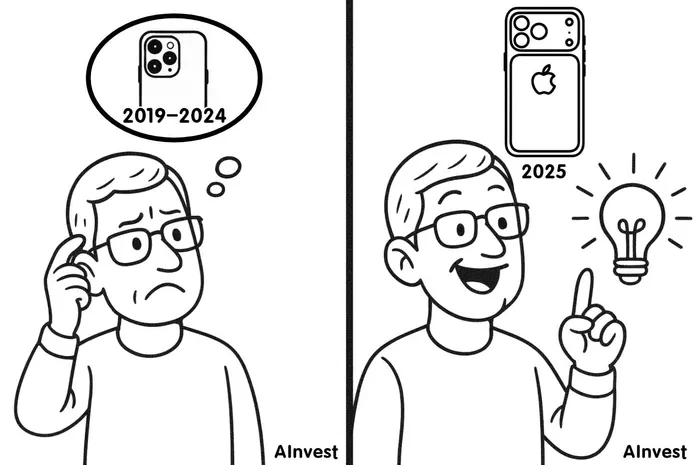
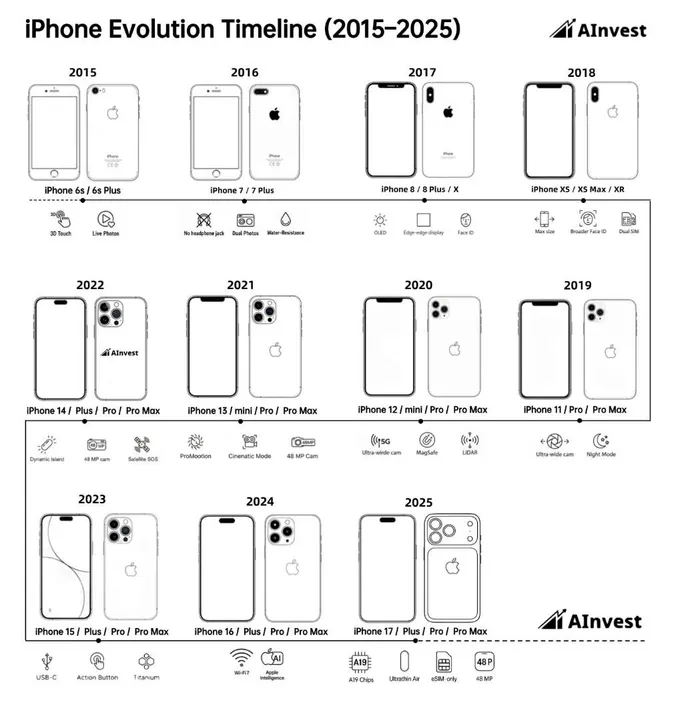
For example, the brand-new iPhone series is believed to be receiving its first major design upgrade in five years: the latest high-end models, iPhone 17 Pro and Pro Max, will feature a new back design that brings a fresh look to the camera area. Meanwhile, the all-new "iPhone 17 Air" will come with an ultra-thin body.
The name follows the branding convention used by the MacBook and iPad. The Air is about 5.5 millimeters thick, roughly one-third thinner than the iPhone 16 Pro, making the reduction in thickness quite noticeable. The iPhone 17 Air will use the same A19 processor as the iPhone 17. It will also feature a standard USB-C port, support ProMotion technology, and include a 6.6-inch display.
However, the thinner body also brings drawbacks: compared to other models in the iPhone 17 series, the 17 Air has shorter battery life, only a single rear camera, and its ultra-thin frame cannot support a physical SIM card, meaning users will need to adopt eSIM. In terms of internal hardware, the 17 Air is also forced to use a lower-grade Wi-Fi chip and the self-developed C1 modem previously used in the iPhone 16e—many believe this modem is significantly inferior to Qualcomm's.
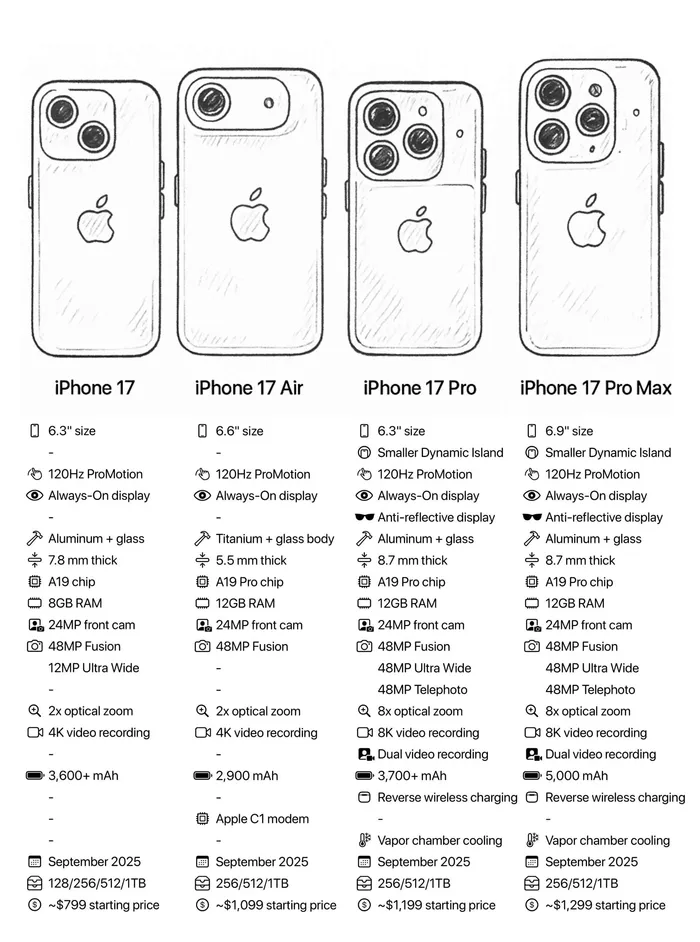
The iPhone 17 Pro and Pro Max are likely to remain the most popular and practical models in the new series. Apple has redesigned the Pro models for the first time since 2020: the back of the phone will present a different look, including a new camera area spanning the top one-third of the device and a new opening area in the bottom two-thirds, which doubles as a wireless charging zone.
As with previous iPhone Pro upgrades, the 17 series high-end models will upgrade to the A19 Pro processor, with significant improvements in battery life and major enhancements in video recording. The telephoto lens will be upgraded from a 12-megapixel sensor to a 48-megapixel component. Other camera upgrades include a new variable aperture system, simultaneous front-and-rear video recording, and the largest selfie camera upgrade to date.
It is worth noting that after switching the high-end iPhone 15 models to titanium in 2023, Apple is returning to aluminum frames this year. Aluminum is lighter and has much better heat dissipation efficiency, which will be a welcome change for users accustomed to the 15 Pro or 16 Pro.
The standard iPhone 17 will not be redesigned, but it will adopt a slightly larger screen to match the 6.3-inch size of the iPhone 16 Pro and 17 Pro. Other changes include a new chip and the addition of a ProMotion display—marking the first time non-Pro iPhones will feature this configuration. The regular iPhone 17 and Pro models will continue to use QualcommQCOM-- modems.
In terms of price, most outsiders currently predict that Apple may cancel the 128GB version of the iPhone Pro, making the $1,099 of the 256GB version the entry-level iPhone 17 Pro. The iPhone 17 Air is expected to start at $999 for the 256GB model, which is $100 higher than the iPhone 16 Plus model it replaces.
The iPhone is Apple's biggest profit driver, with annual sales typically accounting for half of Apple's total yearly revenue. The company also hopes it will remain competitive in the AI era—the device is the core of Apple's services business and the key reason why people purchase add-ons like Apple Watch, AirPods, and protective cases. At a time when AI-driven devices may disrupt the industry, the company wants to maintain this highly profitable ecosystem.
After the "small phone" models represented by the mini encountered poor sales in previous years, Apple shifted toward "large models," launching the iPhone 14 Plus, 15 Plus, and 16 Plus. Now, after confirming that even oversized low-end phones cannot become bestsellers, the company has chosen "thinness and lightness"—introducing the lighter and thinner but large-screen iPhone Air as a companion to the standard iPhone.
However, according to Mark Gurman, a longtime expert on Apple's product dynamics, this product design may actually put the iPhone Air in an awkward position: since spending just a few hundred dollars more gets you a far superior phone with significant upgrades in camera, battery life, and performance, consumers' demand for longer battery life and better cameras may ultimately make the Air series quite "niche."
Limited Upgrades for Apple Watch
Apple Watch is also expected to release new versions: after pausing the Apple Watch Ultra update last year, Apple is preparing a major upgrade for the product this year. The new Apple Watch Ultra 3 will feature a display size matching last year's Apple Watch Series 10, as well as a new S11 chip, 5G RedCap connectivity via a new modem, and support for Apple's satellite functions for messaging and emergency communication. Apple hopes to capture market share from Garmin—which launched new wearable devices earlier this week—and this new model may help achieve that goal.
However, for the new Apple Watch Series 11 and Apple Watch SE, the upgrades may be limited: this year's Series 11 will likely retain the same appearance as the Series 10, with only adjustments to maximum display brightness, case colors, and band options; while the new Apple Watch SE will most likely only replace its chip.
AirPods Pro 3
Apple plans to release AirPods Pro 3 as early as this month, marking the first update to the product in three years. This upgrade will include the addition of a heart rate monitor, matching the Powerbeats launched earlier this year.
The new model will include a significantly smaller "upgraded" charging case, along with a new pairing mechanism, consistent with changes made to the low-end AirPods 4 series last year. At the same time, Apple is reportedly planning an important new feature for the AirPods series: a real-time translation function. This feature, to be added to iPhone and iPad through Apple Intelligence in iOS 26 and iPadOS 26, will allow AirPods to translate conversations in real time.
Other Upcoming Products (Not Necessarily in This Event)
- AirTag 2: Apple has been preparing the first hardware update to its location accessory AirTag since its debut in 2021. The new version will feature an updated wireless chip and improved positioning functionality for greater accuracy and range.
- iPad Pro: A new iPad Pro is under development and is set to become one of Apple's first devices equipped with the M5 chip. Given that last year's M4 model underwent major design and display changes, this follow-up version will feature lighter improvements apart from a stronger engine. One new feature will be a second front camera—placed on the portrait side. Although the market had previously expected the new iPad Pro to launch as early as October or November, recent rumors suggest it may also debut alongside the iPhone 17 series tonight.
- Vision Pro: Apple is preparing the first hardware update to Vision Pro, but this update is relatively minor: the chip will be upgraded from M2 to a newer model (both M4 and M5 have been tested). The company is also considering launching a Deep Space Black version. Over the next two years, Apple plans to release cheaper, lighter models as well as smart glasses.
- Health Monitoring: Although the long-planned "blood pressure detection" feature has encountered regulatory issues and development challenges, this has not changed Apple's attempts in related services—the company plans to launch a paid Health+ service next year, which will include an AI health assistant.
How Will Apple's Stock Perform?
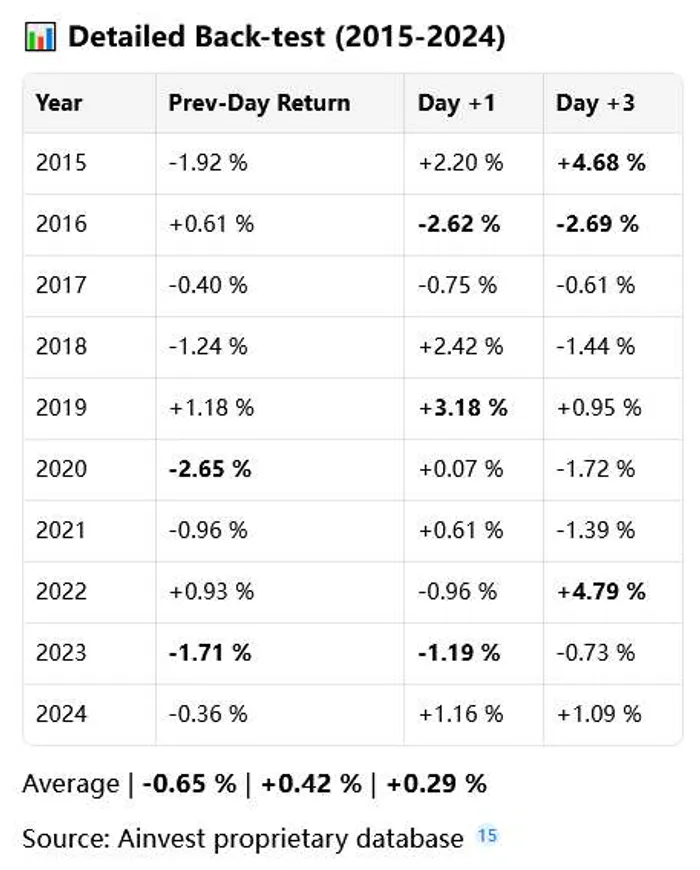
Historically, Apple's stock has shown mixed reactions to iPhone launch events. In the run-up to a new release, shares often climb, but on the actual announcement day, the stock tends to underperform the broader market or slip slightly. This reflects the classic "buy the rumor, sell the news" dynamic, where expectations are priced in well before major announcements—even positive ones.
That said, iPhone launches frequently act as catalysts for longer-term gains once the initial dip subsides. This pattern highlights a key distinction: short-term traders may face volatility around launch dates, while long-term investors often benefit as successful updates and new products fuel sustained growth.

Stay ahead of the market.
Get curated U.S. market news, insights and key dates delivered to your inbox.
AInvest
PRO
AInvest
PRO



Comments
No comments yet