
Apple's AI Strategy Evolves: Subramanya's Leadership and Intel Pact Signal New Era


 Aime Summary
Apple Inc. (AAPL) has undergone a significant leadership shift in its artificial intelligence (AI) division, appointing Amar Subramanya as vice president of AI and announcing the impending retirement of John Giannandrea, its senior vice president for Machine Learning and AI Strategy. Subramanya, a 16-year Google veteran who helped develop the Gemini AI assistant and previously served as Microsoft's corporate vice president of AI, will report directly to Craig Federighi, Apple's senior vice president of Software Engineering. Tim Cook, Apple's CEO, emphasized the strategic importance of Subramanya's expertise, stating, "AI has long been central to Apple's strategy," and highlighted Federighi's role in advancing personalized AI features like the upcoming Siri overhaul. Giannandrea, who has led Apple's AI efforts for seven years, will transition to an advisor role before retiring in early 2026 according to reports.
The leadership change underscores Apple's accelerating focus on AI integration across its product ecosystem, particularly as competitors like Google and Microsoft expand their AI offerings. 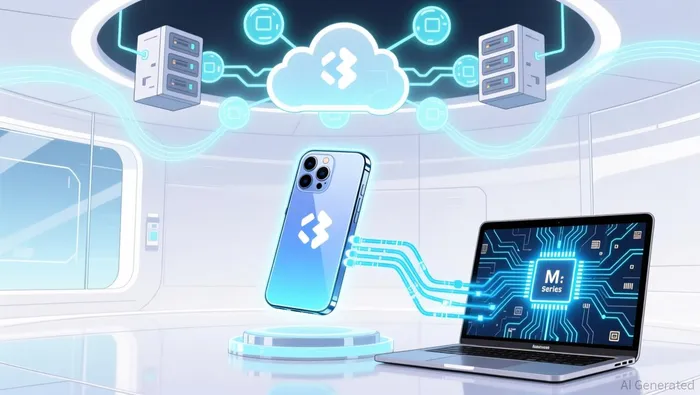 Subramanya's background in large-scale AI development-spanning Google's Gemini project and Microsoft's corporate initiatives-positions him to bridge Apple's hardware-software synergy with advanced machine learning capabilities. Meanwhile, Giannandrea's departure signals a potential reorientation of Apple's AI strategy, though the company remains tight-lipped about specific future plans.
In parallel, Apple's broader supply chain dynamics are shifting as it diversifies chip manufacturing partnerships. Intel (INTC) is reportedly in advanced talks to produce Apple's lower-end M-series processors, a move that could bolster the chipmaker's foundry business while aligning with U.S. "Made in USA" industrial policies. Analyst Ming-Chi Kuo noted that AppleAAPL-- has signed a non-disclosure agreement with Intel and is progressing with simulations for its 18AP advanced-node process. If finalized, Intel could begin manufacturing Apple's M-series chips for MacBook Air and iPad Pro devices as early as mid-2027 according to financial reports. While the initial order volume (15–20 million units annually) is modest compared to Apple's current reliance on TSMC, the partnership would provide Apple with a second chip supplier, enhancing supply chain resilience. For Intel, the deal represents a critical opportunity to regain relevance in advanced-node manufacturing, despite its current technological gap relative to TSMC as analysts point out.
The strategic alignment between Apple and Intel also reflects broader industry trends. Arm Holdings' power-efficient chip architecture, which underpins Apple's M-series chips, continues to gain traction in AI and IoT applications. As AI models proliferate across edge devices and cloud infrastructure, Arm's design philosophy of balancing performance with energy efficiency becomes increasingly valuable. Apple's reliance on Arm-based chips underscores its commitment to optimizing AI workloads for both high-end and low-power devices.
Market reactions to these developments have been mixed. Intel's stock surged 7–10% following reports of the potential partnership, while AI-focused stocks like NVIDIA and Oracle saw declines amid broader sector volatility according to market analysis. Analysts remain divided on Apple's AI trajectory, with some emphasizing its long-term potential and others cautioning about execution risks.

Stay ahead of the market.
Get curated U.S. market news, insights and key dates delivered to your inbox.




Comments
No comments yet