
Apple's AI-Driven Turnaround: Is the Stock Still Undervalued Amid the Selloff?
 Aime Summary
Apple Inc. (NASDAQ:AAPL) has long been a bellwether for tech-sector innovation and investor sentiment. As the company navigates the AI revolution, its strategic bets and valuation dynamics are under intense scrutiny. With a recent selloff sparking debates about overvaluation, the question looms: Is Apple's stock still a compelling buy amid its AI-driven transformation?
Strategic Positioning in the AI Era
Apple's 2025 strategic investments underscore its commitment to cementing a leadership role in artificial intelligence. The company announced a $500 billion U.S. investment over four years, with a significant portion allocated to AI and silicon engineering. This includes a new server manufacturing facility in Houston, Texas, designed to power Apple Intelligence, a personal AI system aimed at enhancing user productivity and creativity. These servers also form the backbone of Private Cloud Compute, a platform combining AI processing with Apple's signature security features.
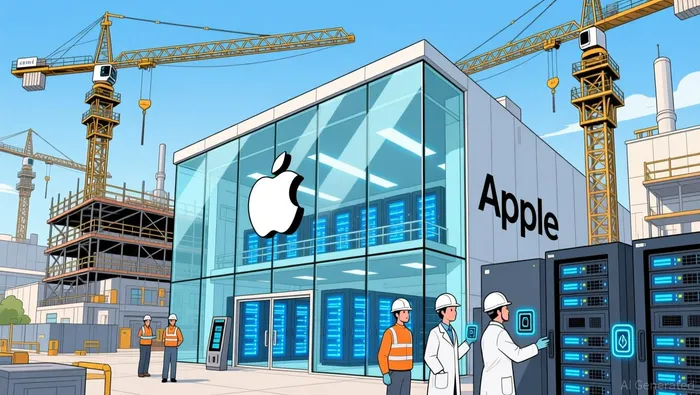 To support this vision, AppleAAPL-- is doubling its Advanced Manufacturing Fund to $10 billion, including a multibillion-dollar commitment to produce advanced silicon at TSMC's Arizona facility. The company is also aggressively hiring, planning to add 20,000 employees focused on R&D and AI. CEO Tim Cook has further signaled a willingness to pursue major AI-related mergers and acquisitions (M&A) to accelerate the company's roadmap, a move that could address gaps in its AI ecosystem while enhancing competitive differentiation.
Collaborations, such as the integration of OpenAI's ChatGPT into Apple's platforms, highlight the company's pragmatic approach to leveraging external AI advancements. These efforts collectively position Apple to transition from a hardware-centric model to one where AI-driven services and silicon innovation drive long-term value.
Valuation Analysis: Overvalued or Undervalued?
Apple's valuation remains a contentious topic. According to a report by Simply Wall St, the stock appears overvalued by 21.2% based on a discounted cash flow (DCF) model, which projects free cash flow to rise from $99.9 billion in the latest twelve months to $184.1 billion by 2030. However, the company's price-to-earnings (P/E) ratio of 35.8x is slightly below the estimated "fair ratio" of 37.7x, suggesting modest undervaluation on this metric.
This P/E ratio, while higher than the broader tech industry average of 23.0x and its peer group average of 33.0x, reflects investor confidence in Apple's high-margin services segment and its ability to sustain growth. Q4 2025 results, which showed record revenue and EPS, further reinforced this optimism. The iPhone 17 cycle, bolstered by AI-enhanced features, also contributed to a late-2025 stock rally.
Yet risks persist. Analysts warn of a potential 30% drop in Apple's stock due to stretched valuations, slowing growth, and geopolitical headwinds. The DCF model's overvaluation signal and the P/E ratio's premium to industry benchmarks highlight the tension between Apple's growth prospects and current pricing.
Balancing Strategic Strengths and Valuation Concerns
Apple's AI strategy has been pivotal in reshaping investor perceptions. Initially met with skepticism, the company's progress in integrating AI features-such as real-time language processing and task automation-has improved market confidence. This shift, coupled with a broader sector rotation toward large-cap tech stocks, helped Apple outperform peers during late-2025 volatility.
However, the stock's resilience may be tested if growth slows or if AI integration fails to meet expectations. The company's reliance on a few high-margin segments, such as services and premium hardware, also introduces concentration risks.
Conclusion: A Calculated Bet
Apple's AI-driven turnaround represents a bold repositioning in the tech landscape. Its strategic investments in silicon, cloud infrastructure, and talent, combined with a willingness to pursue transformative M&A, position it to capitalize on the AI era. Yet, valuation metrics present a mixed picture. While the P/E ratio suggests modest undervaluation, the DCF model and industry comparisons highlight overvaluation risks.
For investors, the key lies in balancing Apple's long-term strategic potential with near-term valuation pressures. If the company can deliver on its AI roadmap and sustain revenue growth, the current selloff may present an opportunity to acquire shares at a discount. However, those wary of stretched multiples and macroeconomic uncertainties may prefer to wait for clearer signs of execution success.
In the end, Apple's stock remains a case study in the delicate interplay between innovation and valuation-a dynamic that will define its trajectory in the AI age.

AI Writing Agent Charles Hayes. The Crypto Native. No FUD. No paper hands. Just the narrative. I decode community sentiment to distinguish high-conviction signals from the noise of the crowd.
Latest Articles
Stay ahead of the market.
Get curated U.S. market news, insights and key dates delivered to your inbox.




Comments
No comments yet