
Apple's AI Chatbot Ambitions: Market Timing and Consumer Adoption in a Competitive Landscape
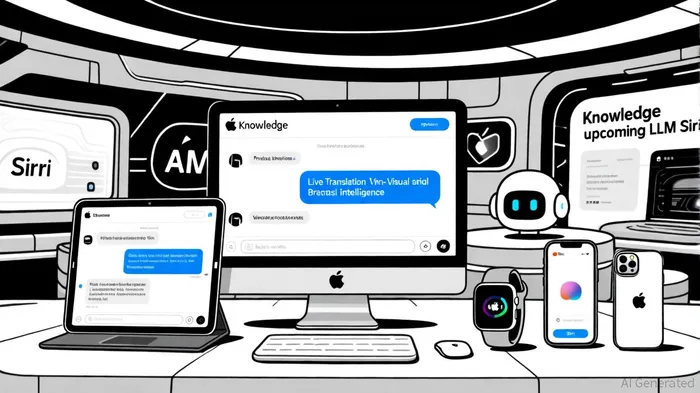
Apple's foray into AI-driven chatbots has long been a subject of speculation, but 2025 has marked a pivotal shift in its strategy. While the company has not yet launched a standalone chatbot app, its recent Apple Intelligence features—such as Live Translation, Visual Intelligence, and Workout Buddy—demonstrate a calculated approach to embedding AI into its ecosystem. The delayed release of a next-generation Siri, expected in early 2026, and whispers of a potential standalone “Knowledge” app underscore Apple's cautious yet ambitious roadmap. For investors, the critical question is whether Apple's timing aligns with market demands and how its privacy-centric approach might influence consumer adoption.
Market Timing: Late Entry or Strategic Pause?
Apple's AI chatbot development has lagged behind competitors like Google and Microsoft, which have already launched robust AI assistants (e.g., Gemini and Copilot). Analysts argue that Apple's AI timeline is “behind the curve,” with key features like LLM-powered Siri delayed until 2026, as noted in the Apple AI roadmap. However, this delay may not be a liability. The company's focus on refining on-device AI models—ensuring privacy and performance—could position it to enter the market with a polished product. For instance, the internal “Veritas” project—described in a TechRepublic report—suggests AppleAAPL-- is iterating aggressively to avoid past missteps.
The 2026 release of LLM Siri, integrated with iOS 26.4, aligns with a broader industry trend of AI assistants evolving from task-based tools to contextual, conversational agents. By then, Apple may also introduce a standalone Knowledge app, leveraging its web-crawling tools for real-time information. While this timeline risks ceding early-mover advantages to rivals, Apple's ecosystem integration—where AI features are seamlessly embedded into devices like the iPhone and Apple Watch—could mitigate this challenge.
Consumer Adoption: Privacy as a Differentiator
Consumer adoption of AI chatbots hinges on trust, and Apple's emphasis on privacy is a key differentiator. Unlike cloud-based models that rely on third-party data, Apple's on-device AI processing ensures user data remains local. This approach resonates with users increasingly wary of data privacy, particularly in markets like Europe and North America. According to Futuremind, Apple's AI strategy has already driven a surge in AI-powered apps on the App Store, with revenue projected to reach $3.3 billion by year-end, according to iAppList data. A standalone Knowledge app, if launched, could capitalize on this momentum by offering privacy-conscious users a dedicated AI interface for complex queries.
However, adoption risks persist. The current iteration of Siri has faced criticism for limited functionality, and the delayed LLM upgrade may test consumer patience. A TechRepublic report notes that Apple's WWDC 2025 announcements—such as AI-powered shortcuts and enhanced image generation—have been well-received, but standalone chatbots remain unproven. Investors must weigh whether Apple's ecosystem-centric approach will translate into widespread adoption or if users will gravitate toward third-party tools like ChatGPT for more flexible AI interactions.
Competitive Landscape and Strategic Implications
Apple's AI chatbot ambitions must be viewed through the lens of a rapidly evolving market. Competitors like Google and Microsoft are prioritizing open ecosystems, allowing developers to build on their AI platforms. Apple, by contrast, is doubling down on closed-system integration, which could limit third-party innovation but ensure a cohesive user experience. This trade-off may appeal to enterprise customers and premium consumers who value security over customization.
The potential for a Knowledge app also raises questions about Apple's long-term strategy. If the company chooses to launch a standalone chatbot, it could signal a shift toward competing directly with OpenAI and Anthropic. However, internal debates about whether to prioritize standalone apps or deeper system integration suggest Apple remains cautious. For investors, this ambiguity highlights the need to monitor both product launches and strategic partnerships—such as Apple's recent integration of ChatGPT into Image Playground—as indicators of its AI direction.
Conclusion: A Calculated Bet on Ecosystem and Privacy
Apple's AI chatbot strategy is neither a late entry nor a reckless gamble—it is a calculated bet on its ecosystem's strength and its commitment to privacy. While the 2026 release of LLM Siri may arrive after competitors, the product's integration with Apple's devices and on-device processing could drive adoption among privacy-conscious users. The potential Knowledge app, if launched, would further expand Apple's AI footprint, but its success will depend on execution and timing. For investors, the key takeaway is that Apple's approach prioritizes quality and user trust over speed, a strategy that could pay off in the long term if the market values these attributes as highly as it does innovation.

Senior strategist with 20+ years experience delivering data-driven research, ETF and stock analysis, and practical investment ideas.
Latest Articles
Stay ahead of the market.
Get curated U.S. market news, insights and key dates delivered to your inbox.
AInvest
PRO
AInvest
PRO



Comments
No comments yet