

John Ternus takes over from Tim Cook on September 1, 2026. The story most people are telling themselves is simple: here is a new CEO, and now AppleAAPL-- will finally spend like an AI company. New leader, big budget, problem solved. The story is half true, and the half that is false is the half that matters.
Look at the budget that is supposed to be on its way. It is already here. Apple's annual research and development spending has roughly tripled over eight years, from $14.2 billion in fiscal 2018 to $42.9 billion on a trailing twelve-month basis through June 30, 2026, up about 28 percent year over year. The fiscal 2025 line by itself was $34.6 billion, about 8.3 percent of a record $416 billion in revenue. The June quarter alone ran $11.7 billion, up 32 percent year over year. These figures come through aggregators rather than straight from the filing, so the exact cents deserve a grain of salt, but the direction is not ambiguous.
Fiscal-year GAAP expense (FY2018-FY2025) and trailing-twelve-month expense ended June 30, 2026, in USD billions. The final bar is a trailing-twelve-month reading, not a fiscal-year figure, so the two bases are kept separate.
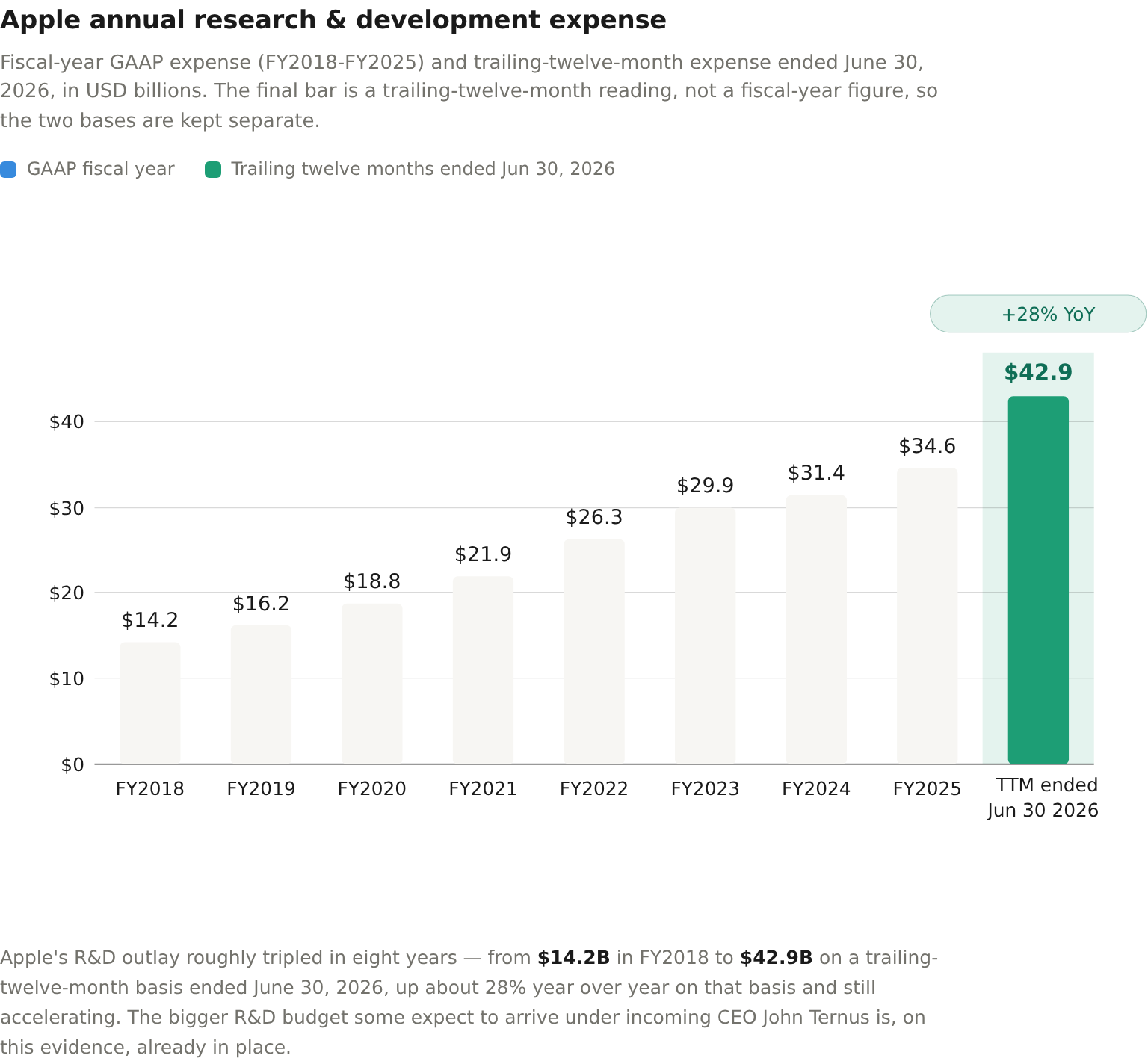
Apple's R&D outlay roughly tripled in eight years — from $14.2B in FY2018 to $42.9B on a trailing-twelve-month basis ended June 30, 2026, up about 28% year over year on that basis and still accelerating. The bigger R&D budget some expect to arrive under incoming CEO John Ternus is, on this evidence, already in place.
| Period | Basis | R&D ($B) |
|---|---|---|
| FY2018 | GAAP fiscal year | 14.236 |
| FY2019 | GAAP fiscal year | 16.217 |
| FY2020 | GAAP fiscal year | 18.752 |
| FY2021 | GAAP fiscal year | 21.914 |
| FY2022 | GAAP fiscal year | 26.251 |
| FY2023 | GAAP fiscal year | 29.915 |
| FY2024 | GAAP fiscal year | 31.370 |
| FY2025 | GAAP fiscal year | 34.550 |
| TTM ended Jun 30 2026 | Trailing twelve months | 42.901 |
So the question people keep asking — will Ternus finally get Apple a big AI budget — is partly true and unoriginal. A larger budget is not being withheld; the escalation is underway. What is genuinely contested is narrower and stranger: whether Ternus turns that growing spending into infrastructure Apple owns, or keeps renting the foundation of its AI from the companies it is supposed to be competing with.
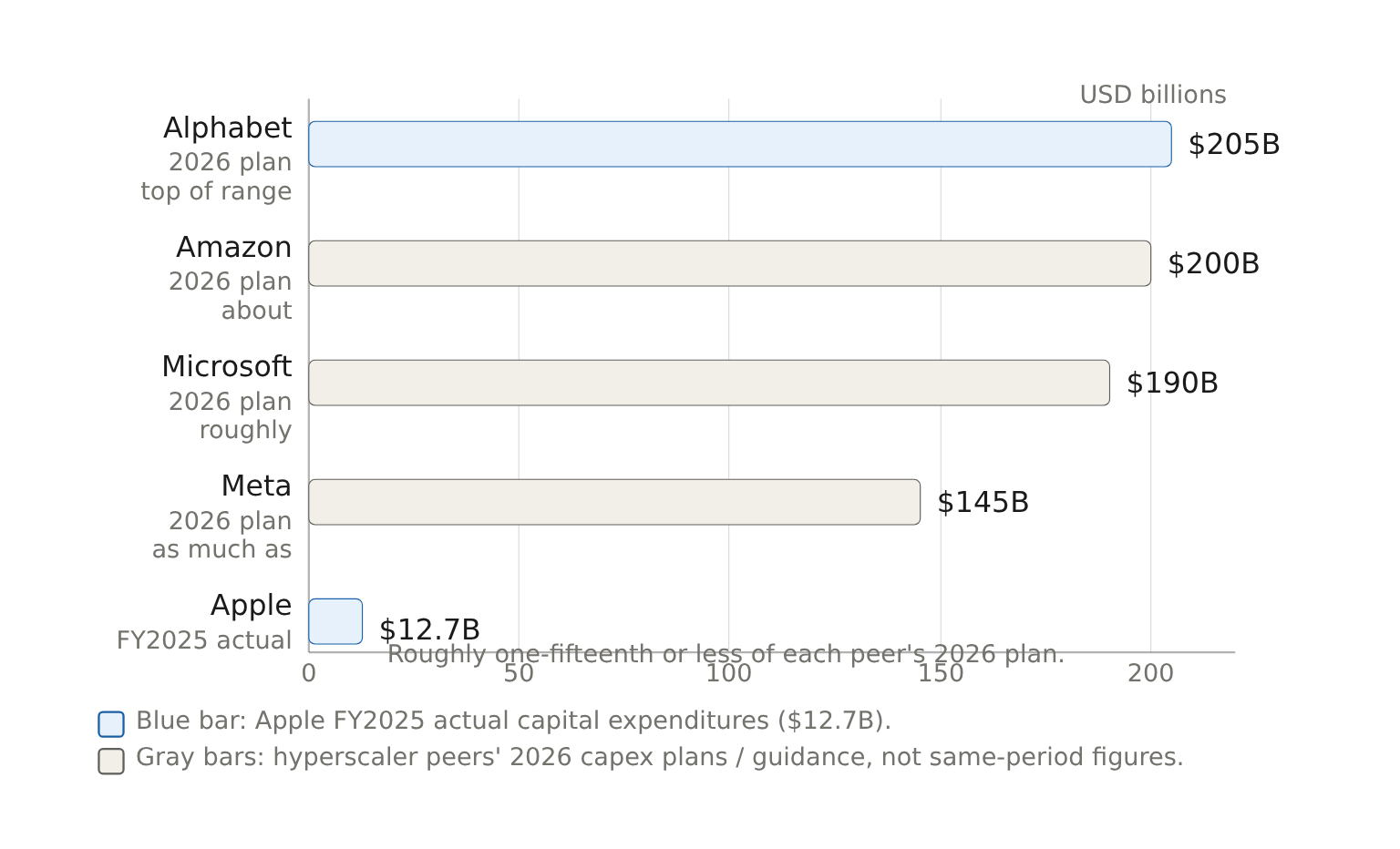
There is a clean accounting split that makes the choice visible. R&D is what you spend to invent the next product. Capital expenditures are what you spend to own the machinery the products run on. Apple's capital expenditures in fiscal 2025 were $12.7 billion. In the same planning cycle, four rivals guided to 2026 AI-infrastructure spending of roughly $145 billion at Meta, about $190 billion at Microsoft, roughly $200 billion at Amazon, and up to $205 billion at Alphabet — more than $700 billion combined. Apple declined to enter the contest. The comparison is lopsided by design: Apple's figure is a fiscal-year actual while the peers' are forward plans, and the gap between them is still enormous.
Apple's answer to all that is a hybrid, and the word is doing real work. Chief financial officer Kevan Parekh describes renting computing power from cloud providers while running Apple's own chips in its own servers. The flagship test of the arrangement is Siri, rebuilt from the ground up, powered by Google's Gemini and still in beta, with no date set for general availability.
Renting a foundation works until it stops working, and the stoppage is structural. The hyperscalers are converting hundreds of billions of dollars into owned GPU and data-center capacity, and they will allocate the best of it to their own products first. As demand tightens, the compute Apple rents gets pricier and less reliably available. So the mechanism forks. Keep renting: the operating margin holds while the dependence compounds. Start owning: capex steps up, R&D steps up, and the gap between Apple's spending profile and its cash pile narrows. That fork is what Ternus inherits. He is not inheriting a budget question. He is inheriting a choice between two versions of Apple.
There is one piece of evidence pointing toward spending up, and it is worth being precise about what it is. In April 2026 Apple dropped its net-cash-neutral target — the 2018 policy that sent the bulk of free cash flow to buybacks and dividends rather than investment, the policy under which it had accumulated $163 billion in net cash. The same announcement brought a new $100 billion buyback authorization and a 4 percent dividend raise to $0.27 per share. BofA Securities analyst Wamsi Mohan reads the target's removal as signaling "a period of higher investment in R&D, Capex, and larger M&A". Read that statement closely. It is an analyst interpreting intent, not a company making a commitment. Neither the succession announcement nor Ternus has publicly promised a materially larger AI budget. Barron's asked Apple, and as of August 20, 2026 there was no answer on the record. A forecast is not a fact, even when it is a comfortable one.
Underneath all of this, the company is not struggling. The June quarter set records — revenue up 16 percent to $109.4 billion, diluted earnings per share up 29 percent. That is the tension the market is watching. The R&D surge is happening inside record results without crushing profitability, which is what makes the deliberate hold on infrastructure read as a choice rather than a necessity.
Then the part shareholders feel directly. The stock briefly touched a $5 trillion market cap on July 28, 2026, on an intraday high of $342.89, up 25 percent for the year, a day after overtaking Nvidia as the most valuable public company.
That is the finish of a long run: under Tim Cook the company went from a $346.4 billion market cap to a $4.63 trillion one, per Barron's. The multiple sitting on top of it is the loaded part. Yahoo's key-statistics page put the trailing multiple at 32.39x in the June quarter; at WWDC this year it was closer to 36x, against Apple's own ten-year average of about 26 times. Paying 32 to 36 times earnings for a company growing revenue in the mid-teens is a vote that AI pays off — the exact vote that the next budget either justifies or betrays.
Morningstar's $285 fair value implies roughly 32 times fiscal 2026 earnings. Compare that with the July intraday high of $342.89 and the arithmetic says the market is already paying above a disciplined, long-horizon estimate of what Apple is worth. Which is the point of the whole argument. A stock priced at 32 to 36 times earnings leaves no room for a bigger budget that does not accelerate growth. The budget is not the risk. The return on it is.

So here is the model worth carrying through the transition and into fiscal 2027. Apple does not guide to R&D or capex, so the disclosures do the work. The next quarterly filings and the annual report will show whether the R&D acceleration holds and, more tellingly, whether the capex line starts moving off its $12.7 billion base toward owned infrastructure. Watch the Siri general-availability date. Watch the foldable iPhone that lands this September, the first product reveal of Ternus's tenure. Listen to what analysts say about his mandate as the year turns. The R&D budget is already here — that part of the story is finished. The live question is what Ternus does with it. Renting the foundation of a company's future from its competitors only works while the competitors let it. The most interesting thing the new CEO could do is decide otherwise, and spend like he means it.








Comments
No comments yet