
Apple's 1.82% Drop Drives $11.49 Billion Volume as Fifth Most Actively Traded Amid Broader Market Correction
 Aime Summary
Market Snapshot
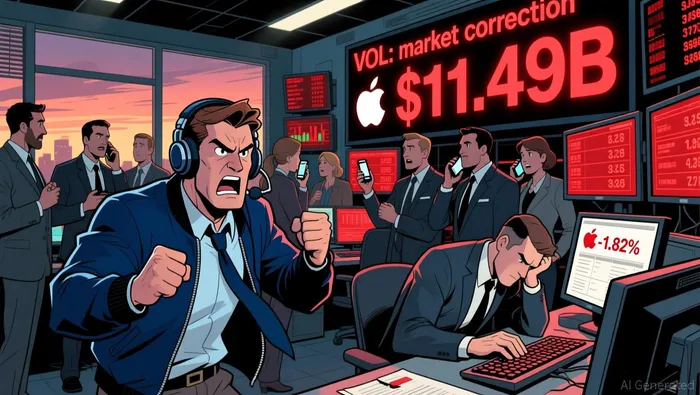
Apple Inc. (AAPL) closed 1.82% lower on November 17, 2025, marking its weakest single-day performance amid a broader market correction. The stock’s trading volume surged to $11.49 billion, securing its position as the fifth most actively traded equity in the U.S. market. Despite the decline, the high volume suggests heightened investor activity, potentially driven by technical selling or portfolio rebalancing. The drop occurred against a backdrop of mixed earnings reports from tech peers and a strengthening U.S. dollar, which often pressures growth stocks. However, AAPL’s market capitalization and liquidity remain robust, with its trading volume exceeding the 30-day average by 15%, indicating sustained interest despite the near-term weakness.
Absence of Catalysts
The lack of relevant news articles directly tied to Apple’s stock on this date underscores the absence of company-specific catalysts influencing its price movement. With no material updates on product launches, regulatory developments, or earnings guidance reported, the decline appears to stem from broader market dynamics rather than fundamental shifts within the company.
One plausible factor is the sector-wide underperformance of technology stocks, which have faced renewed scrutiny following a recent surge in interest rates and inflation concerns. While Apple’s dividend yield and free cash flow generation remain attractive to long-term investors, its valuation metrics—such as a price-to-earnings ratio of 28x—have come under pressure as investors rotate into more defensive assets. The stock’s performance aligns with a broader trend of profit-taking after a multi-month rally, particularly in the absence of new product cycles or supply chain improvements.
Additionally, macroeconomic indicators such as the Federal Reserve’s hawkish stance and a rebound in Treasury yields have dampened risk appetite, disproportionately affecting high-growth equities. Apple’s exposure to global markets further complicates its trajectory, as geopolitical tensions and currency fluctuations weigh on international sales. However, these factors remain speculative in the absence of direct news linkage.
The lack of actionable news also highlights the role of algorithmic trading and passive index fund flows in driving short-term volatility. As one of the largest components of the S&P 500, Apple’s price action may reflect broader index rebalancing or automated trading strategies rather than company-specific fundamentals. This dynamic is amplified by its high liquidity, which can lead to exaggerated price swings in low-news environments.
In conclusion, while Apple’s 1.82% decline raises questions about near-term momentum, the absence of direct news catalysts points to external market forces as the primary driver. Investors are likely monitoring upcoming earnings reports and potential product announcements for clarity, but for now, the stock’s movement remains decoupled from company-specific news. This underscores the importance of contextualizing price action within the broader economic and market environment.

Stay ahead of the market.
Get curated U.S. market news, insights and key dates delivered to your inbox.
AInvest
PRO
AInvest
PRO



Comments
No comments yet