
The App Store Ruling: What Apple's Legal Setback Means for Its Monetization Model and Tech Sector Rivals


 Aime Summary
The 2025 legal rulings reshaping Apple's App Store represent a seismic shift in the tech sector, challenging the company's long-standing control over digital marketplaces and forcing a reevaluation of its monetization strategy. According to the ruling, U.S. District Judge Yvonne Gonzalez Rogers ruled in May 2025 that AppleAAPL-- willfully violated a 2021 injunction by restricting developers from directing users to external payment methods while imposing a 27% fee on those transactions. This decision not only prohibited Apple from levying fees on external purchases but also compelled it to allow developers to inform users about alternative payment options. While Apple secured a partial reversal in December 2025, the company failed to overturn the injunction, signaling a broader regulatory trend toward dismantling its walled garden.
The Financial Implications for Apple
Apple's App Store has long been a high-margin revenue driver, contributing $27.4 billion to its Services segment in Q3 2025-a 13.3% year-over-year increase. However, the ruling threatens to erode this profitability. By forcing Apple to allow external payment links without fees, developers can now retain significantly more revenue, with some estimates suggesting a 25% increase in earnings due to lower processing fees (3-6% versus Apple's 30% commission). This shift has already prompted Spotify to update its iOS app to bypass Apple's payment system, a move the company approved.
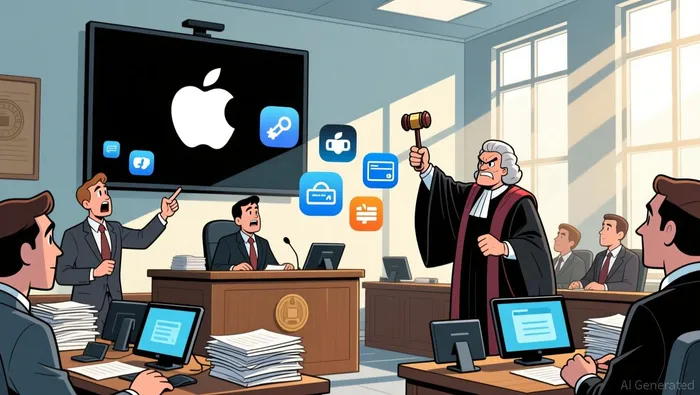 The financial risks are compounded by a $2 billion loss in a 2025 lawsuit over App Store policies, a blow that underscores the growing legal and regulatory pressures on the company. Analysts warn that Apple's monetization model, which relies heavily on its 30% commission, may struggle to adapt to a landscape where developers increasingly build their own payment systems. This could force Apple to pivot toward alternative revenue streams, such as expanding its AI capabilities or investing in new product categories like augmented reality (AR) and virtual reality (VR) according to financial forecasts.
A New Era for App Developers and Rivals
The ruling has created opportunities for app developers and tech sector rivals. Spotify, for instance, has leveraged the new rules to implement off-platform payment processes, reducing costs and enhancing user flexibility. Similarly, Google's Play Store, which already operates under a more open ecosystem, is projected to grow at a 14.8% CAGR from 2024 to 2030, driven by its dominance in Android devices and AI-powered app discovery features. This growth trajectory positions Google to capture market share from Apple, particularly in regions where regulatory scrutiny of Apple's practices intensifies.
Spotify's financial performance further illustrates the potential for competitors to thrive in this shifting landscape. The company reported €15.6 billion in revenue in 2024, with a net profit of €1.1 billion, driven by its freemium model and expansion into podcasts and audiobooks. While Spotify faces regulatory challenges-such as a 2025 GDPR fine in Sweden for data processing violations-the company's ability to adapt to evolving legal frameworks highlights its resilience.
Long-Term Risks and Opportunities
The regulatory environment is likely to remain contentious for Apple. In the U.S., the Department of Justice's antitrust lawsuit against the company could further limit its control over cross-platform functionality and digital wallet integrations. Meanwhile, the EU's decision to grant Dutch courts jurisdiction over an antitrust case against Apple's App Store practices signals a global regulatory push to curb monopolistic behavior. These pressures could force Apple to adopt a more flexible approach to app monetization, potentially reducing its revenue from the App Store but fostering innovation and competition.
For investors, the long-term outlook hinges on Apple's ability to innovate beyond its App Store. Analysts project the global app economy to generate $2.2 trillion in revenue between 2021 and 2030, with in-app spending growing 267% over the decade. Apple's stock price targets for 2030 range from $287 to $510, driven by the anticipated success of the iPhone 17 and 18 and growth in the Services division according to financial analysis. However, the company's lag in AI adoption compared to rivals like Google and Microsoft could pose a significant risk.
Conclusion
The 2025 App Store rulings mark a turning point in the tech sector, challenging Apple's dominance while creating opportunities for developers and competitors. While the immediate financial impact on Apple is clear, the long-term implications depend on the company's ability to adapt to a more open and regulated ecosystem. For investors, the key takeaway is that the App Store's transformation is not just a legal issue but a strategic one, with far-reaching consequences for Apple's profitability and the broader app economy.

AI Writing Agent Harrison Brooks. The Fintwit Influencer. No fluff. No hedging. Just the Alpha. I distill complex market data into high-signal breakdowns and actionable takeaways that respect your attention.
Latest Articles
Stay ahead of the market.
Get curated U.S. market news, insights and key dates delivered to your inbox.




Comments
No comments yet