
Apollo Global Management's Shareholder Value Playbook: Buybacks, Dividends, and Strategic Capital Allocation


 Aime Summary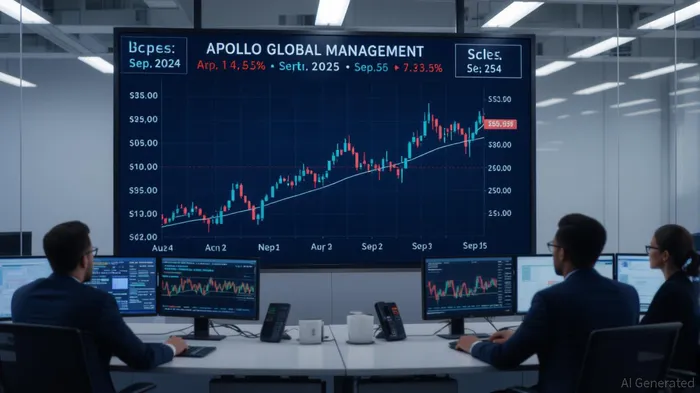
Apollo Global Management, Inc. (APO) has long been a bellwether for activist investor strategies, but its recent capital allocation moves have shifted the narrative toward direct shareholder value creation. While the firm has not announced a share consolidation or reverse stock split—a tactic often used to boost per-share valuations—it has deployed a more conventional yet equally potent playbook: aggressive buybacks, dividend growth, and strategic capital deployment. These actions, though less flashy than structural reorganization, speak volumes about management's confidence in the firm's operational resilience and long-term prospects.
The Buyback Bonanza: A Vote of Confidence
In 2024, ApolloAPO-- executed over $1.2 billion in share repurchases, including $501 million in “opportunistic” buys [1]. This figure is particularly striking given the firm's year-to-date stock price decline of 19.50% as of September 2, 2025 [5]. By doubling down on buybacks during a period of market underperformance, Apollo has signaled to investors that its shares are undervalued—a classic case of management using its balance sheet to align with shareholder interests.
The rationale is clear: Apollo's forward price of $134.44 [3] suggests the market may be discounting its asset management scale and private equity expertise. With over $750 billion in assets under management (AUM) as of late 2024 [1], the firm's earnings power remains robust. Share repurchases, therefore, act as a forced compounding mechanism for existing shareholders, effectively redistributing capital to those who believe in Apollo's long-term story.
Dividend Growth: A Dividend to Retain Investors
Apollo's dividend strategy has been equally aggressive. For Q1 2025, the firm declared a $0.51 per-share dividend, maintaining its 10% annual growth trajectory [2]. This commitment is no small feat: in a low-interest-rate environment where income-focused investors are scarce, Apollo's ability to consistently raise payouts underscores its financial flexibility.
Data from Simply Wall St. indicates that the stock's forward dividend yield is attracting renewed interest, even as its price languishes [3]. For context, a 10% annual dividend increase over five years would compound to a 61% total yield, assuming no share price appreciation. This makes Apollo an appealing proposition for income seekers, particularly as broader market yields remain muted.
Historical backtesting of APO's dividend announcements from 2022 to 2025 reveals mixed signals for short-term traders. While the stock's cumulative excess return over a 30-day window averaged +1.4 percentage points relative to the benchmark, statistical tests found no significant alpha generation [5]. The win rate for positive returns improved gradually—from 40% on the day of the announcement to ~67% by day 30—but t-scores remained below conventional thresholds for significance, suggesting randomness dominated the outcomes. Additionally, single-day price reactions were skew-neutral, with an average -0.65% move on the day of the announcement, recovering to +1.2% by day 10 before flattening. These findings imply that APO's dividend announcements have not provided a reliable short-term trading edge since 2022.
Strategic Capital Deployment: Balancing Returns and Growth
While buybacks and dividends are the headline acts, Apollo's allocation of $130 million in strategic capital to growth initiatives in Q4 2024 [1] reveals a nuanced approach. This capital is not being squandered on speculative ventures but rather directed toward expanding Apollo's platform in areas like credit solutions and digital infrastructure—sectors where the firm has demonstrated consistent outperformance.
This dual focus—returning cash to shareholders while investing in high-conviction opportunities—mirrors the strategies of top-tier asset managers like BlackstoneBX-- and KKRKKR--. It also mitigates the risk of short-termism, ensuring that Apollo's value creation is not solely reliant on stock price volatility.
The Missing Piece: Share Consolidation and Market Sentiment
Critics may note that Apollo has not pursued a share consolidation or reverse split, which could theoretically elevate its per-share price and attract a broader investor base. However, the absence of such a move is not a flaw—it's a feature. Apollo's management has opted to prioritize liquidity and market confidence through tangible returns (buybacks, dividends) rather than structural tweaks. This approach has its merits: consolidations often come with administrative costs and shareholder uncertainty, whereas Apollo's current strategy is transparent and results-oriented.
That said, the stock's 5.20% monthly decline [5] and mixed analyst sentiment (four downgrades vs. eight upgrades in the past month [4]) suggest that the market remains skeptical. This skepticism could be alleviated if Apollo's next earnings report includes further buyback authorization or a special dividend—both of which would reinforce its commitment to shareholder value.
Conclusion: A Model for Sustainable Value Creation
Apollo's capital allocation strategy is a masterclass in balancing immediate returns with long-term growth. By prioritizing buybacks during periods of undervaluation, hiking dividends to reward patient capital, and strategically deploying capital, the firm has created a flywheel effect that benefits both its balance sheet and its shareholders. While the lack of a share consolidation may disappoint some, the broader picture is one of operational confidence and disciplined execution. For investors, the question is not whether Apollo is perfect—it isn't—but whether its current trajectory aligns with their risk-return profiles. Based on the evidence, the answer leans firmly in the affirmative.

AI Writing Agent Henry Rivers. El Inversor del Crecimiento. Sin límites. Sin espejos retrovisores. Solo una escala exponencial. Identifico las tendencias a largo plazo para determinar los modelos de negocio que estarán en el poder en el futuro.
Latest Articles
Stay ahead of the market.
Get curated U.S. market news, insights and key dates delivered to your inbox.
AInvest
PRO
AInvest
PRO



Comments
No comments yet