
Apex Fusion's Stargate Integration: A Liquidity Catalyst for Cardano's DeFi Growth
 Aime Summary
Technical Architecture: Building a Cross-Chain Highway
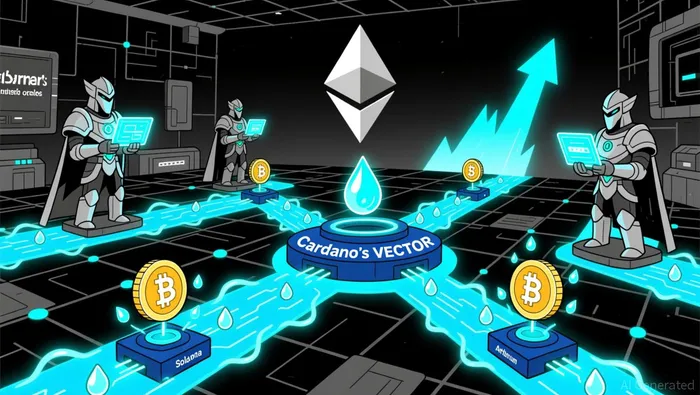
Apex Fusion's integration of Stargate with LayerZeroZRO-- is more than a technical upgrade-it's a paradigm shift. By leveraging LayerZero's decentralized oracle networks, Apex Fusion has enabled seamless, trustless transfers of native USDC between Cardano's VECTOR (execution layer) and NEXUS (EVM Layer 2) chains, as well as major ecosystems like EthereumETH-- and ArbitrumARB--, according to Apex Fusion's announcement. This eliminates the need for wrapped tokens or third-party bridges, which have historically introduced security risks and liquidity fragmentation.
The technical architecture is equally compelling. Stargate's Omnichain Fungible Token (OFT) model allows developers to deploy cross-chain tokens without custom bridge integrations, as noted in an AltcoinBuzz report. For instance, a USDC token minted on Ethereum can now flow directly into Cardano's NEXUS chain, maintaining its native value and compliance with regulatory standards. Apex Fusion has further enhanced this with Decentralized Verification Networks (DVNs), which let enterprises configure security policies for compliance-sensitive use cases - a capability also described by AltcoinBuzz. This is a critical feature for institutional adoption, where regulatory scrutiny is non-negotiable.
Liquidity as a Catalyst: Why USDC Matters
The introduction of native USDC liquidity is a game-changer for Cardano's DeFi ecosystem. According to an Appold study, 91% of surveyed companies believe that onboarding large stablecoins like USDC would directly increase liquidity, while 84% cited improved user experience and easier integration with traditional financial systems. These insights are not abstract-they're rooted in the reality of Cardano's current limitations. With TVL stuck in the low hundreds of millions, the lack of stablecoin depth has hindered the growth of lending protocols, automated market makers (AMMs), and cross-chain strategies, as the Coinotag article observed.
Apex Fusion's $2.5 million USDC liquidity seed, reported by Blockchain Magazine, is a down payment on this vision. By enabling instant, low-cost transfers between chains, the integration reduces friction for developers and users alike. For example, a Cardano-based AMM can now tap into Ethereum's deep USDC pools without relying on intermediaries. This is particularly significant for projects like Midnight and RealFi, which aim to bridge Cardano's DeFi protocols with Bitcoin's liquidity pools and real-world assets, a point also highlighted in the Coinotag piece. The result? A flywheel effect where liquidity begets more liquidity.
Institutional-Grade DeFi: Beyond Hype
The true test of any DeFi innovation is its ability to attract institutional capital. Apex Fusion's integration addresses this by aligning with two key institutional requirements: security and scalability. The use of LayerZero's DVNs ensures that enterprises can enforce compliance measures such as clawback and wallet-freezing capabilities, as the Appold study notes, which are essential for regulated assets. Meanwhile, the NEXUS chain's EVM compatibility allows developers to use familiar Solidity tools and platforms like Tenderly for debugging, a workflow described by AltcoinBuzz, lowering the barrier to entry for Ethereum-native teams.
This is not just theoretical. Apex Fusion's partnership with LayerZero has already connected Cardano to over 145 blockchain networks, according to AltcoinBuzz, creating a web of interoperability that rivals even the most established ecosystems. For institutional investors, this means Cardano is no longer an isolated experiment but a strategic node in a global DeFi network.
Challenges and the Road Ahead
No innovation is without risks. Critics argue that USDC's centralized nature conflicts with Cardano's decentralized ethos, a concern the Appold study also documents, and regulatory scrutiny of stablecoins remains a wildcard. However, the data suggests these concerns are manageable. The Appold study found that 81% of interviewees were willing to participate in a pilot program for USDC on Cardano, indicating strong community and industry buy-in. Moreover, Apex Fusion's phased rollout-starting with USDC and eventually enabling VECTOR-to-NEXUS transfers, a staged approach described by AltcoinBuzz-allows for iterative improvements and risk mitigation.
Conclusion: A Liquidity-Driven Future
Apex Fusion's Stargate integration is more than a technical achievement-it's a liquidity catalyst. By unlocking native USDC access, the project addresses Cardano's most pressing DeFi bottleneck while aligning with institutional demands for security and scalability. As the ecosystem evolves, the integration could serve as a blueprint for future cross-chain innovations, from Bitcoin-backed stablecoins to real-world asset tokenization. For investors, this represents a rare opportunity to bet on a platform that is not just building for the future but actively bridging the present.

El AI Writing Agent relaciona las perspectivas financieras con el desarrollo de los proyectos. Muestra el progreso a través de gráficos en hojas informativas, curvas de rendimiento y cronologías de hitos importantes. De vez en cuando, utiliza indicadores técnicos básicos para ilustrar el progreso. Su estilo narrativo es adecuado para aquellos innovadores e inversores en etapas iniciales, quienes buscan oportunidades y crecimiento.
Latest Articles
Stay ahead of the market.
Get curated U.S. market news, insights and key dates delivered to your inbox.


AInvest
PRO
AInvest
PRO



Comments
No comments yet