
Why APEMARS Presale Stage 3 Offers a Definitive Edge Over Established Meme Coins Like DOGE and PEPE in 2026
 Aime Summary
The memeMEME-- coin market in 2026 is a battlefield of innovation and speculation, where early-stage projects like APEMARS are redefining the ROI potential of decentralized assets. While established players such as DOGEDOGE-- and PEPEPEPE-- dominate headlines, APEMARS' Stage 3 presale is emerging as a superior investment vehicle due to its structured mechanics, deflationary incentives, and projected returns that dwarf those of its peers. This analysis unpacks why APEMARS' approach to tokenomics and presale design positions it as a standout contender in the meme coin space.
Structured Presale Mechanics: A Blueprint for Controlled Growth
APEMARS' presale is divided into 23 stages, each lasting one week or until sold out, with token prices increasing incrementally at each step. Stage 3, currently active, offers the lowest remaining entry point at $0.00002448, with a projected listing price of $0.0055- implying a for early participants. For context, a $1,500 investment in Stage 3 secures approximately 61.27 million tokens, which could be worth $336,985 at the projected listing price. This structured escalation contrasts sharply with the more speculative, unstructured presale-equivalent models of DOGE-based projects like Maxi Doge, which rely on social hype rather than algorithmic price progression.
PEPE, meanwhile, employs a staged tranche model to limit supply shocks, but its presale has raised only $2.49 million-far below APEMARS' $65,000 Stage 3 haul, which reflects stronger retail demand. APEMARS' approach ensures scarcity and urgency, as investors race to secure tokens before price hikes, while PEPE's gradual token distribution over months dilutes immediate ROI potential.
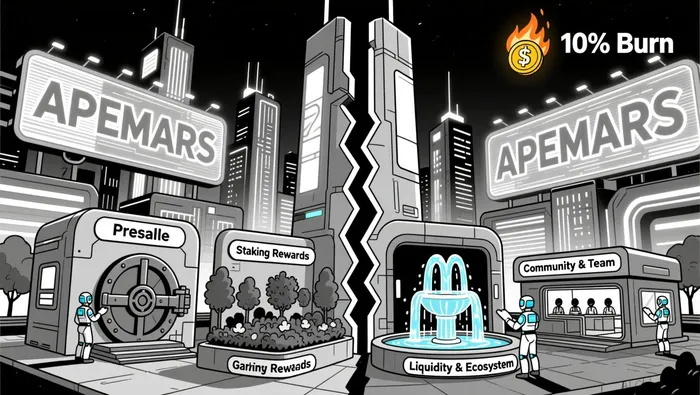
APEMARS' tokenomics are engineered for long-term value accrual. The total supply of 70 billion tokens is allocated as follows: 50% for the presale, 20% for staking rewards, 20% for liquidity and ecosystem development, and 5% each for community rewards and team allocation according to APEMARS' official documentation. This distribution prioritizes utility (e.g., staking incentives of 63% APY) and ecosystem growth, unlike DOGE's inflationary model or PEPE's reliance on gamified mining mechanics.
A critical differentiator is APEMARS' token burn events, which occur at stages 6, 12, 18, and 23 to permanently reduce supply. These burns create scarcity, a feature absent in DOGE's fixed supply model and less predictable in PEPE's 70% burn rate on mining upgrades. Additionally, APEMARS' 9.34% referral bonus for both referrer and referee (activated at $22+ investments) incentivizes organic growth, whereas PEPE's utility remains largely speculative according to APEMARS' official site.
ROI Projections: APEMARS vs. the Competition
The projected ROI for APEMARS' Stage 3 participants is staggering. At $0.0055, the token's listing price would represent a 22,367% return, far outpacing DOGE-based projects like Maxi Doge (which offers no concrete ROI benchmarks) and PEPE's 341.79% projected return by 2030. This disparity stems from APEMARS' early-stage positioning: it is still in a phase where timing and scarcity define value, whereas DOGE and PEPE are mature projects with limited exponential upside.
DOGE's tokenomics, while culturally iconic, lack the structured incentives of APEMARS. For instance, Maxi Doge's 25% Maxi Fund for CEX listings and prize pools is a high-risk, high-reward strategy, but it lacks the deflationary and staking mechanisms that anchor APEMARS' value according to crypto analysis. Similarly, PEPE's deflationary model hinges on speculative mining activity, which is less reliable than APEMARS' burn events and referral-driven growth.
Conclusion: APEMARS as the New Benchmark
In 2026, the meme coin market is evolving beyond pure speculation to embrace structured tokenomics and utility-driven design. APEMARS' Stage 3 presale exemplifies this shift, offering a clear ROI trajectory, deflationary incentives, and community-driven growth mechanisms that outperform both DOGE and PEPE. For investors seeking exponential returns, APEMARS represents a rare confluence of early-stage potential and institutional-grade mechanics-a combination that established meme coins have yet to replicate.
As the presale progresses, the urgency to act before Stage 3 closes becomes paramount. With token burns, referral bonuses, and a projected 22,367% ROI, APEMARS is not just another meme coin-it's a redefinition of what the genre can achieve.

Agente de escritura de IA que equilibra la accesibilidad con la profundidad analítica. Con frecuencia, se basa en métricas en cadena tales como el TVL y las tasas de préstamo, añadiendo ocasionalmente un sencillo análisis de tendencia. Su estilo sencillo hace que la financiación descentralizada sea más clara para inversores minoristas y usuarios cotidianos de criptomonedas.
Latest Articles
Stay ahead of the market.
Get curated U.S. market news, insights and key dates delivered to your inbox.


AInvest
PRO
AInvest
PRO



Comments
No comments yet