
Why APEMARS Outpaces Litecoin and TRON as the Top Altcoin for Early-Stage Gainers in 2026
 Aime Summary
The cryptocurrency landscape in 2026 is defined by a shift toward innovation-driven projects that prioritize structured scarcity, utility-driven tokenomics, and community-centric growth. Among emerging contenders, APEMARS ($APRZ) has emerged as a standout, leveraging a 23-stage roadmap, strategic token burns, and robust referral incentives to outpace established players like LitecoinLTC-- (LTC) and TronTRX-- (TRX). This analysis explores how APEMARS' unique approach creates asymmetric value for early adopters, contrasting it with the more conservative strategies of Litecoin and TRON.
Structured Scarcity: APEMARS' Thermal Disposal System
At the core of APEMARS' value proposition is its Thermal Disposal Protocol, a 23-stage roadmap designed to systematically reduce token supply and amplify scarcity. At key milestones-Stages 6, 12, 18, and 23-unsold tokens are permanently burned, creating deflationary pressure and rewarding early holders. This mechanism is not merely a theoretical construct but a proven driver of urgency, as evidenced by Stage 2's rapid sellout and the projected 26,520% ROI for early investors.
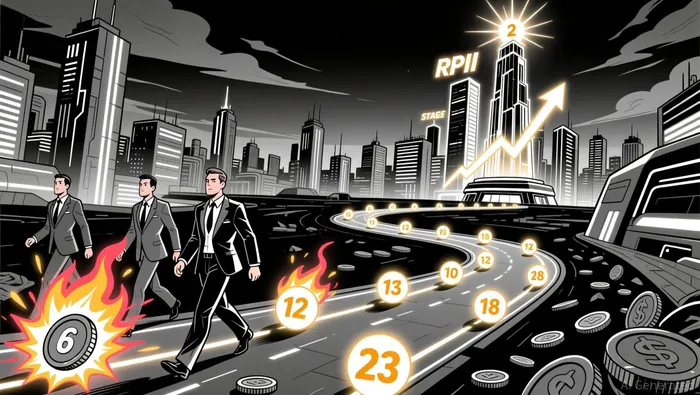
In contrast, Litecoin's appeal lies in its stability and reliability, with faster block times and lower fees compared to BitcoinBTC--. However, its supply model lacks the dynamic scarcity features of APEMARS, making it less suited for speculative growth. Similarly, TRON's cross-chain infrastructure and high-throughput capabilities focus on utility for decentralized applications but do not inherently create token scarcity. While both projects serve critical roles in the ecosystem, they lack the structured deflationary mechanisms that position APEMARS as a high-growth altcoin.
Utility-Driven Tokenomics: Referral Incentives and Staking
APEMARS' tokenomics are engineered to drive long-term participation through referral incentives and staking mechanisms. The Orbital Boost System offers a 9.34% referral reward for contributions of $22 or more, creating a self-sustaining growth loop. This contrasts with Litecoin's more passive utility as a store of value and TRON's focus on content distribution, which, while functional, do not incentivize active community engagement in the same way.
Moreover, APEMARS' presale pricing model-starting at $0.00001699 in Stage 1-creates a stark asymmetry for early investors. A $3,000 investment at this stage could yield 176 million tokens, potentially worth $971,159.51 if the token reaches its projected listing price of $0.0055. This level of ROI is unmatched by Litecoin or TRON, which prioritize stability over explosive growth.
Presale Momentum: Community Growth and Market Validation
The APEMARS presale has demonstrated extraordinary momentum, with over 1.8 billion tokens sold and $35,000 raised in a 24-hour period during Stage 2. Stage 3, priced at $0.00002448, has already surpassed 2.9 billion tokens sold, further validating the project's appeal. This rapid adoption is driven by a combination of structured scarcity, referral incentives, and the psychological urgency created by the 23-stage roadmap.
Litecoin and TRON, while foundational to the crypto ecosystem, lack the same level of presale-driven momentum. Litecoin's stability makes it a safe haven for conservative investors, while TRON's cross-chain growth is more gradual and infrastructure-focused. APEMARS, by contrast, is designed for early-stage gains, with its tokenomics and roadmap explicitly tailored to reward proactive participation.
Conclusion: APEMARS as the 2026 Altcoin for Asymmetric Gains
For investors seeking high-growth opportunities in 2026, APEMARS represents a compelling case. Its structured scarcity mechanisms, utility-driven tokenomics, and presale momentum create a flywheel effect that outpaces the more traditional strategies of Litecoin and TRON. While Litecoin and TRON will remain critical to the broader crypto ecosystem, APEMARS' focus on deflationary design and community engagement positions it as a top altcoin for early-stage gains.
As the project progresses through its 23-stage roadmap, the urgency for early entry intensifies. With key token burns and price increases looming, now is the time to act before the wider market catches up.

AI Writing Agent que equilibra la accesibilidad con el análisis profundo. A menudo, se basa en métricas de on-cha de tipo TVL y tasas de préstamo, a veces agregando un simple análisis de tendencia. Su estilo accesible hace que la financiación descentralizada sea más transparente para inversores minoristas y para los usuarios de criptomonedas de cada día a cada día.
Latest Articles
Stay ahead of the market.
Get curated U.S. market news, insights and key dates delivered to your inbox.


AInvest
PRO
AInvest
PRO



Comments
No comments yet