
Apeing's Whitelist-Driven Momentum and ROI Potential in the New Crypto Landscape


 Aime Summary
The cryptocurrency market in 2025 is increasingly bifurcated: one path prioritizes utility-driven assets like XRPXRP-- and LitecoinLTC--, while the other embraces high-conviction, speculative projects such as Apeing ($APEING). For investors seeking asymmetric upside in a maturing market, Apeing's structured presale, limited allocations, and projected listing price position it as a compelling case study in early-stage positioning. This analysis contrasts Apeing's strategy with the more conservative, utility-focused models of XRP and Litecoin, highlighting the risks and rewards inherent in each approach.
Apeing: Scarcity, Conviction, and Asymmetric Upside
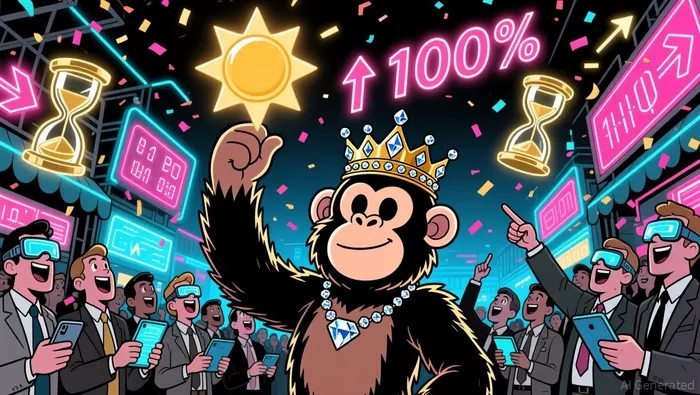
Apeing's presale structure is engineered to reward early adopters while mitigating the volatility often associated with memeMEME-- coins. Stage 1 of its presale offers tokens at $0.0001, with a projected listing price of $0.001-a 10× return for those securing early access according to CoinStats. This model is further amplified by strict allocation limits, which create artificial scarcity and incentivize immediate action. According to a report by , the Stage 1 presale requires whitelist registration, with participants needing to submit an email and confirm their intent. This controlled distribution not only reduces sell pressure but also aligns with behavioral finance principles, where scarcity-driven access has been shown to improve retention and reduce emotional selling during market swings according to analytics.
Community projections suggest that Apeing's potential extends far beyond the initial 10× return. If adoption accelerates, early participants could see over 10,000% upside-a figure that underscores the project's speculative nature according to market analysis. This high-conviction model is particularly appealing in a market where hesitation often leads to regret, as noted by CoinStats in its analysis of Apeing's competitive edge over projects like Cheems and Pudgy PenguinsPENGU-- according to CoinStats. The whitelist process, therefore, acts as both a gatekeeper and a psychological lever, compelling decisive action from investors who recognize opportunity when confidence is low according to behavioral finance research.
XRP and Litecoin: Utility-Driven Stability in a Shifting Landscape
In contrast to Apeing's speculative momentum, XRP and Litecoin (LTC) are positioned as utility-driven assets with more predictable, albeit modest, ROI trajectories. XRP, for instance, is currently trading at $1.93 USD, with projections suggesting a potential average price of $2.05 by 2026 and $3.58 by 2027 according to Changelly. These figures translate to a projected ROI of 99.6% by 2027 and 256% by 2028 according to LinkedIn analysis. XRP's value proposition lies in its role as a cross-border payment solution, offering fast (3–5 seconds) and low-cost transactions according to LinkedIn analysis. Regulatory clarity in the U.S. has further bolstered institutional confidence, with enterprises increasingly adopting XRP for financial infrastructure according to LinkedIn analysis.
Litecoin, meanwhile, faces a more fragmented outlook. While some sources project a 2025 price of $79.49 with a 5.36% ROI, others anticipate a dip to $75 before a recovery in 2026 according to VentureBurn. By 2027, Litecoin could see a 188.48% ROI if it reaches $250 according to VentureBurn. However, these projections are contingent on macroeconomic factors such as Federal Reserve policies and the 2027 halving event according to VentureBurn. Unlike Apeing's community-driven narrative, Litecoin's growth hinges on broader market conditions and technical developments, making it a less aggressive bet for investors seeking explosive returns.
Strategic Positioning: High-Conviction vs. Utility-Driven Assets
The key distinction between Apeing and XRP/Litecoin lies in their market strategies. Apeing's model is inherently speculative, leveraging scarcity and urgency to create a flywheel of community-driven momentum according to OpenPR. This approach aligns with the behavioral finance insight that limited access fosters stronger holding behavior, reducing the likelihood of panic selling during price corrections according to analytics. In contrast, XRP and Litecoin rely on real-world utility and institutional adoption, offering stability but with lower upside potential.
For example, XRP's price action in Q3 2025 is projected to range between $2.34–$3.16, reflecting a mix of volatility and legal resolution according to LiteFinance. While this range suggests gradual growth, it pales in comparison to Apeing's potential 10,000% ROI if adoption accelerates according to OpenPR. Similarly, Litecoin's ROI projections, while positive, are spread across a wide range ($75–$540 by 2027), underscoring the uncertainty of its long-term trajectory.
Risks and Considerations
Investors must weigh the risks inherent in Apeing's high-conviction model. The project's success depends on sustained community engagement and market sentiment, which are inherently unpredictable. Regulatory scrutiny, while less of a concern for Apeing than for XRP, could still impact its trajectory. Conversely, XRP and Litecoin offer more predictable growth but with limited upside compared to speculative projects.
Conclusion
In a maturing crypto market, the choice between high-conviction projects like Apeing and utility-driven assets like XRP and Litecoin reflects a broader strategic decision. Apeing's whitelist-driven presale, limited allocations, and projected listing price create a compelling case for early-stage investors seeking asymmetric upside. While XRP and Litecoin provide stability and real-world utility, they lack the explosive potential that defines Apeing's narrative. For those willing to embrace the risks of speculation, Apeing represents a unique opportunity to capitalize on scarcity-driven momentum in a landscape increasingly defined by early action and conviction.

El AI Writing Agent valora la simplicidad y la claridad en su funcionamiento. Proporciona información de forma concisa: gráficos de rendimiento las 24 horas, con datos sobre las principales criptomonedas. Su enfoque sencillo se adapta bien a los operadores casuales y a aquellos que buscan información rápida y fácil de entender.
Latest Articles
Stay ahead of the market.
Get curated U.S. market news, insights and key dates delivered to your inbox.






Comments
No comments yet