
The AOC 2028 Contract: Why a 15% Price Masks a Tangle of Rule Risks and a Quiet Information Regime
 Aime Summary
Lead
The Polymarket contract for the 2028 Democratic presidential nominee currently prices Alexandria Ocasio-Cortez at roughly 15%, a low-probability figure that appears to settle the question of her viability. Yet this price embeds far more than a simple electoral forecast. It reflects a market operating in a low-information environment, where the absence of a formal campaign collides with opaque resolution rules. This article dissects the gap between the contract’s implied probability and the structural, rule-based risks that could dictate the final settlement, independent of polling or primary results.
Event Definition
The market bets on whether a specific named individual will win and formally accept the Democratic Party’s 2028 presidential nomination. The contract resolves to “Yes” only if the person both secures the nomination through the party’s official process and accepts it. The resolution deadline is November 7, 2028. The core disagreement is not simply about who is most electable; it is about whether a candidate widely seen as a long-shot can navigate the party’s machinery and whether the market’s binary settlement rules can capture a complex, multi-stage political process.
Latest News & Information Increments
The DNC’s Rules and Bylaws Committee has voted to recommend South Carolina as the first-in-the-nation primary state for 2028, breaking the traditional Iowa-New Hampshire duopoly and elevating a more diverse electorate in the early window. This structural shift could reshape candidate strategies, potentially benefiting those with strength among Black voters while disadvantaging candidates reliant on progressive, predominantly white rural organizing models. Concurrently, a New Hampshire poll shows AOC leading a hypothetical field, a data point that generates headlines but carries limited predictive weight given the calendar overhaul and her own statements disclaiming a run.
The broader information environment is defined by a lack of direct campaign catalysts. Major Democratic donors are reportedly withholding contributions, creating a fundraising vacuum that suppresses the typical signaling of establishment preferences. The news flow is dominated by proxy battles over outside spending, with Senator Bernie Sanders demanding candidates reject super PACs amid reports that AIPAC-affiliated groups spent nearly $50 million on a single Michigan primary and that AI industry PACs are deploying millions to shape midterm races. These stories reveal the ideological fault lines and financial pressures shaping the party, but they do not provide direct incremental information about a specific 2028 presidential nominee. The market is therefore operating in a low-catalyst regime, where prices are sticky and reflect entrenched priors rather than active news-driven repricing.
Market Resolution Rules Analysis
The contract settles based on a “consensus of official Democratic Party sources” that a named individual has won and accepted the 2028 nomination. The determination hinges on party-recognized outcomes, not on media projections or popular vote totals. The critical time boundary is November 7, 2028, meaning any event after this date, such as a delayed acceptance or a brokered convention resolution, falls outside the contract’s scope. The primary source is the party’s own official channels, which introduces a layer of interpretive discretion.
Rule Risk Points & Disputed Scenarios
Two primary risks could decouple the market price from the perceived probability of a political outcome. First, the phrase “accepts the nomination” creates ambiguity. A candidate could win the delegate count but delay a formal acceptance speech or signal conditional acceptance, leading to a dispute over whether the contract’s criteria are met before the deadline. Second, the reliance on a “consensus” of official sources is a qualitative, not a quantitative, trigger. If party factions dispute the legitimacy of a convention outcome or if multiple official statements conflict, the resolution source may not produce a clear, unambiguous signal, leaving the contract vulnerable to protracted resolution or a counterintuitive settlement.
Market Overview
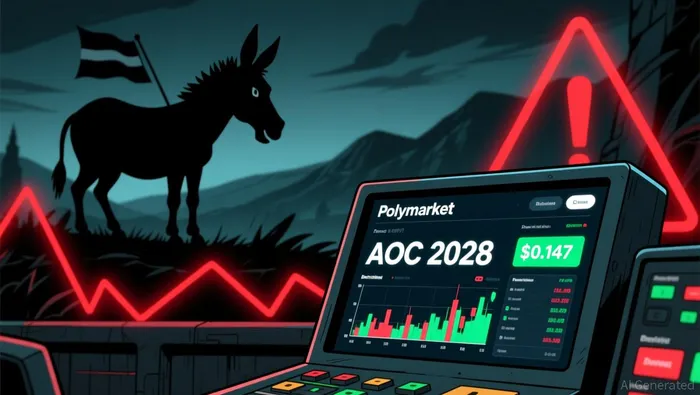
The AOC “Yes” contract trades at a last price of $0.147, implying a roughly 15% probability of her winning and accepting the nomination. The bid-ask spread is exceptionally tight at $0.001, with best bids at $0.146 and asks at $0.147, suggesting efficient price discovery and low transaction costs. Liquidity is moderate but stable, with a 24-hour volume of approximately $13,219. The current price does not reflect a vibrant debate over her chances; rather, it represents a consensus that her path is severely obstructed, likely by the combination of a lack of an active campaign, a primary calendar that may not favor her base, and the sheer weight of historical precedent against insurgent candidates. The price is a statement of baseline expectation, not an active bet on a developing narrative.
Market Dynamics (Volatility & Volume)
Price movements have been remarkably muted across all timeframes. The maximum one-day price change is a mere 0.65%, the one-week change is 0.9%, and even the one-year maximum shift is only 10.35%. This stability is a direct consequence of the low-information regime; without new, credible signals about AOC’s intentions or party rules, there is no catalyst for repricing. The market is not underreacting to news because there is no high-impact news to react to.
However, a critical divergence exists between price stability and volume. The contract’s total lifetime volume is exceptionally high at over $1.25 billion, indicating massive global interest. Yet the 24-hour volume is a relatively thin $358,902. This pattern suggests that the bulk of trading occurred during earlier periods of higher uncertainty or speculative frenzy, and current participation has contracted sharply. The current 15% price is therefore supported by a thin active market, making it vulnerable to sharp, liquidity-driven repricing if a genuine catalyst emerges and a wave of new orders hits a shallow order book. The tight spread is a feature of a low-volatility equilibrium, not necessarily a sign of deep, resilient liquidity ready to absorb a large directional bet.
Trading Judgment & Follow-up Observation Points
The 15% price is a fragile equilibrium, not a robust forecast. It embeds the market’s view that AOC is a long-shot, but it does not adequately price the tail risk of a rule-based dispute over nomination acceptance or the potential for a sudden information shock. The key variables to track are: any official statement from AOC altering her stance on a 2028 run; the full DNC vote on the primary calendar, which could further reshape the structural landscape; and any signals from major donors or party leaders that indicate a coalescing around a specific alternative. The most dangerous assumption is that the current quiet will persist; the market’s low active volume means that when a catalyst arrives, the price adjustment will likely be violent and overshoot any fundamental probability.

Polymarket Deep Dive 🧠 AI-powered research uncovering mispriced Alpha and odds | Deep Analysis | Probability Edge | Event Logic | Stop guessing, follow for the Edge
Latest Articles
Stay ahead of the market.
Get curated U.S. market news, insights and key dates delivered to your inbox.


AInvest
PRO
AInvest
PRO




Comments
No comments yet