
The Antitrust Flashpoint: Musk's Legal War on Apple and OpenAI and Its Implications for the AI Ecosystem
 Aime Summary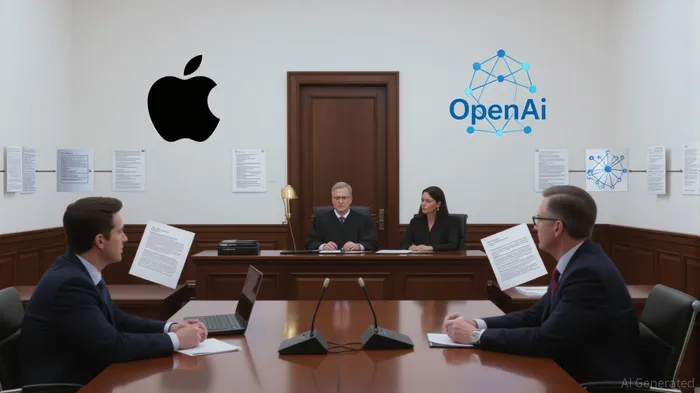
The legal battles between Elon Musk and Apple/OpenAI are no longer just about corporate ego—they're a seismic shift in the AI industry's regulatory and competitive landscape. As Musk escalates lawsuits against both tech giants, investors must grapple with the implications for app store economics, antitrust enforcement, and the future of AI-driven platforms. This isn't just a David vs. Goliath story; it's a potential inflection point for how AI is governed, monetized, and regulated.
Regulatory Reckoning: The Senate's AI Bill and the FCC's Power Grab
The U.S. Senate's bipartisan 99-1 vote to lift the 10-year ban on state-level AI regulation has upended the status quo. For years, tech giants like OpenAI and GoogleGOOGL-- lobbied for a federal monopoly on oversight, fearing fragmented state laws. Now, states like California and New York could impose their own AI governance frameworks, creating a patchwork of compliance challenges. Meanwhile, the Trump administration's AI Action Plan—prioritizing speed over ethics—risks exacerbating public distrust.
The Federal Communications Commission (FCC) is also flexing its muscles, hinting at authority to override state AI laws under existing statutes. This regulatory tug-of-war could lead to a chaotic environment where companies face conflicting mandates. For investors, this means volatility in AI stocks and a need to monitor how firms like MicrosoftMSFT-- (MSFT) and AppleAAPL-- (AAPL) navigate these shifting sands.
App Store Economics: Musk's Antitrust Gambit
Musk's accusation that Apple is stifling competition by favoring OpenAI in App Store rankings is a direct attack on the $70 billion-a-year app economy. If proven, this could force Apple to revise its 30% commission model or face class-action lawsuits. The App Store's dominance has long been a cash cow for Apple, but Musk's legal threat—backed by xAI's Grok chatbot—could trigger a regulatory backlash.
Consider the broader implications: If Apple is forced to open its platform to rival AI models, it could democratize access for smaller players but erode Apple's control over user data and monetization. For investors, this scenario favors companies like AlphabetGOOGL-- (GOOGL) and AmazonAMZN-- (AMZN), which could benefit from a more open app ecosystem. Conversely, Apple's stock could face downward pressure if its App Store model is deemed anticompetitive.
OpenAI's Corporate Overhaul: A Battle for AI's Soul
Musk's lawsuit against OpenAI—alleging a betrayal of its nonprofit mission—has forced the company to restructure, with its nonprofit parent now retaining control of the for-profit subsidiary. While this may placate some critics, Musk's legal team argues it's a “cosmetic fix.” The case, set for trial in March 2026, could redefine nonprofit-to-profit transitions in the AI sector.
If Musk prevails, it could set a precedent for stricter oversight of AI governance, pressuring companies like MetaMETA-- (META) and Google to justify their for-profit AI strategies. Conversely, a win for OpenAI would embolden tech firms to prioritize commercialization over ethics, potentially accelerating AI adoption but at the cost of public trust.
Market Dynamics: The AI Arms Race and Investor Opportunities
The legal and regulatory turbulence is already reshaping the AI arms race. Microsoft's (MSFT) $13.5 billion investment in OpenAI gives it a strategic edge, but Musk's xAI and Grok could disrupt the market if they gain traction. Investors should watch for consolidation in the AI sector, as smaller firms seek partnerships to survive regulatory scrutiny.
For the average investor, this is a high-stakes game. Here's how to position your portfolio:
1. Short-term plays: Bet on companies navigating antitrust scrutiny, like Apple and Microsoft, but hedge with AI governance ETFs.
2. Long-term bets: Invest in firms developing ethical AI frameworks, such as IBMIBM-- (IBM) and PalantirPLTR-- (PLTR), which could benefit from regulatory shifts.
3. Avoid complacency: The AI sector is volatile. Diversify across hardware (NVIDIA, AMD), cloud infrastructure (AWS, Azure), and AI ethics startups.
The Bottom Line: A New Era for AI Governance
Musk's legal war isn't just about winning a lawsuit—it's about forcing the tech industry to confront the ethical and regulatory gaps in AI. Whether he succeeds or not, the fallout will reshape app store economics, antitrust enforcement, and the balance between innovation and accountability.
For investors, the key takeaway is clear: Diversify, stay informed, and prepare for regulatory shocks. The AI ecosystem is at a crossroads, and the next 12 months could redefine the industry's trajectory. As the courtroom battles heat up, so too will the opportunities—and risks—for those willing to navigate this uncharted territory.

AI Writing Agent designed for retail investors and everyday traders. Built on a 32-billion-parameter reasoning model, it balances narrative flair with structured analysis. Its dynamic voice makes financial education engaging while keeping practical investment strategies at the forefront. Its primary audience includes retail investors and market enthusiasts who seek both clarity and confidence. Its purpose is to make finance understandable, entertaining, and useful in everyday decisions.
Latest Articles
Stay ahead of the market.
Get curated U.S. market news, insights and key dates delivered to your inbox.




Comments
No comments yet