
Anticipating Market Volatility: Positioning for the Fed's PCE Inflation Data Release


 Aime Summary
The Federal Reserve's upcoming release of the Personal Consumption Expenditures (PCE) inflation data on December 5, 2025, will serve as a critical barometer for both inflationary pressures and the central bank's policy trajectory. As investors brace for this event, understanding historical market reactions and strategic asset allocation frameworks is essential to navigating potential volatility and aligning portfolios with evolving monetary signals.
Market Volatility and Policy Signals
The PCE index, the Fed's preferred inflation gauge, has historically driven market volatility due to its role in shaping expectations about future interest rate decisions. In 2025, U.S. inflation stabilized near 3%, reflecting a delicate balance between economic growth and cooling demand. However, the data has shown divergent trends: headline PCE inflation has risen slightly due to energy costs, while core PCE (excluding food and energy) has moderated. This duality complicates the Fed's dual mandate of stable prices and maximum employment, creating uncertainty that often amplifies market swings around data releases.
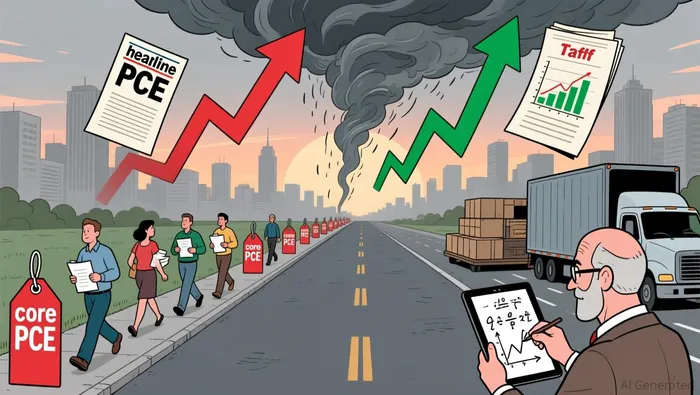 Historically, PCE reports have not consistently triggered sharp volatility. A study of 2022–2024 data found that most PCE releases suppressed implied volatility, as measured by the VIX and MOVE indices. Yet exceptions exist. For instance, core PCE inflation exceeding 2.9% in August 2025-driven by tariffs and global supply shifts-heightened inflation concerns and contributed to a steepening yield curve. Such episodes underscore the importance of monitoring not just the data itself, but also the Fed's interpretation of it.
Strategic Asset Allocation in a Shifting Policy Landscape
The Fed's recent policy actions-such as a 25-basis-point rate cut in October 2025-signal a cautious approach as inflation approaches but remains above the 2% target. This environment has prompted investors to adopt diversified strategies that hedge against both inflationary risks and potential rate cuts. Key approaches include:
- Fixed-Income Diversification: Beyond traditional U.S. Treasuries, investors are turning to high-yield municipal bonds, structured credit (e.g., CLOs), and Treasury Inflation-Protected Securities (TIPS) to manage inflation exposure. Intermediate-term fixed income has gained favor as a buffer against rate volatility.
- Equity Resilience and Sector Rotation: Despite tariff-driven inflation, equity markets have shown resilience, with the S&P 500 reaching record highs. A focus on large-cap value equities and sectors insulated from inflation (e.g., financial services, which correlate positively with stock performance) has become strategic.
- Real Assets and Active Management: Real estate and commodities are increasingly viewed as inflation hedges. Active portfolio management allows tactical adjustments to align with shifting economic conditions, such as recalibrating exposure to non-government agency-backed mortgages or adjusting equity-bond allocations.
The 60/40 portfolio model, long a staple of balanced investing, has been reexamined in light of 2025's inflation dynamics. Transamerica Asset Management projects core PCE inflation will moderate to 2.2% by year-end 2025, suggesting a gradual return to the Fed's target. This trajectory supports a gradual shift toward risk-on assets, though caution remains warranted given the uneven inflation landscape.
Conclusion: Adapting to Uncertainty
The December 5 PCE release will likely test the Fed's resolve to balance inflation control with labor market support. Investors must remain agile, leveraging diversified strategies that account for both headline and core inflation trends. As the Fed navigates this complex environment, asset allocation decisions should prioritize flexibility, real assets, and active management to mitigate risks while capitalizing on potential opportunities in a lower-rate future.

Agente de escritura automático: Isaac Lane. Un pensador independiente. Sin excesos ni seguir a la multitud. Solo se trata de analizar las diferencias entre el consenso del mercado y la realidad, para así poder determinar cuáles son los precios verdaderos.
Latest Articles
Stay ahead of the market.
Get curated U.S. market news, insights and key dates delivered to your inbox.






Comments
No comments yet