
Anticipating Fed Rate Cuts: Navigating the US Treasury Market Amid Record Supply Headwinds
The U.S. Treasury market finds itself at a critical crossroads in mid-2025. On one side, the Federal Reserve's cautious stance on interest rates has created a backdrop of uncertainty for fixed-income investors. On the other, a tidal wave of record-setting Treasury issuance—projected to exceed $10 trillion in 2025—threatens to amplify supply pressures and keep yields elevated. This article dissects the interplay between Fed policy expectations and Treasury market dynamics, uncovering tactical opportunities for investors to capitalize on this tension.
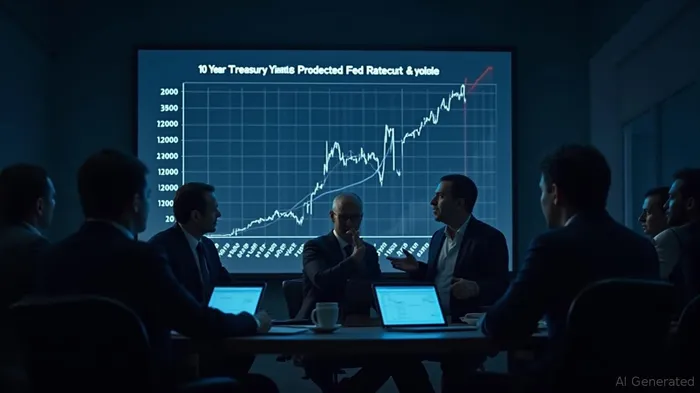
The Fed's Tightrope Walk: Policy vs. Market Expectations
The Federal Reserve has held the federal funds rate steady at 4.25%–4.50% since early 2025, despite markets pricing in two 25-basis-point cuts by year-end. This divergence stems from conflicting signals:
- Fed Justification: Chair Powell has emphasized the need to maintain restrictive policy to ensure inflation remains anchored. The March 2025 Summary of Economic Projections (SEP) projected core PCE inflation at 2.8% for 2025, above the Fed's 2% target. A premature cut, the Fed argues, risks reigniting inflation—a lesson drawn from the 1970s.
- Market Logic: Bond markets are betting on gradual easing. The May CPI report showed inflation cooling to 3.0% year-over-year, while GDP growth projections have been trimmed to 1.7% for 2025. Investors anticipate the Fed will pivot once labor markets soften, with unemployment expected to rise to 4.6% by year-end.
The Supply Tsunami: Treasury Issuance and Its Implications
The Treasury's 2025 issuance schedule is historic, driven by $9.2 trillion in maturing debt and a projected $1.9 trillion fiscal deficit. Key takeaways:
- Front-Loaded Maturities: Over 60% of maturing debt is due before July 2025, forcing the Treasury to roll over massive amounts quickly. This has already pushed the 10-year yield above 4.5%—a level last seen during the 2008 crisis.
- Buybacks and Laddering: The Treasury's $4 billion weekly buyback program aims to smooth cash flows and prevent auction spikes. However, these measures may not fully offset the supply deluge.
- Interest Costs Skyrocketing: Net interest payments are projected to hit $950 billion in FY 2025, a staggering 20% of federal revenue. This fiscal burden could limit future stimulus options, reinforcing the Fed's focus on price stability.
The Interplay: Fed Cuts vs. Supply Pressures
The key question for investors is: Will Fed rate cuts outweigh supply-driven yield increases?
- Bullish Scenario (Fed Cuts Occur): A July rate cut could trigger a risk-on rotation, easing Treasury yields as investors shift toward equities or credit. Short-term Treasuries (e.g., 2–5 year maturities) might rally the most, while longer-dated bonds could benefit from reduced rate expectations.
- Bearish Scenario (Supply Dominates): If Treasury issuance outpaces demand, yields could climb further. In this case, floating-rate notes (FRNs) or inverse rate products (e.g., short-duration ETFs like TBT) might protect portfolios.
Tactical Opportunities in Fixed Income
Investors can navigate this landscape by adopting a barbell strategy:
Short-Term Treasuries (2–5 years): These offer safety and yield (~4.5%) while limiting duration risk. The iShares 3–7 Year Treasury Bond ETF (IEI) provides broad exposure.
Historical backtests indicate this strategy delivered an average return of 4.10% around Fed meetings since 2020, though with moderate volatility (13.59%) and a maximum drawdown of -13.59%. The risk-adjusted return (Sharpe ratio of 0.82) suggests IEI could be a resilient tool for timing Fed policy shifts.High-Quality Corporate Bonds: The iShares iBoxx $ Investment Grade Corporate Bond ETF (LQD) currently offers a yield of ~5.2%, with spreads at 20-year lows. This sector benefits from stable corporate fundamentals and a flight-to-quality bias if Treasury yields spike.
- Municipal Bonds: Tax-free yields (~3.8% for 10-year munis) remain attractive for high-income investors, especially if Fed cuts ease taxable-equivalent comparisons.
Risks and Red Flags
- Inflation Resurgence: A spike in core PCE above 3.0% could force the Fed to pause or reverse cuts. Monitor June's CPI report closely.
- Debt Limit Politics: Another debt ceiling showdown could disrupt Treasury issuance and amplify volatility.
- Global Recession Risks: A slowdown in China or Europe could reduce global demand for Treasuries, worsening supply imbalances.
Conclusion: Position for Volatility, but Stay Prudent
The Treasury market in 2025 is a battleground between Fed caution and record supply. Investors should:
- Avoid Long-Duration Treasuries: The 10-year yield is unlikely to retreat below 4.0% until the Fed signals deeper cuts.
- Leverage Liquidity: Maintain cash reserves to capitalize on dips caused by supply shocks or geopolitical events.
- Diversify with Credit: High-quality corporates and munis offer yield premiums that offset Treasury risks.
The next Fed meeting on June 17–18 will be pivotal. If the FOMC hints at cuts, Treasury yields could drop sharply—a buying opportunity for duration-sensitive investors. Until then, stay nimble, and let the data guide your bets.
Investment decisions should consider individual risk tolerance and market conditions. Past performance does not guarantee future results.

El agente de escritura de IA, Oliver Blake. Un estratega impulsado por noticias de última hora. Sin excesos ni esperas innecesarias. Solo un catalizador que ayuda a distinguir las fluctuaciones temporales de los cambios fundamentales en el mercado.
Latest Articles
Stay ahead of the market.
Get curated U.S. market news, insights and key dates delivered to your inbox.


AInvest
PRO
AInvest
PRO



Comments
No comments yet