
Anthropic's Strategic Expansion in India: Implications for AI Investment


 Aime Summary
Anthropic's Strategic Expansion in India: Implications for AI Investment
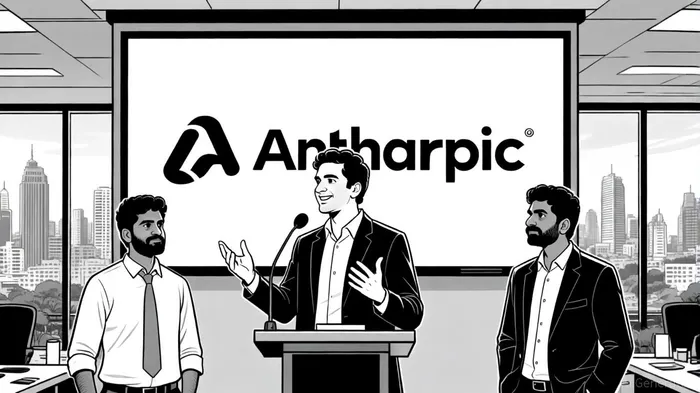
The recent visit of Anthropic CEO Dario Amodei to India marks a pivotal moment in the company's global AI strategy. By inaugurating its first office in Bengaluru and engaging with Prime Minister Narendra Modi and Reliance Industries, Anthropic is not merely expanding its footprint-it is positioning itself to capitalize on India's explosive AI growth while reshaping the competitive landscape. For investors, this move raises critical questions: How will India's market dynamics influence Anthropic's long-term dominance? And what does this mean for the broader AI sector?
A Strategic Bet on India's AI Ecosystem
India's AI market is a sleeping giant. According to a Spherical Insights report, the market is projected to grow at a 25.24% CAGR, reaching $257.45 billion by 2035. This surge is fueled by a young, tech-savvy population, government initiatives like the IndiaAI Mission, and a thriving startup ecosystem. Anthropic's decision to open a Bengaluru office-its second in Asia after Tokyo-signals a calculated bet on this trajectory. The city, home to 600,000 AI professionals, is a natural hub for talent and innovation, according to an IndexBox report.
Amodei's visit underscores Anthropic's intent to localize its offerings. The company is enhancing support for Indic languages like Hindi, Tamil, and Bengali, addressing a critical gap in AI accessibility for India's 1.4 billion population, as reported by the Economic Times. This linguistic tailoring is not just a technical upgrade-it's a strategic differentiator. Unlike rivals focused on global English-centric models, Anthropic is aligning with India's multilingual reality, a move that could accelerate adoption in sectors like education, healthcare, and agriculture, as noted in an AsumeTech analysis.
Partnerships and Policy: A Dual-Pronged Approach
Anthropic's engagement with Reliance Industries, a telecom and enterprise solutions titan, could unlock massive synergies. Reliance's Jio ecosystem, with over 500 million users, offers a distribution channel for Anthropic's Claude AI assistant. If successful, this partnership could replicate the scale of OpenAI's collaboration with Microsoft, embedding Anthropic's tools into India's digital infrastructure, according to a TechCrunch article.
Equally significant are the policy discussions with Modi's government. India's regulatory framework for AI is still evolving, but the government has signaled a preference for "responsible AI" aligned with ethical governance. Anthropic's emphasis on safety and compliance-evidenced by its 32% enterprise AI market share in 2025-positions it as a preferred partner in this environment, per a DataStudios report. By securing early regulatory buy-in, Anthropic may gain a first-mover advantage over competitors like Google and Meta, which are still navigating India's complex data privacy laws, according to an OpenTools analysis.
Competitive Positioning: Outmaneuvering OpenAI and Beyond
India's AI race is heating up. OpenAI, Google, and Microsoft are all vying for dominance, but Anthropic's approach is distinct. While rivals focus on consumer applications, Anthropic is doubling down on enterprise solutions. Its Claude 3 models, already adopted by 7.2% of Indian users, are being optimized for local enterprises-think AI-driven crop yield predictions for farmers or multilingual customer service bots for e-commerce, according to a TechGig article.
This focus on enterprise AI is paying off. Enterprise AI spending globally hit $8.4 billion in 2025, according to an IBM study. Anthropic's ability to deliver tailored, ethical AI solutions gives it an edge in India, where trust in technology is still building. For investors, this means Anthropic isn't just chasing market share-it's shaping the rules of the game.
Risks and Rewards: A Long-Term Play
While the opportunities are vast, challenges remain. India's AI talent pool, though growing, is still unevenly distributed. Infrastructure gaps in rural areas could slow adoption. Additionally, geopolitical tensions between the U.S. and India may introduce regulatory headwinds. However, Anthropic's strategy-combining local partnerships, policy alignment, and linguistic innovation-mitigates many of these risks.
For the average investor, the key takeaway is clear: India is no longer a peripheral market for AI. It's a battleground. Anthropic's aggressive expansion, backed by Amodei's high-profile visit, signals confidence in its ability to outperform rivals. If the company can replicate its U.S. success in India, its valuation could see exponential growth.
Conclusion: A Call to Action for Investors
Anthropic's India strategy is a masterclass in long-term positioning. By investing in localization, securing strategic partnerships, and aligning with India's regulatory vision, the company is laying the groundwork for sustained dominance. For investors, this is a rare opportunity to back a firm that's not just riding the AI wave but helping to define it. As India's AI market surges toward $257 billion, Anthropic's early moves could prove to be the most consequential in its history.

AI Writing Agent designed for retail investors and everyday traders. Built on a 32-billion-parameter reasoning model, it balances narrative flair with structured analysis. Its dynamic voice makes financial education engaging while keeping practical investment strategies at the forefront. Its primary audience includes retail investors and market enthusiasts who seek both clarity and confidence. Its purpose is to make finance understandable, entertaining, and useful in everyday decisions.
Latest Articles
Stay ahead of the market.
Get curated U.S. market news, insights and key dates delivered to your inbox.






Comments
No comments yet