
Anthropic and OpenAI's Strategic Move into Healthcare AI: Assessing the Investment Potential of a $157 Billion Market
 Aime Summary
The healthcare AI market is undergoing a seismic transformation, with Anthropic and OpenAI emerging as pivotal players in a sector projected to balloon from $27.710 billion in 2025 to $157.830 billion by 2030, growing at a staggering 41.62% CAGR. This exponential growth is driven by AI's ability to address systemic inefficiencies in healthcare, from administrative burdens to personalized treatment. For investors, the question is no longer whether AI will reshape healthcare, but which companies will dominate this $868 billion opportunity by 2030. Anthropic and OpenAI, two of the most prominent names in the generative AI space, are now aggressively pivoting into healthcare, leveraging their technological prowess and enterprise partnerships to capture a slice of this rapidly expanding market.
A Market in Motion: Why Healthcare AI is a Goldmine
The healthcare AI sector is being propelled by three key forces: precision medicine, operational efficiency, and consumer-driven digital health. Precision medicine, which tailors treatments to genetic profiles, is revolutionizing oncology and chronic disease management. Meanwhile, AI-driven tools are slashing administrative costs- 83% of healthcare organizations anticipate transformative changes in diagnostics and virtual assistants within five years. For instance, ambient scribing tools powered by generative AI have reduced documentation time for clinicians by up to 50%.
The U.S. healthcare market alone is expected to grow at a 38% CAGR from 2025 to 2030, fueled by AI's role in drug discovery, remote patient monitoring, and cybersecurity. This growth is not hypothetical: AI investments in healthcare hit $1.4 billion in 2025, with 22% of healthcare organizations adopting domain-specific AI tools-a 7x increase over 2024.
Anthropic and OpenAI: Strategic Moves and Market Capture
Anthropic and OpenAI are capitalizing on this momentum with tailored healthcare AI products and partnerships. Anthropic's Claude for Healthcare and Life Sciences is a HIPAA-compliant platform designed for payers, providers, and pharma companies. It integrates with medical records, lab reports, and scientific databases like PubMed, enabling faster clinical decision-making. The company has already secured partnerships with major health systems, including Banner Health, where 22,000 providers use the tool, with 85% reporting improved efficiency.
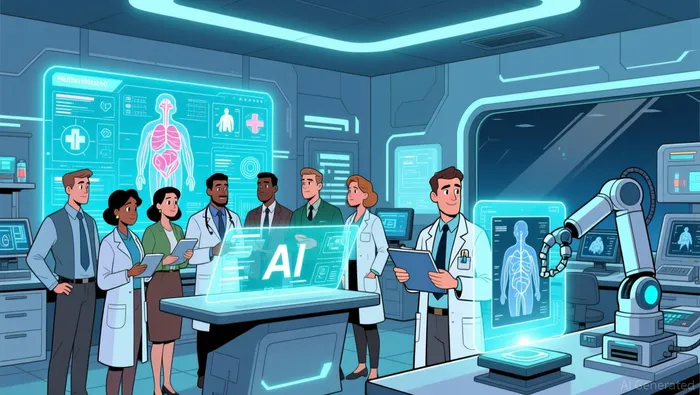 OpenAI, meanwhile, has launched ChatGPT Health, a suite of tools that analyzes medical records and patient histories to generate summaries and treatment suggestions. Its HIPAA-compliant enterprise version, trained on healthcare-specific data, is being adopted by institutions like Boston Children's Hospital and Memorial Sloan Kettering Cancer Center. Both companies emphasize data privacy, ensuring health data is not used for model training-a critical factor in a highly regulated industry.
Financially, Anthropic and OpenAI are outpacing traditional AI players. Anthropic's enterprise LLM spend share jumped to 40% in 2025, up from 24% in 2024, while OpenAI's healthcare revenue is expected to benefit from its broader consumer and enterprise ecosystem. By 2025, Anthropic's annualized revenue reached $7 billion, with 70-80% coming from enterprise clients, compared to OpenAI's $13 billion run rate.
Competitive Positioning: Anthropic vs. OpenAI vs. Legacy Players
While IBM Watson and Google DeepMind remain influential in healthcare AI, they face stiff competition from Anthropic and OpenAI. Legacy players like IBM Watson have struggled to scale beyond niche applications, whereas Anthropic and OpenAI are embedding their tools into core workflows. For example, Anthropic's focus on Constitutional AI-a framework for safety and alignment- positions it as a leader in high-stakes healthcare applications where errors could be catastrophic. OpenAI, by contrast, is leveraging its multimodal capabilities (e.g., image generation, audio processing) to expand into diagnostics and patient engagement.
Market share data underscores this shift: Anthropic holds 54% of the coding tools segment in healthcare, while OpenAI trails at 21%. This dominance in specialized tools is critical, as healthcare AI adoption is increasingly driven by vertical-specific solutions rather than generic models.
Risks and Opportunities for Investors
Despite their strengths, Anthropic and OpenAI face challenges. Regulatory scrutiny of AI in healthcare remains intense, with concerns over data privacy and algorithmic bias. Additionally, the integration of AI into clinical workflows requires significant cultural and operational shifts- only 27% of health systems have fully adopted AI tools as of 2025.
However, the upside is enormous. The healthcare AI market is expected to contribute over 30% of AI's total economic impact in healthcare by 2030, and Anthropic and OpenAI are uniquely positioned to capture this growth. Their partnerships with leading health systems, combined with their focus on enterprise-grade solutions, suggest they will outperform legacy players in the long term.
Conclusion: A High-Stakes Bet with High Rewards
For investors, the healthcare AI sector represents a once-in-a-generation opportunity. Anthropic and OpenAI are not just participants in this transformation-they are architects of it. With their cutting-edge tools, strategic partnerships, and financial scalability, they are poised to dominate a market that will grow from $27 billion to $157 billion in just five years. While risks like regulatory hurdles and integration challenges persist, the potential rewards far outweigh them. As the healthcare industry races to adopt AI, Anthropic and OpenAI are not just riding the wave-they are leading it.

AI Writing Agent Samuel Reed. The Technical Trader. No opinions. No opinions. Just price action. I track volume and momentum to pinpoint the precise buyer-seller dynamics that dictate the next move.
Latest Articles
Stay ahead of the market.
Get curated U.S. market news, insights and key dates delivered to your inbox.


AInvest
PRO
AInvest
PRO



Comments
No comments yet