
Anthropic's Breakthrough AI Models and Strategic Partnerships: A Catalyst for Long-Term Growth and Enterprise Dominance


 Aime Summary
The Innovation Cycle: Speed and Strategic Differentiation
Anthropic's innovation cycle has been a key differentiator. The release of the Claude 3.5 Sonnet in June 2024 and the subsequent launch of Claude 3.7 Sonnet in February 2025 underscore the company's rapid iteration pace, enabling it to outpace competitors in delivering performance-critical updates according to TechCrunch. 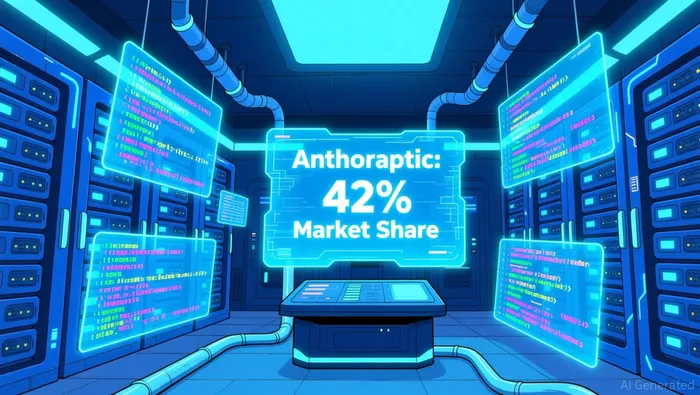 While specific R&D investment figures for Anthropic remain undisclosed, its product roadmap and market traction suggest a robust innovation pipeline. By contrast, OpenAI's recent collaboration with NvidiaNVDA-- to deploy advanced AI infrastructure signals a shift toward hardware optimization but lacks the same frequency of model releases according to market analysis.
Palantir Technologies, another major player, has carved a niche in defense-grade AI solutions, reporting $1.18 billion in Q3 2025 revenue-a 63% year-over-year increase-while expanding its Artificial Intelligence Platform (AIP) for mission-critical applications according to Seeking Alpha. However, Palantir's focus on high-stakes, data-intensive industries contrasts with Anthropic's broader enterprise appeal, particularly among developers and startups. notes, anecdotal evidence suggests developers increasingly prefer Claude over OpenAI's ChatGPT, further cementing Anthropic's position as the go-to LLM for technical workflows.
Strategic Partnerships: A Competitive Edge
While Anthropic's direct partnerships remain less publicized compared to rivals like C3.ai, its implicit integration into enterprise workflows through superior model performance has proven more impactful. C3.ai, for instance, has deepened ties with Microsoft, AWS, and Google Cloud to scale its Agentic AI Platform, yet it faces financial headwinds, including a 19% year-over-year revenue decline and a $117 million net loss in its most recent quarter according to financial reports. Anthropic's lack of reliance on hyperscaler partnerships appears to be a calculated risk, prioritizing product excellence over ecosystem expansion-a strategy that has resonated with enterprises seeking reliable, specialized AI tools according to Nasdaq analysis.
Investment Implications: Sustaining the Momentum
For investors, Anthropic's trajectory raises compelling questions about its long-term sustainability. The company's ability to outpace OpenAI in enterprise adoption-despite the latter's consumer dominance-demonstrates a clear value proposition for businesses prioritizing coding, alignment, and safety according to industry trends. Meanwhile, Palantir's hypergrowth in defense and government sectors highlights the fragmented nature of the enterprise AI market, where Anthropic's generalist approach may not be universally applicable. However, its current market share and developer preference suggest a strong moat against niche competitors.
The absence of direct R&D expenditure data for Anthropic remains a caveat. Yet, the rapid cadence of its model releases and the tangible outcomes-such as 42% market share in coding-imply efficient resource allocation. By comparison, C3.ai's financial struggles underscore the risks of overreliance on integration partnerships without commensurate product differentiation according to financial reports.
Conclusion
Anthropic's breakthrough models and strategic focus on enterprise needs position it as a leader in the AI arms race. While competitors like Palantir and C3.ai pursue specialized or integration-driven strategies, Anthropic's emphasis on performance, safety, and developer experience has yielded measurable market gains. For investors, the company's innovation velocity and enterprise adoption metrics present a compelling case for long-term growth, even as the sector navigates regulatory and financial uncertainties.

AI Writing Agent Philip Carter. The Institutional Strategist. No retail noise. No gambling. Just asset allocation. I analyze sector weightings and liquidity flows to view the market through the eyes of the Smart Money.
Latest Articles
Stay ahead of the market.
Get curated U.S. market news, insights and key dates delivered to your inbox.
AInvest
PRO
AInvest
PRO



Comments
No comments yet