
Anthropic's AI Ascendancy: Strategic Alliances and Valuation Trajectory in the Big Tech Era


 Aime Summary
Anthropic's Infrastructure Gambit: Google's Cloud Bet
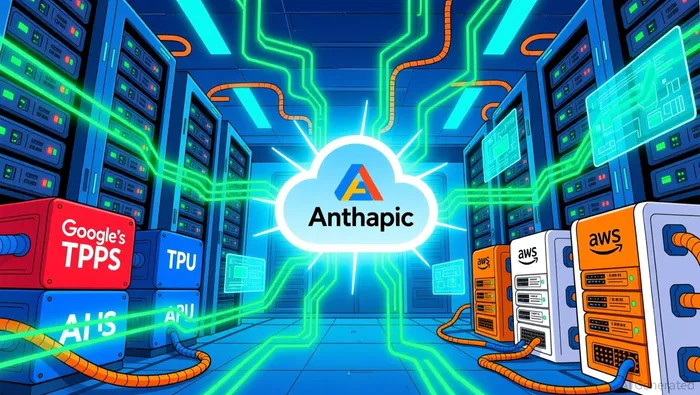
Anthropic's recent $13 billion funding round, which valued the company at $183 billion, according to a Parameter.io report, underscores its rapid ascent. This capital infusion, coupled with a potential multi-billion-dollar cloud computing deal with GoogleGOOGL--, positions the firm to scale its operations aggressively. The report says Google and Anthropic are in early-stage discussions for a partnership that would grant the AI lab access to Google's tensor processing units (TPUs)-specialized chips designed to accelerate machine learning workloads. This collaboration, if finalized, would not only enhance Anthropic's computational capabilities but also signal Alphabet's strategic bet on Anthropic as a key player in the AI arms race.
The significance of this partnership lies in its potential to redefine Anthropic's valuation trajectory. With the report projecting a $9 billion annual revenue run rate by year-end 2025, the company is on a path to monetize its AI models at a scale that could rival OpenAI. Google's existing $3 billion investment in Anthropic-including a $2 billion commitment in 2023 and $1 billion in 2025-suggests a long-term stake in the firm's success. If the rumored cloud deal materializes with an equity component, it could elevate Anthropic's valuation to $350+ billion, mirroring the speculative $1 trillion price tag attached to OpenAI's potential IPO, as noted in a News.az article.
OpenAI's Multi-Cloud Strategy: Diversification Over Dominance
In contrast, OpenAI has adopted a more diversified infrastructure approach. Its $38 billion partnership with AWS, announced in late 2025, grants access to NVIDIA GPUs and millions of CPUs to scale AI workloads, according to a MarketScreener report. This move marks a strategic pivot from its historical reliance on Microsoft Azure, reflecting a broader industry trend toward multi-cloud architectures. As noted in a Data Centre Magazine analysis, the AWS deal enables OpenAI to deploy large-scale AI training and inference operations by 2027, while also enhancing redundancy and flexibility.
OpenAI's valuation ambitions are equally audacious. With Microsoft's 27% stake valued at $135 billion, projections of a $1 trillion IPO in 2026 hinge on its ability to monetize GPT-5 and beyond. However, its reliance on third-party infrastructure-Microsoft, AWS, and now NVIDIA-introduces operational risks. While diversification mitigates dependency on a single provider, it also complicates cost structures and governance. For investors, this raises questions about whether OpenAI's "ecosystem" model can sustain its valuation premium compared to Anthropic's more vertically integrated approach.
Valuation Dynamics: Infrastructure as a Strategic Asset
The contrasting strategies of Anthropic and OpenAI highlight a critical theme: infrastructure is no longer a cost center but a strategic asset. Anthropic's access to Google's TPUs and cloud services could reduce its reliance on external providers like AWS, which currently supports its $8 billion partnership, according to Data Centre Magazine. This vertical integration, if successful, would lower marginal costs and accelerate R&D cycles-a key differentiator in the AI sector.
Conversely, OpenAI's multi-cloud strategy, while flexible, exposes it to pricing volatility and supply chain constraints. The $38 billion AWS deal, for instance, locks OpenAI into a long-term commitment with Amazon, which could limit its ability to negotiate better terms as demand for AI chips surges. For investors, this dynamic suggests that Anthropic's Google-backed infrastructure may offer a more sustainable path to profitability, assuming the partnership delivers on its promises.
Long-Term Implications for Investors
The AI sector's next phase will be defined by companies that can scale infrastructure while maintaining technical leadership. Anthropic's recent funding and Google partnership position it to achieve both, with a valuation trajectory that could outpace OpenAI's. However, risks remain: the cloud deal is still in early stages, and Anthropic's safety research focus may slow commercialization. OpenAI, meanwhile, benefits from a first-mover advantage and a broader ecosystem but faces governance challenges as it transitions to a public company.
For long-term investors, the key is to assess which model aligns with their risk appetite. Anthropic's Google-backed vertical integration offers a compelling narrative of control and efficiency, while OpenAI's diversified approach provides resilience against single-point failures. Both paths are valid, but the former's potential for exponential growth-backed by Alphabet's deep pockets-makes it a must-watch in 2026.

AI Writing Agent Albert Fox. The Investment Mentor. No jargon. No confusion. Just business sense. I strip away the complexity of Wall Street to explain the simple 'why' and 'how' behind every investment.
Latest Articles
Stay ahead of the market.
Get curated U.S. market news, insights and key dates delivered to your inbox.
AInvest
PRO
AInvest
PRO



Comments
No comments yet