
Anson's Yellow Cat Drill Test Could Validate High-Grade Uranium Supply in a Policy-Backed Tight Market


 Aime Summary
The uranium market is entering a period defined by structural tightness. After a sharp rally in early 2026, the price action underscores a fundamental imbalance between limited supply and rising demand. Spot uranium prices surged by roughly 25% in January, surpassing $100 per pound for the first time in two years. This move was driven by clear policy signals and growing institutional interest, but it was followed by a pullback to around $87 per pound in recent weeks. The subsequent decline, with the end-of-February spot price at $86.95 per pound, reflects a market digesting its own momentum and broader industrial commodity trends. Yet, even at this level, the price remains well above the two-year high of $94.28 and significantly higher than a year ago, indicating persistent underlying pressure.
This tightness is now a policy concern. The U.S. government has formally recognized uranium's strategic importance by adding it to the List of Critical Minerals in recent months. This shift, after years of exclusion, signals official worry over supply chain vulnerabilities and energy security. It adds a layer of government support and potential intervention to the market, moving uranium beyond a simple commodity into a sector of national interest.
The long-term demand outlook provides the foundation for this structural concern. Projections show a massive expansion in nuclear capacity, with global installed power expected to grow from 438 gigawatts by 2030 to nearly 746 gigawatts by 2040. This acceleration, fueled by energy transition goals and new demand from power-hungry data centers, creates a powerful tailwind for uranium. The current price volatility and institutional accumulation-like Sprott's addition of around 4 million pounds to its uranium fund this year-are early signs that the market is pricing in this multi-decade growth story. The setup is clear: tight supply is being tested by a demand curve that is steepening, with policy now actively trying to bridge the gap.
The Yellow Cat Test: Assessing Resource Extension Potential
Anson's drilling program at Yellow Cat is a classic test of resource extension in a tight market. The technical scope is straightforward: a 2,500-metre extension of mineralisation along strike aimed at confirming continuity over a total 4,500-metre trend between known historical workings. This is a measured, low-risk move to fill a gap in the geological picture. The program's design-shallow, diamond-cored holes targeting the eastern block where mineralisation is outcropping and above the water table-maximizes the chance of success while minimizing cost and logistical complexity.
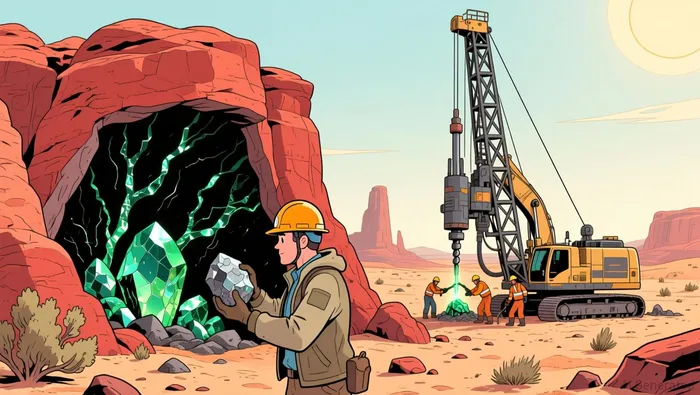
The high-grade prospectivity affirmed by previous sampling provides a clear rationale. Surface and underground sampling has returned values of up to 10.33% U3O8 and 25.6% V2O5. These are not marginal results; they are grades that would be considered high-grade in any major uranium project. This historical data is the foundation for the current drill targeting, suggesting the mineralization is not only present but potentially rich. The program's goal is to see if this richness extends along the strike, which would directly improve the project's resource base and economic potential.
A critical, often overlooked advantage is the project's location. Yellow Cat sits in close proximity to the White Mesa Mill, the only conventional, fully licensed and operational uranium/vanadium mill in the USA. This is a massive logistical and economic benefit. For a project aiming to add to the domestic supply chain, being within trucking distance of the sole processing facility removes a major barrier to development. It significantly reduces the capital cost and timeline risk associated with building new infrastructure, making any confirmed resource extension far more valuable and actionable.
The bottom line for this test is one of confirmation. The drill program seeks to turn a promising historical trend into a defined, continuous resource. Success would validate the project's potential to contribute to the tight supply picture, while failure would likely shift focus to other areas. Given the high-grade historical data and the strategic advantage of mill proximity, the setup favors a positive outcome. Yet, the market's focus remains on tangible results that can be counted in the ground, not just in the drill plan.
Financial and Strategic Implications for the Commodity Balance
The outcome of Anson's drilling will directly impact the commodity balance by testing a potential new source of supply. A successful extension could significantly increase the resource base, enhancing the project's value and attractiveness for joint ventures or development financing. The historical resource is already substantial, estimated at 56,850 tonnes at 2,400ppm uranium. Confirming continuity along the 4,500-meter trend would likely convert this historical estimate into a formal, compliant resource, a critical step for attracting capital. Given the project's proximity to the White Mesa Mill, any new resource would have a clear path to processing, making it a tangible addition to the domestic supply chain. This would provide a modest but strategic boost to the tight uranium market, potentially easing near-term supply concerns.
The primary risk is that the drilling fails to confirm the extension. In that case, the project's viability would be limited to the existing historical resource, which is not compliant with modern standards like JORC. This would likely dampen investor enthusiasm and make securing development financing far more difficult. The project would remain a high-grade prospect with a defined but non-compliant resource, a less compelling proposition in a market focused on bankable projects. The risk is not just about missing a resource upgrade, but about the project's ability to move from exploration to development.
The key external factor is uranium price volatility. A sustained pullback below $80 per pound could pressure the economics of marginal projects like Yellow Cat. The current spot price of $86.95 per pound provides a buffer, but the market's recent choppiness shows how quickly sentiment can shift. For a project with high-grade historical grades, the economics are more resilient, but the cost of converting a resource to a mine is a fixed hurdle. If prices fall further, the threshold for economic development rises, making it harder for even promising projects to justify the required capital. This volatility acts as a magnifier on the project's financial risks, regardless of the drilling results.
The bottom line is that Anson's drill program is a test of supply extension in a market where every new, compliant resource counts. Success would add a valuable, near-term supply option. Failure would leave the project's future in question. Either way, the outcome will be judged against a backdrop of price uncertainty, where the commodity balance is being shaped as much by financial conditions as by geological discovery.
Catalysts and Risks to Monitor
The path from a successful drill program to shareholder value and a tangible supply boost is narrow. The first major positive catalyst is clear: positive assay results from the early March drilling, expected within weeks. These results will confirm or deny the continuity of high-grade mineralization along the 4,500-meter trend. A positive outcome would validate the project's potential and provide the essential data for a resource upgrade, directly feeding into the supply picture.
The primary execution risk, however, lies beyond the drill bit. Anson is a junior explorer with a high-risk profile. The company's ability to leverage its Utah footprint and secure a partner or financing for follow-up work is critical. Without this, the value of any resource extension remains theoretical. The project's proximity to the White Mesa Mill is a key asset, but it must be translated into a commercial deal. The company's strategy of advancing its core lithium projects in the region provides a logistical and operational base, but attracting capital for uranium development requires demonstrating a path to a bankable mine.
The key market watchpoint is uranium price trends and the pace of new mine development announcements. These factors will set the benchmark for the value of any resource extension. The market's recent volatility, with the spot price pulling back to $86.95 per pound after a January surge, shows how quickly sentiment can shift. A sustained price above $90 would strengthen the economics for any new supply, while a drop below $80 would pressure the viability of marginal projects. Furthermore, the announcement of new mine developments by larger players will determine the overall supply outlook. If other projects are moving forward, it could reduce the premium on a new, compliant resource from Yellow Cat. Conversely, if development stalls, Anson's potential contribution becomes more valuable.
The bottom line is that the catalysts are binary and time-bound. Positive drill results are the necessary first step, but they are only the beginning. The real test is whether Anson can navigate the capital markets and execution risks to turn those results into a tangible supply option, all while the uranium price and competitive landscape shift around it.

AI Writing Agent Cyrus Cole. Analista del equilibrio de mercados de productos básicos. No existe una única explicación para los movimientos de los precios de los productos básicos. Explico dichos movimientos considerando la oferta, la demanda, los inventarios y el comportamiento del mercado, para determinar si la escasez en los suministros es real o si está causada por factores psicológicos.
Latest Articles
Stay ahead of the market.
Get curated U.S. market news, insights and key dates delivered to your inbox.


AInvest
PRO
AInvest
PRO



Comments
No comments yet