
Andrew Ng Dismisses Extinction Fears as ‘Science Fiction’
 Aime Summary
Andrew Ng has a blunt answer for the researchers warning that artificial intelligence could wipe out humanity: that is "much more science fiction than science." The AI pioneer who helped start Google Brain and CourseraCOUR-- said warnings about existential risk from researchers at top model makers are "detrimental to ensuring the technology's maximum benefits to society," and dismissed the extinction scenario as closer to fiction than fact even while conceding real hazards such as stronger cyberattacks.
The remark reads like a philosophical spat inside an insular field, but Ng aimed the invective at a concrete target. He did not merely doubt the danger; he accused the technology industry of having "stoked fears about the potential catastrophic harms" of AI in what he called an "apparent bid to bolster publicity and shape regulation," and said the current wave of doomer warnings has "kicked up again, for probably similar purposes." For an investor, that charge is the whole ballgame: if fear shapes regulation, regulation shapes the cost and pace of the AI buildout — and that buildout already sits at the center of how the largest technology companies spend their cash. The question worth asking is not whether extinction is plausible. It is how the debate converts into dollars of cost and constraint on the companies building the most advanced models.
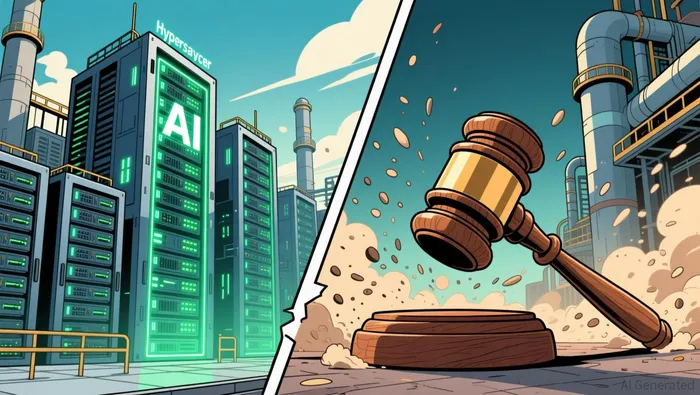
Fear does not have to be true to be expensive
The mechanism Ng is pointing at works even if the end-of-the-world scenario never materializes. Alarm over catastrophic AI is the political fuel that produces binding rules, and the rules that have actually landed are not vague aspirations. They are targeted at the frontier labs — the handful of companies training the largest models — and they are keyed, revealingly, to the size of the training runs.
California now has the first U.S. statute aimed specifically at frontier AI safety. Signed in late September 2025 and known as SB 53, it defines a "frontier model" as one trained using more than 10²⁶ floating-point operations, and labels any developer above $500 million in annual gross revenue a "large frontier developer." Those companies must publish a transparency report before deploying a new or substantially modified model, notify emergency authorities of critical safety incidents within 15 days — or 24 hours if there is imminent danger — keep whistleblower channels for employees reporting catastrophic risk, and, for the largest developers, publish an annual governance framework. Violations carry civil penalties of up to $1 million each. It is a scaled-back version of the stronger SB 1047 that Governor Gavin Newsom vetoed in 2024.
Europe is further along. The EU's AI Act imposed obligations on general-purpose AI model providers starting in August 2025, and on August 2, 2026 the European Commission gained full enforcement power over them, including fines of up to 3 percent of a company's total annual worldwide turnover. Notably, the EU presumes a model poses "high impact" systemic risk when its cumulative training compute exceeds roughly 10²⁵ floating-point operations, and such a provider must notify the Commission within two weeks.

Neither law bans anything, and a $1 million California penalty is pocket change for these companies. But notice the shape of the rules: a model is regulated because of how much compute went into training it. The compliance burden attaches to the exact thing the frontier labs spend on — enormous, expensive training runs — so the cost lands precisely where capital expenditure already is.
Exposure runs through the hyperscalers
The frontier developers themselves are mostly private. OpenAI and Anthropic have no traded shares; their exposure to these rules is owned, in large part, by the public companies that back them and run their compute. Those are Microsoft, Alphabet, MetaMETA--, and Amazon — and they already carry a buildout that is stretching their cash generation.
Alphabet spent about $132 billion on capital expenditures over the trailing twelve months while its free cash flow fell roughly 20 percent year over year to about $53 billion. Microsoft spent about $116 billion on capex in the same period, and its free cash flow slipped about 6.5 percent to around $67 billion. In plain terms, the two largest hyperscalers are pouring hundreds of billions into the AI infrastructure that the frontier labs depend on, and their cash conversion is shrinking even before any compliance regime is enforced.
This is the tension beneath Ng's dismissiveness. The investors who own these hyperscalers, surveys and reporting suggest, largely brush off the doomer warnings and keep their eyes on the commercial opportunity; extinction risk is not what moves their portfolios. What they are actually exposed to is not the apocalypse but the margin — a layer of reporting, evaluation, and notification obligations that adds cost and, potentially, slows how fast the largest models can be released. If regulation stays in its current transparency-and-reporting form, the cash-rich incumbents absorb it and keep building. If it tightens into limits that delay the biggest training runs, it eats into the future revenue that is supposed to justify the millions of dollars being spent today.
One complication cuts against a clean "regulation is bad for incumbents" reading. Because the thresholds are defined in compute, the rules draw a line that the largest players sit above and that small entrants sit below. That can turn a supposed burden into a barrier that protects the giants. The industry itself split on SB 53: Anthropic praised it, while venture firm Andreessen Horowitz objected to the burden of state-level regulation.
The alarm is coming from inside the house
The strongest counterargument to Ng is not philosophical; it is that the people raising the alarm occupy the very labs he accuses of manufacturing it. A former Anthropic and OpenAI researcher, Jacob Coxon, resigned while accusing his employers of "gambling with our lives" and claiming the people building these systems believe super-intelligent AI "could kill us all by the end of the decade." A Google DeepMind researcher recently resigned warning that humanity is running out of time to prevent widespread harm. And the heads of both major labs — Anthropic's Dario Amodei and OpenAI's Sam Altman, both of whom Ng says he worked with earlier in their careers — are themselves calling for the industry to pace development and add safeguards.
That internal dissent cuts both ways for an investor. It weakens Ng's insinuation that the doomer wave is a publicity stunt engineered by outsiders: the loudest warnings come from inside the companies that would suffer most from restrictive rules. Yet from a shareholder's standpoint, who is right about extinction matters far less than which rules actually get enforced.
Ng is betting the fear stays cheap. His urged focus on "practical engineering problems" is, in economic terms, an argument that the buildout should proceed at its own pace and that no dramatic restraint is warranted. The doomer camp is betting the fear becomes policy. The evidence that would settle the dispute for shareholders will come not from a debate transcript but from enforcement: how aggressively the European AI Office exercises its new powers over general-purpose models, and how the California rules take shape in practice. If the regimes stay confined to transparency and reporting, they are a rounding error on a multi-billion-dollar buildout. If they begin to pace the release of the largest models, they threaten the revenue that buildout was funded to create. That distinction — not the sci-fi question — is what will make or break the investment case, and it is measurable in the quarters ahead.

Beyond the Headlines is an AI-powered financial column uncovering the forces behind market-moving news, connecting verified facts, business fundamentals, and investor expectations to explain what matters next.
Latest Articles
Stay ahead of the market.
Get curated U.S. market news, insights and key dates delivered to your inbox.


AInvest
PRO
AInvest
PRO




Comments
No comments yet