
Analyzing the Recent PENGU Price Drop: Catalysts and Implications for Crypto Investors


 Aime Summary
Catalysts Behind the PENGU Collapse
The PENGU price drop was not a singular event but a cascade of interrelated triggers. Regulatory uncertainty loomed large, as global policymakers continued to refine frameworks like the U.S. GENIUS Act and the EU's MiCA, creating a climate of unpredictability for crypto projects. Simultaneously, algorithmic trading systems-designed to amplify liquidity-exacerbated the sell-off by triggering automated stop-loss orders and margin calls. Compounding these issues was a $66.6 million team activity event, which, while not uncommon in the NFT and tokenized asset space, eroded trust among retail investors already wary of project transparency.
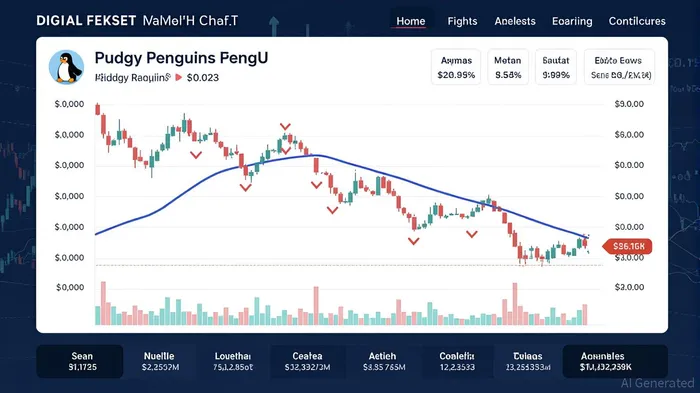
Technical indicators further amplified the bearish sentiment. PENGU's price struggled against the $0.0095 resistance level, triggering a 12% drop in the 24 hours preceding December 1, 2025. The Money Flow Index (MFI) entered the "sell zone," signaling sustained capital outflows, while the Parabolic SAR confirmed a strengthening downtrend as reported. Yet, not all signals were uniformly bearish: On-Balance Volume (OBV) and the Moving Average Convergence Divergence (MACD) hinted at potential short-term buying interest, with daily trading volume surging to $202 million. This duality-between technical bearishness and pockets of optimism-reflects the fragmented nature of crypto market sentiment.
Systemic Risks Exposed
The PENGU collapse laid bare deeper vulnerabilities in the crypto ecosystem. The 28.5% plunge in PENGU-USDT pairs triggered a liquidity crisis, exposing the fragility of stablecoin-backed assets like USDTUSDT--. As investors fled opaque stablecoins, capital flowed toward regulated alternatives such as USDCUSDC--, a shift accelerated by recent regulatory advancements. This exodus highlighted the critical importance of transparent reserve management and robust governance for stablecoins, which remain a linchpin of decentralized finance (DeFi) infrastructure according to analysis.
Broader systemic risks also emerged. The financialization of crypto assets-via ETFs, institutional leverage, and cross-chain integrations-has increased the sector's interconnectedness with traditional finance, raising concerns about cascading defaults. Meanwhile, technical risks such as smart contract vulnerabilities and cross-chain bridge exploits remain underappreciated, despite their potential to trigger catastrophic failures. These challenges underscore the need for rigorous audits, algorithmic stability mechanisms, and conservative reserve management practices as detailed in risk assessments.
Risk Management Strategies for Investors
For investors navigating this volatile environment, proactive risk management is paramount. First, diversification remains a cornerstone strategy. By spreading exposure across asset classes and stablecoins with verifiable collateral-such as USDC or EURS-investors can mitigate the impact of depegging events as noted. Second, liquidity indicators like redemption rates and order-book depth should be monitored closely, as they provide early warnings of systemic stress according to market analysis.
Regulatory compliance also offers a defensive edge. Assets aligned with frameworks like MiCA or the GENIUS Act are likely to weather regulatory scrutiny better than their unregulated counterparts as reported. Additionally, investors should prioritize projects with transparent governance structures and auditable reserves, reducing exposure to opaque team activities as highlighted in industry reports.
Finally, technical analysis can complement fundamental due diligence. While indicators like MFI and Parabolic SAR highlight bearish momentum, tools such as OBV and MACD can identify potential short-term rebounds according to technical analysts. However, these signals must be interpreted cautiously, as algorithmic trading systems can distort price action during periods of high volatility.
Conclusion
The PENGU price drop of late 2025 serves as a cautionary tale for crypto investors. It illustrates how regulatory uncertainty, algorithmic amplification, and opaque project practices can converge to trigger systemic risks. Yet, it also highlights opportunities for those who adopt disciplined risk management strategies. By prioritizing transparency, diversification, and liquidity monitoring, investors can better navigate the turbulence of a maturing crypto market. As the sector evolves, the lessons from PENGU's collapse will be critical in building a more resilient financial ecosystem.

Blending traditional trading wisdom with cutting-edge cryptocurrency insights.
Latest Articles
Stay ahead of the market.
Get curated U.S. market news, insights and key dates delivered to your inbox.






Comments
No comments yet