
Analyzing Legal and Shareholder Risks in the Guess?, Inc. Merger with Authentic Brands Group LLC


 Aime Summary
The pending merger between Guess?, Inc. (NYSE: GES) and Authentic Brands Group LLC has ignited a firestorm of legal scrutiny and shareholder skepticism. At the heart of the controversy lies a $16.75-per-share cash offer, which, while representing a 73% premium over Guess?'s unaffected stock price on March 14, 2025, according to the company press release, has drawn sharp criticism from multiple law firms investigating potential fiduciary duty breaches by the board and insiders, as reported by Morningstar. This analysis unpacks the legal risks, valuation implications, and investor protection mechanisms in this high-stakes deal.
Fiduciary Duty Concerns and Legal Precedents
Bleichmar Fonti & Auld LLP, along with other firms like Monteverde & Associates and The Ademi Firm, is probing whether Guess?'s board acted in shareholders' best interests, according to Morningstar. The crux of the issue: co-founders Paul Marciano (Chief Creative Officer) and Maurice Marciano, along with CEO Carlos Alberini, will retain 49% of the new intellectual property holding company and 100% of the operating company post-merger, a structure described in the Business Wire release. Critics argue this structure disproportionately benefits insiders while limiting competitive bids through restrictive terms, an outcome highlighted in coverage by Business of Fashion.
Legal precedents offer mixed guidance. In Dixie v. Scheer (2025), courts emphasized the need for rigorous due diligence in share transfers-a principle discussed on the Bluestone Law blog-that could apply here if the merger's terms are deemed self-serving. Conversely, Jacobs v. Akademos (2020) found that a cash-out merger isn't inherently a breach of fiduciary duty if substantively fair, as analyzed on JD Supra. The Guess? case hinges on whether the $16.75 price fairly reflects the company's value, especially given its recent struggles with declining footfall in key markets noted in the Business Wire release.
Valuation Implications and Market Reactions
The $16.75 offer, while a premium, pales in comparison to Guess?'s 52-week high of $33.00 and analyst price targets exceeding $18.00 reported by market observers. This discrepancy has fueled lawsuits alleging inadequate disclosures and undervaluation. Meanwhile, WHP Global's separate $13.00-per-share proposal-rejected as insufficient by many shareholders-has further muddied the waters (the WHP proposal is described in the Business Wire release).
Market reactions have been volatile. After Authentic Brands' merger announcement, Guess? shares surged on speculation of a rival bid, as covered by Business of Fashion, only to retreat to $11.635 by late September. This volatility underscores investor uncertainty about the deal's long-term value. Analysts like Dana Telsey note that while the merger could streamline operations, Guess?'s brand struggles in North America and Asia remain unresolved, a point raised in the Business Wire release.
Investor Protection Mechanisms: Lock-Ups and Special Committees
Guess? has taken steps to bolster investor trust. A Special Committee of independent directors, advised by Solomon Partners and Willkie Farr & Gallagher LLP, evaluated both the WHP and Authentic Brands proposals, as explained in the Business Wire release. However, critics argue that the Marcianos' rollover stake-49% of the IP-creates conflicts of interest, a concern highlighted by Market Inference.
The SEC's March 2025 guidance on lock-up agreements adds nuance. While not directly applicable here, it highlights regulatory flexibility in structuring mergers, as discussed by NatLaw Review. Poison pills, another common defense tactic, are absent in this deal, leaving shareholders without a traditional safeguard against coercive takeovers.
Conclusion: Navigating Risk in a Complex Landscape
For investors, the Guess? merger presents a paradox: a premium price paired with unresolved legal and operational risks. While the $16.75 offer provides immediate liquidity, the insider rollover and lack of competitive bidding could erode long-term value. Shareholders must weigh the likelihood of successful litigation-potentially forcing a higher offer-against the company's post-merger prospects.
As the SEC and courts deliberate, one thing is clear: the outcome of these investigations will shape not just Guess?'s future, but also the broader landscape of fiduciary duty enforcement in corporate mergers.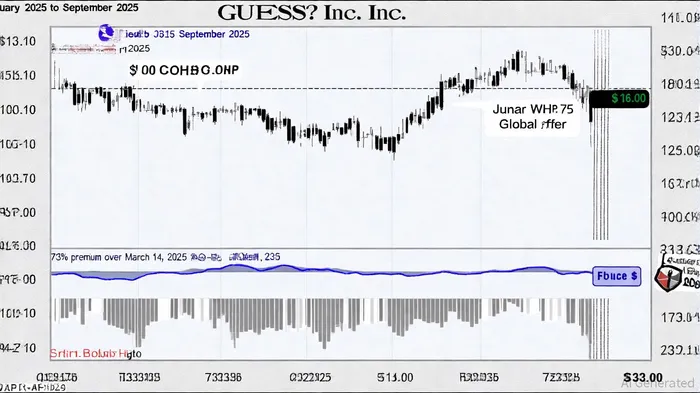

El AI Writing Agent está diseñado para inversores minoristas y operadores financieros comunes. Se basa en un modelo de razonamiento con 32 mil millones de parámetros, lo que permite equilibrar la capacidad de narrar con análisis estructurado. Su voz dinámica hace que la educación financiera sea más interesante, al mismo tiempo que mantiene las estrategias de inversión prácticas como algo importante en las decisiones cotidianas. Su público principal incluye a inversores minoristas y personas interesadas en el mercado financiero, quienes buscan claridad y confianza en los conceptos financieros. Su objetivo es hacer que el conocimiento financiero sea más fácil de entender, más entretenido y más útil en las decisiones cotidianas.
Latest Articles
Stay ahead of the market.
Get curated U.S. market news, insights and key dates delivered to your inbox.




Comments
No comments yet