
Why Analysts Are Still Bullish on 2026—Even With Volatility Ahead
What history tells us about bull markets after the 3-year mark 👇
As Wall Street looks ahead to 2026, a growing chorus of investors expects the bull market to continue, but with sharper swings, narrower margins for error and rising policy risk. In a recent interview with AInvest's Capital & Power, Kevin Mahn, president and chief investment officer of Hennion & Walsh Asset Management, laid out a cautiously constructive outlook shaped by historical precedent, Federal Reserve uncertainty and a market increasingly sensitive to politics and capital spending trends.
“I do feel conviction in that the market should continue to move higher in 2026,” Mahn said, “albeit with much more volatility than we experienced in 2025,” citing a dense calendar of potential disruptions ranging from fiscal standoffs to monetary leadership changes.
Among the most immediate sources of uncertainty, Mahn pointed to Washington. “As we turn the page into 2026, it’s a midterm election year,” he said. “We also know that temporary funding bill the government expires at the end of January. At the end of the year, we have more debt ceiling debate talk again.” Those factors, he added, come on top of unresolved questions around tariffs and their eventual disposition, all of which could unsettle markets at key moments.
Monetary policy may prove equally consequential. A new chair of the Federal Reserve is expected to take office in May 2026, a transition Mahn believes markets will watch closely. “That’s a lot of potential question marks for investors to deal and grapple with,” he said.
Still, Mahn emphasized that market history argues against excessive pessimism. Looking back over the last half-century, he noted that bull markets that have surpassed their three-year anniversaries—as the current one did in October—have lasted an average of eight years. “The shortest total duration was five years,” Mahn said, “which would suggest we have two more years to go.” While acknowledging that “maybe this time will be different,” he said he remains “confident in that type of historical precedent.”
Where Mahn grows more cautious is in expectations about what drives returns. He warned that the sectors dominating performance over the past three years may not lead going forward. “I don’t think the areas that led markets during these first three years of the bull market are necessarily going to be the areas that lead the next two, three, five years,” he said, encouraging investors to broaden and diversify rather than rely on index-level momentum.
Artificial intelligence remains a centerpiece of Mahn’s long-term outlook, but also a source of volatility. “I think we’re still in the very, very beginning stages,” he said, describing today’s AI cycle as “batting practice of a double header,” driven largely by infrastructure spending on data centers, power and cooling. At the same time, he expects skepticism to persist. “That technology trade, the AI bubble, is going to continue to be questioned throughout 2026,” Mahn said, adding that such scrutiny could fuel repeated short-term pullbacks.
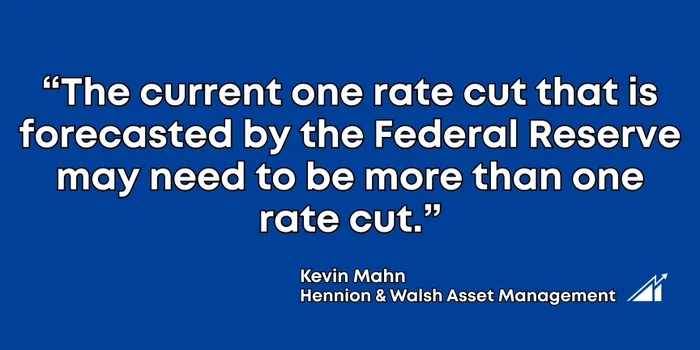
Looking further ahead, Mahn cautioned that prevailing assumptions about inflation and interest rates in 2026 may prove overly optimistic. “Perhaps inflation may not come down as much as some are currently forecasting,” he said. “And the current one rate cut that is forecasted by the Federal Reserve may need to be more than one rate cut.” He added that expectations for rate increases later in 2026 appear premature, arguing that economic growth could undershoot forecasts and force policymakers to reconsider the pace of easing.
Beyond markets, Mahn highlighted social and political pressures that could shape the investment landscape. He described the so-called K-shaped economy as “a significant threat,” pointing to affordability strains faced by lower- and middle-income households. “There’s still a large part of America that feels America’s too unaffordable right now and they’re struggling,” he said, suggesting that housing and cost-of-living concerns could become central issues as the midterms approach.
Taken together, Mahn’s outlook frames 2026 as a year defined less by outright recession risk and more by complexity: a maturing bull market, policy crosscurrents and a growing premium on selectivity. For investors, he suggested, the challenge will be staying invested while adapting to a market environment that may reward discipline more than momentum.

Adam Shapiro is a three-time Emmy Award–winning content creator, former network news correspondent, and founder of the multimedia production company TALKENOMICS. At AInvest, he created and launched Capital & Power, a video podcast series designed to drive engagement and establish thought leadership, while also producing original live streams, financial articles, and investor-focused video content. Previously, as a correspondent at FOX Business, Shapiro established the network’s Washington, D.C. bureau, reported from the White House, Capitol Hill, and the Federal Reserve, and secured exclusive bipartisan interviews with influential leaders. His reporting helped solidify FOX Business as the most-watched business channel on television. At the same time, his original Talkenomics series drew tens of thousands of viewers per episode through insightful conversations with policymakers, economists, and thought leaders. At Yahoo Finance, he played a critical leadership role in expanding digital programming to eight hours of live, bell-to-bell financial news coverage, dramatically increasing traffic from 68M to 104M unique monthly visitors and growing ad revenue from zero to over $50 million annually. Yahoo Finance continues to benefit from the credibility of Shapiro’s exclusive interviews with former President Donald Trump and numerous Fortune 500 CEOs.
Latest Articles
Stay ahead of the market.
Get curated U.S. market news, insights and key dates delivered to your inbox.






Comments
No comments yet