
AMT Slides 0.78% as $0.51 Billion Volume Ranks 212th in U.S. Liquidity Amid Sector Rotation and Institutional Healthcare Selloff
 Aime Summary
Market Snapshot
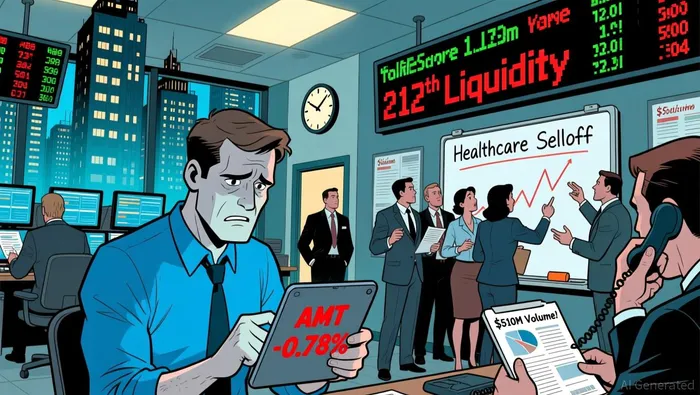
American Tower (AMT) closed on November 12, 2025, with a 0.78% decline in its stock price, marking a negative performance for the day. The company’s shares saw a trading volume of $0.51 billion, ranking 212th in terms of liquidity among U.S. equities. While the drop in price was modest, the trading activity suggests moderate investor engagement, though it did not move to the forefront of market attention.
Key Drivers
The provided news articles do not contain direct references to American TowerAMT-- (AMT) or events likely to impact its stock price. However, indirect market dynamics may offer context for its performance.
The first article highlights portfolio adjustments by Kahn Brothers, a firm that reduced its holdings in GSK PLC and Bristol-Myers Squibb Co. While these changes do not directly involve AMTAMT--, they reflect broader institutional selling pressure in the healthcare and pharmaceutical sectors. Such sector-specific activity could contribute to a cautious market tone, potentially affecting REITs like AMT, which often trade in tandem with risk-on sentiment. The second article details GSK’s strategic moves, including a 12-month high for its U.S. ADRs and a new tuberculosis research collaboration. While GSK’s performance is unrelated to AMT, its positive momentum in the healthcare sector might have diverted capital away from other asset classes, including real estate.
The third article focuses on Novo Nordisk’s price cut for Wegovy in India, a move aimed at competing with Eli Lilly’s Mounjaro. While this development is confined to the biopharmaceutical sector, it underscores a competitive landscape where companies are aggressively adjusting pricing strategies to capture market share. Such sector-specific volatility could indirectly influence investor behavior, with capital shifting toward high-growth areas and away from more stable, dividend-focused sectors like real estate.
Additionally, the absence of AMT-specific news in the provided data suggests that its price movement may be attributable to broader market factors or sector rotation rather than company-specific events. REITs are often sensitive to interest rate expectations and macroeconomic data, which were not detailed in the articles. Without direct news, the decline in AMT’s stock could be interpreted as a reflection of general market conditions or sector-wide trends rather than operational or strategic developments at American Tower.
In summary, while no direct news about AMT was identified in the provided data, the broader context of institutional portfolio adjustments in healthcare and pharmaceuticals, coupled with competitive dynamics in the biopharma sector, may have contributed to a risk-off sentiment that indirectly affected AMT’s performance. Investors may need to monitor macroeconomic indicators and sector-specific trends to better understand the drivers behind the REIT’s stock movement.

Stay ahead of the market.
Get curated U.S. market news, insights and key dates delivered to your inbox.
AInvest
PRO
AInvest
PRO



Comments
No comments yet