
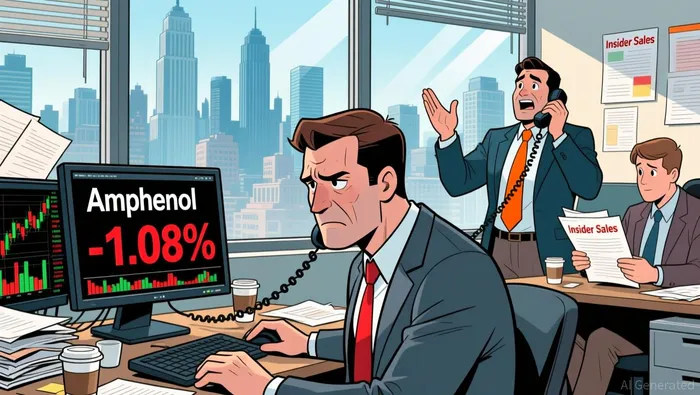
Amphenol Shares Drop 1.08% Amid Insider Sales, Ranks 108th in $930M Volume Despite Analyst Optimism
 Aime Summary
Market Snapshot
On November 12, 2025, AmphenolAPH-- (APH) closed with a 1.08% decline, marking one of the most actively traded stocks of the day. The stock saw a trading volume of $0.93 billion, securing the 108th position in overall market activity. While institutional and retail investors showed significant interest in APHAPH--, the downward price movement contrasted with recent analyst optimism, which had positioned the stock as a “buy” with price targets ranging from $120 to $160. The volume and price action suggest heightened short-term volatility amid mixed signals from market participants.
Key Drivers
Insider Selling and Shareholder Confidence
The most immediate pressure on Amphenol’s stock stemmed from two large-scale insider sales disclosed via SEC Form 144 filings. Craig Lampo, the company’s Chief Financial Officer, and the LAMPO FAMILY TRUST collectively announced plans to sell over 300,000 shares of common stock on November 11, 2025, with a combined market value of approximately $42.7 million. These sales followed a broader trend of share reduction: since August 22, 2025, Lampo and the family trust had offloaded 239,920 shares, totaling $26.5 million in value. Such concentrated divestments by top executives and their families often signal a lack of confidence in near-term performance, potentially triggering investor caution.
The timing of these transactions also raised questions. The sales occurred ahead of the stock’s 1.08% drop, suggesting that insider activity may have exacerbated downward momentum. While Rule 144 filings are a standard requirement for large insider sales, the magnitude and frequency of these transactions—particularly the family trust’s $5.75 million sale—highlighted a shift in ownership dynamics. Institutional investors and analysts often interpret such moves as a red flag, especially when executed by high-ranking officers with deep company insights.
Analyst Optimism and Institutional Ownership
Despite the insider selling, Amphenol’s stock had been buoyed by a series of analyst upgrades in the preceding weeks. Major firms like UBS Group, Citigroup, and Bank of America reiterated “buy” ratings, with price targets ranging from $120 to $160. These upgrades were based on Amphenol’s strong fundamentals in the electrical and fiber optic connector markets, particularly in defense and industrial sectors. However, the recent price action indicated that the market may have discounted this optimism, prioritizing short-term shareholder behavior over long-term growth narratives.
Interestingly, Compass Capital Management Inc. maintained Amphenol as its second-largest position, underscoring institutional confidence in the company’s strategic positioning. This contrast between insider selling and institutional ownership highlights a nuanced market sentiment: while executives may be hedging their personal stakes, long-term investors remain bullish on Amphenol’s core business.
Market Context and Investor Behavior
The broader market context also played a role in Amphenol’s performance. The stock’s 1.08% decline occurred amid a general trend of profit-taking following a period of strong analyst-driven optimism. High trading volume ($0.93 billion) suggests that both retail and institutional investors were actively participating, with some likely capitalizing on the post-upgrade rally. The insider sales may have acted as a catalyst for this profit-taking, amplifying the downward move.
Moreover, the fact that insiders collectively owned 1.67% of the stock as of the latest filings indicates that while their holdings are significant, they are not large enough to single-handedly dictate the stock’s trajectory. However, the perception of insider disengagement can still sway retail investor sentiment, particularly in a market environment where short-term signals often outweigh fundamentals.
Synthesis of Factors
The interplay between insider selling, analyst ratings, and market dynamics created a complex backdrop for Amphenol’s stock. While the company’s fundamentals and institutional ownership suggest resilience, the short-term sell-off by executives and their families introduced uncertainty. This duality—positive long-term expectations versus immediate shareholder actions—underscored the stock’s volatility. Investors will likely monitor whether these insider transactions continue and whether the broader market can reconcile the conflicting signals into a coherent valuation framework. For now, Amphenol’s performance reflects the delicate balance between strategic confidence and personal financial decisions by its leadership.

Encuentre esos activos que tienen un volumen de negociación explosivo.
Latest Articles
Stay ahead of the market.
Get curated U.S. market news, insights and key dates delivered to your inbox.
AInvest
PRO
AInvest
PRO



Comments
No comments yet