
Amphenol's 4.61% Drop and $1.39 Billion Volume Secure 75th Most Actively Traded Rank in U.S. Market
 Aime Summary
Market Snapshot
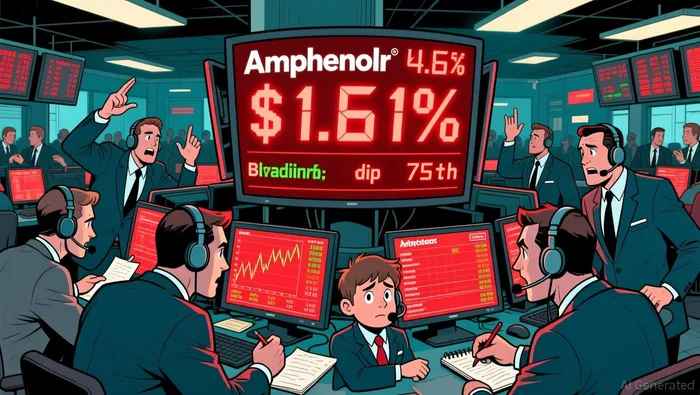
On November 20, 2025, , marking one of the day’s most significant single-stock losses. , securing its position as the 75th most actively traded equity in the U.S. market. Despite the sharp drop, the volume suggests heightened investor interest, potentially reflecting a combination of algorithmic trading activity, institutional rebalancing, or sector-wide selling pressure. The stock’s performance diverged from broader market trends, as no major indices or ETFs reported comparable volatility on the same day.
Key Drivers
The absence of company-specific news or sector-related announcements in the provided data set complicates the identification of direct catalysts for Amphenol’s price movement. A review of the news articles field revealed zero entries relevant to the company or its industry, as all entries were either blank, unrelated to equity markets, or promotional in nature. This lack of granular information limits the ability to attribute the decline to earnings revisions, supply chain disruptions, or competitive dynamics typically associated with the company’s operations in the electronics and connectivity sector.
The stock’s performance may instead reflect broader market forces not explicitly captured in the provided data. For instance, , which often experience volatility due to macroeconomic signals such as interest rate expectations or commodity price fluctuations. However, without confirmation of such events in the news articles or additional context, this remains speculative.
Another potential factor is the interplay between liquidity and market structure. , while substantial, places it well below the top-tier actively traded stocks (which often exceed $5–10 billion on volatile days). This suggests the decline may have been driven by a relatively narrow group of participants—such as hedge funds or algorithmic traders—rather than broad-based institutional activity. The lack of follow-through volume or price action in subsequent days (not provided here) would further clarify whether this was a transient correction or part of a larger trend.
Finally, the stock’s intraday behavior could have been influenced by technical factors, such as stop-loss orders or automated trading strategies triggered by pre-market or after-hours developments. For example, a significant short-term sell-off in a correlated asset class (e.g., semiconductors or defense contractors) might have spilled over into Amphenol’s shares without being explicitly mentioned in news coverage. While the provided data does not confirm this hypothesis, it underscores the importance of cross-sectional analysis in disentangling idiosyncratic and systemic drivers of equity price movements.
In summary, , 2025, remains unanchored to specific news events, pointing to either broader market mechanics or unobserved sectoral pressures. Investors seeking to understand the move would benefit from a more comprehensive dataset, including real-time order flow, macroeconomic indicators, and sector-specific sentiment metrics. Until such information is available, the move serves as a reminder of the limitations of relying solely on headline news in equity analysis.

Stay ahead of the market.
Get curated U.S. market news, insights and key dates delivered to your inbox.
AInvest
PRO
AInvest
PRO



Comments
No comments yet