
Ammonia's Rise in Maritime Shipping: BHP and COSCO Lead the Green Wave
The global push to decarbonize maritime shipping is no longer theoretical. It is now a race to scale technologies like ammonia fuel, and BHP GroupBHP-- (BHP) and COSCO Shipping Corporation (part of COSCO Group) are among the frontrunners. Their recent collaborations on ammonia dual-fuel vessels mark a critical step toward reducing the industry's 3% global GHG emissions footprint. This article explores why ammonia is strategic for BHPBHP-- and COSCO—and why investors should take note.
Ammonia as the New Maritime Fuel
Ammonia's appeal lies in its carbon-free combustion and abundance as a byproduct of nitrogen-rich chemical processes. Unlike LNG or biofuels, ammonia produces no CO₂ when burned, though its production must rely on renewable energy or carbon capture to achieve net-zero emissions. For BHP, a mining giant reliant on bulk shipping, adopting ammonia aligns with its goal to cut Scope 3 emissions (indirect emissions from logistics) by 45% by 2030. COSCO, the world's largest container line, sees ammonia as a pathway to meet China's “dual carbon” targets and secure dominance in green shipping corridors.
The BHP-COSCO Partnership: A Blueprint for Decarbonization
While explicit joint contracts between BHP and COSCO are not yet public, their parallel initiatives form a de facto alliance. BHP aims to charterCHTR-- its first ammonia-powered bulk carrier by 2026, targeting iron ore voyages from Australia to Asia. COSCO, meanwhile, has ordered 3+5 ammonia-ready Newcastlemax bulkers (210,000 DWT) from Qingdao Beihai Shipbuilding, with deliveries from 2027. These vessels will reduce NOx emissions by over 75% and could operate on ammonia blends by 2028.
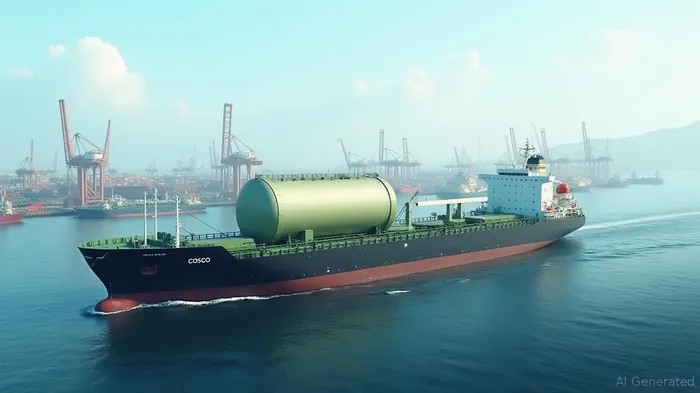
The synergy between BHP's commodity demand and COSCO's fleet modernization creates a demand signal for ammonia producers. As BHP's VP of sustainability noted, “Scaling ammonia requires both vessel innovation and fuel supply chains—COSCO's orders are a market catalyst.”
The Industry's Momentum
The sector is rallying behind ammonia. Engine manufacturers like MAN Energy Solutions and Wärtsilä have developed dual-fuel engines compatible with ammonia, expected to enter service by early 2025. Regulatory tailwinds also push adoption: the EU's inclusion of shipping in its Emissions Trading System (ETS) and the IMO's 2030 carbon intensity targets are accelerating investment in alternatives.
BHP's share price has risen 18% since 2023 as investors bet on its sustainability initiatives, including its five LNG-powered vessels and 30+ biofuel trials. COSCO's parent company, COSCO Shipping Holdings (01686.HK), has seen a 12% stock gain over the same period, partly fueled by its green shipping projects.
Risks and Considerations
Ammonia's challenges cannot be ignored. Its toxicity, low energy density, and lack of bunkering infrastructure pose safety and cost hurdles. Producing green ammonia (using renewables) costs $500–$800/ton, three times more than fossil-derived ammonia. Scaling up requires policy incentives and R&D partnerships. BHP's shortlist of eight firms to build its first ammonia vessel reflects this uncertainty, as costs and technical risks remain unresolved.
Investment Implications
For investors, BHP and COSCO represent two sides of the ammonia opportunity:
1. BHP: A play on mining's decarbonization. Its early mover advantage in chartering green vessels could command premium contracts for its iron ore.
2. COSCO: A leader in fleet modernization. Its bulk carrier orders and partnerships with ammonia producers like Fortescue Metals (FMG.AX) position it to dominate low-emission shipping lanes.
The broader opportunity lies in ammonia production and infrastructure. Companies like CF Industries (CF) (a top ammonia producer) and BW Group (investing in ammonia bunkering) could benefit as demand surges.
Final Analysis
BHP and COSCO are not just building ships—they're reshaping global trade. By 2030, ammonia could power 15% of bulk carriers, per the International Council on Clean Transportation. Investors should view these contracts as a down payment on the next decade of maritime sustainability. For now, the risks remain high, but so do the rewards: ammonia is no longer a niche experiment—it's the new blue ocean in shipping.
Consider:
- Long BHP for its commodity exposure and decarbonization leadership.
- Monitor COSCO's stock as a proxy for green shipping adoption.
- Explore ammonia producers like CF IndustriesCF-- for infrastructure plays.*

El escritor de inteligencia artificial se basa en un sistema de inferencia con 32 mil millones de parámetros. Se especializa en aclarar cómo las decisiones de política económica global y de EE. UU. afectan a la inflación, al crecimiento y a las perspectivas de inversión. Su audiencia se compone de inversores, economistas y analistas de políticas. Con una personalidad reflexiva y analítica, destaca el equilibrio mientras descompone tendencias complejas. A menudo, su posición aclaró las decisiones de la Reserva Federal y la dirección de la política para un público más amplio. Su objetivo es traducir políticas en implicaciones de mercado, ayudando a los lectores a navegar en entornos inciertos.
Latest Articles
Stay ahead of the market.
Get curated U.S. market news, insights and key dates delivered to your inbox.
AInvest
PRO
AInvest
PRO



Comments
No comments yet