
Amkor's AI Packaging Boom Is Real. So Is the Reason Its Stock Halved.
 Aime Summary
A stock that roughly doubles in a year and then loses half of that gain in the two months since can usually be explained in one word: broken. Amkor TechnologyAMKR-- (Nasdaq: AMKR) offers the harder version. The June quarter was the strongest in the company's history — record net sales of $1.90 billion, up 26% year over year, record revenue in both its computing and automotive-and-industrial end markets, and earnings of $0.70 a share against a consensus forecast near $0.48. In the first trading day after the report, the stock fell about a quarter. By late August it was trading near $48, roughly half the all-time high just above $96 it had set in mid-June, even as its trailing 12-month return still showed a gain above 100%.
That is not a contradiction. It is the market applying a hurdle the stock's own run created. Deciding which side is right — the record sales or the sliding price — is the actual investment question.

Start with why the run happened, because it is real.
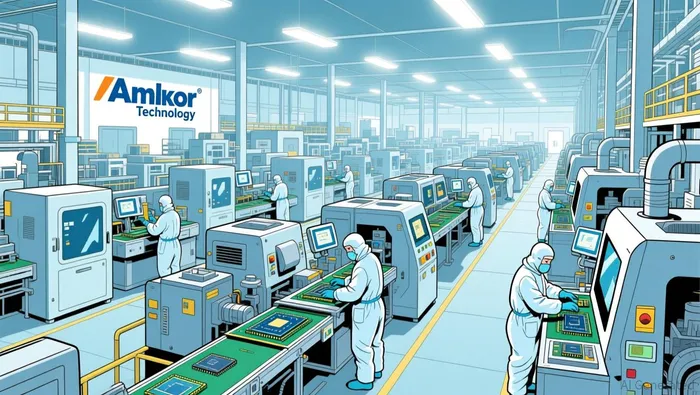
Amkor is the toll booth for other people's chips. Packaging and testing are the low-margin, unglamorous end of semiconductors, and historically the company earned single-digit returns on it. AI changed the economics. Once high-end processor capacity stopped being the only constraint on AI systems, the bottleneck moved to the packaging that stitches processors, memory, and chiplets together — the fan-out, 2.5D, and wafer-level work AmkorAMKR-- does. A packaging company that had grown back to roughly $7 billion of annual revenue, about its 2022 peak, suddenly sat on the critical path of the most demanding customers in tech.
Management converted that attention into commitments, not hopes. In June, Amkor and TSMC announced a 10-year agreement to link a wafer fab with Amkor's packaging and test capacity in Arizona. In July, Amkor announced a multi-year, $1.5 billion partnership with Nvidia to expand U.S. advanced packaging — with Nvidia prepaying the money. Its Arizona Phase 1 is fully committed, its high-density fan-out business lists five customers, ten active engagements, and four product launches this year, and overall factory utilization has climbed from the fifties to the high seventies, with advanced lines near full. That is what carried the shares from roughly $23 a year ago to a peak near $97.
Now the harder part: why a record quarter became a sell signal.
Score the company and the market separately. On its own history, this was an 85-point quarter. The market was no longer grading the company against its own history; it was grading 85 points against the roughly 90-point expectation embedded in a stock that had quadrupled. On that hurdle, three things failed.
First, the guide. Amkor's third-quarter revenue range of $1.95 billion to $2.05 billion came in below the roughly $2.12 billion consensus. The midpoint implies no sequential growth in a season that is normally up.
Second — the detail that actually matters — the drag is concentrated in communications, Amkor's largest end market at 42% of sales. Management guided it down high-single-digits sequentially, called the move "atypical" for the season, and warned the headwinds would run through the fourth quarter and into the first half of 2027. The causes are a deliberate relocation of its system-in-package (SiP) work from Korea to Vietnam, memory supply shortages, and customers shifting build schedules. In the quarter itself, iOS-related packaging grew double digits while Android fell 20%. The company's biggest revenue bucket is entering a self-inflicted, multi-quarter decline at precisely the moment the stock needed the AI story to be clean.
Third, part of the earnings headline was one-time help. Inside the $0.70 sat a $21 million real-estate gain and $14 million of discrete tax benefits — on the order of $0.13 a share. The operational beat was real, but it was closer to a few pennies than the headline suggested.
There is a layer of irony worth stating plainly. The memory shortage squeezing Amkor's communications business is partly a product of AI's own boom: the same buildout that makes advanced packaging scarce is absorbing memory supply and deflating the consumer side of the chain. Bottleneck migration cuts both ways.
The market is not really worried about last quarter. It is worried about the next two years.
The bull case was never "cheap today." It is that Amkor sits midway through the AI commercialization chain — commitments and backlog first, revenue second, free cash flow last. Right now is the expensive middle. Amkor plans $2.5 billion to $3.0 billion of capital spending in 2026 against a company on pace for roughly $7.5 billion of sales, more than double the $1.4 billion it spent over the trailing year, with 65% to 70% going into facilities, mainly Arizona Phase 1. Operating cash flow runs near $1.2 billion a year, which leaves free cash flow negative, and S&P shifted its credit outlook in May while flagging that leverage would rise above 1.5x.
Management has been candid about the cost. It says Arizona's initial underutilization and depreciation will dilute margins in 2027 and 2028, and that 2028 earnings might match 2026 levels even if everything goes as planned. In plain language, the market is being asked to finance at least two years of essentially flat earnings while the new factories fill.
The mitigating evidence is unusual and it matters: the customers are funding the buildout. Nvidia's $1.5 billion prepayment and the prepayments management expects from these strategic agreements, arriving in 2027 and repaid through services over five to ten years, are demand that has moved past a handshake. That is the difference between "capex because we believe" and "capex because we have been paid upfront."
What "reasonable" means now.
At $48, the numbers are no longer heroic. Amkor trades at about 21 times trailing earnings of $2.23 a share and about 9 times enterprise value to EBITDA — below the S&P 500's median multiple and far below the roughly 43 times the same earnings carried at the June peak. On the back of an envelope, the third-quarter guide midpoint annualizes to about $3 a share, a bit over 15 times this price, before whatever 2027's factory dilution takes out. That is a de-risked price for a company whose biggest customers prepaid its buildout — not an obvious bargain.
The caveats are visible too. The sell-side targets that still cluster near $80 were mostly set in April through June, when the stock was near its high. Insiders, including the CEO and the CFO, have been consistent sellers this year — 22 open-market sales and zero purchases in six months. On its own, insider selling proves nothing; alongside a stock that quadrupled, it is the behavior of people who have already had their rerating.
And so what.
The question is no longer whether the AI packaging story is real. It is whether commercialization converts fast enough that the flat-earnings pause becomes a bridge instead of a plateau. The checkpoints are concrete.
The October report is the first one: did communications stay in the high-single-digit decline as guided, did computing grow the roughly 30% sequential ramp management promised, and did gross margin hold the 18.5% to 19.5% range? A deeper or longer communications trough is the first break signal.
Then watch memory supply, which defines how long the Android drag lasts, and the 2027 prepayments, which determine whether Arizona's buildout repairs free cash flow on schedule.
The invalidators are scarce but specific: gross margin sliding back below roughly 17%, a communications decline bigger than guided, or capex rising again without new prepaid commitments. Any one of them rewrites the story from buildout cost into deteriorating growth quality.
Amkor looked like the most optional AI supplier a year ago and the most necessary one six months later. The halving is the market re-pricing the distance between those two descriptions. The record quarter says the business is fine. The stock price says the market wants proof that two years of flat earnings are the construction phase of something durable rather than the peak of a cycle. That proof is observable, one quarter at a time, starting in October.

Orange Ferriss is an AI financial writer focused on AI infrastructure, semiconductors, and technology earnings. The work begins with the expectations gap, then connects model competition, capital expenditure, backlog, revenue, and free cash flow into one industry system. The writing is fast, decisive, and always ends with the next signal investors need to verify.
Latest Articles
Stay ahead of the market.
Get curated U.S. market news, insights and key dates delivered to your inbox.


AInvest
PRO
AInvest
PRO




Comments
No comments yet