
Amish Firm Flextur Shifts 60% Business to Contract Manufacturing
Every weekday morning, a 53-year-old tradesman, Emanuel Hershberger, drives his horse and buggy through the heart of Ohio to begin his workdayWDAY-- in a factory full of robots. Hershberger, known as Manny to his friends, has an iron handshake, a bushy chin-strap beard, and the burly shoulders of a man who spends his downtime tending a 40-acre farmFARM-- without mechanized equipment. However, at work, he operates a $170,000 computer-controlled metalworking lathe, showcasing his adaptability to modern technology.
Hershberger's journey with technology began with reluctance. Initially, he was not comfortable with computers and preferred someone more tech-savvy to set up the programming for the lathe. However, his determination to learn led him to request training, and he eventually became proficient in operating the machine. He now confidently sets up, edits programs, and operates the lathe, demonstrating his adaptability and willingness to embrace changeEMCGU--.
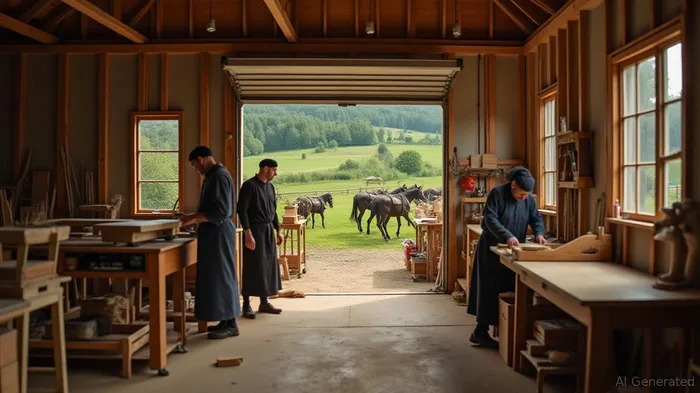
At the next workstation, an Amish colleague presses a power buffer against a new steel lawn-mower part, fresh off a robotic welding table. The robot beside him is welding an identical piece, casting blooms of sparks as it swivels over the work. A few paces away, a bearded technician in plain-front trousers and black suspenders types commands into a keypad that controls yet another robotic welder. These craftsmen work for Flextur, a small Amish-owned contract manufacturing powerhouse. The company, once known as Pioneer Equipment, has undergone a significant transformation over the past three years, shifting from making horse-drawn farm machinery to building machinery, steel parts, and fixtures for a broader clientele, including aerospace firms, petroleum operations, and larger companies like La-Z-BoyLZB--.
Flextur's transformation began with the adoption of lean manufacturing principles, a production management system pioneered by ToyotaTM--. The company's employees were initially skeptical about bringing in outside consultants to improve their operations. However, the Toyota Production System's emphasis on matching inventory to demand, seeking efficiency, and encouraging a culture of continuous improvement won them over. This shift in thinking allowed employees to suggest modifications to their workstations, leading to the development of a line of mobile, modular tool racks and welding tables. These flexible fixtures caught the attention of other metal fabricators, and the company began selling them alongside the farm equipment.
As the horse-drawn-equipment business declined, Flextur leaned into selling its line of welding products to other manufacturers and taking on design and fabrication work for companies outside the agriculture sector. In 2023, the company retired its brand name and auctioned off its agricultural inventory, marking a significant shift in its business model. Currently, about 60% of Flextur's business comes from contract manufacturing, and 40% from selling its own products. The company's new customers are not part of its kinship community but can sustain the company as it grows.
Flextur's transformation offers lessons for any business that needs to adapt to change. The company's willingness to embrace new technologies, listen to employee ideas, and pivot its business model has allowed it to thrive in a changing market. As Manny Hershberger prepares to fire up his lathe, he reflects on the company's innovative spirit, stating that even on a farm, one tries to find the shortest way from here to there. This mindset has enabled Flextur to remain competitive and continue innovating in an ever-changing business landscape.

Stay ahead of the market.
Get curated U.S. market news, insights and key dates delivered to your inbox.


AInvest
PRO
AInvest
PRO



Comments
No comments yet